Blog
The Scented Garden


If you choose your plants solely for their appearance you could be missing
out on one of the greatest garden pleasures – scent!
Whenever I see a beautiful flower the first thing I do (after checking for
bees) is to smell it. And if the flower has no scent , I find it that little bit
less attractive.
Of all the senses, the sense of smell is the most evocative. The sweet citrus
smell of rose ‘Chinatown’, or the spicey perfume of lily of valley conjures up
memories of my childhood forays into gardening. The apricot-like smell of
freesias reminds me of my mother, they were her favourite cut flower, a
memory link my colleague Mechelle recently told me was the same for her.
Although scented flowers can be enchanting, we often take their scent for
granted. Invisible ‘smells’ is a design element that is usually overlooked by
garden designers while they are busy searching for a tree with a particular
shape, a shrub that will fit a colour palette, or a path that is the right scale.
Fragrant foliage
Scent is not just produced by flowers. One of my party tricks when showing
friends around Kew Gardens is to take them to a particular shrub by the
Waterlily House and ask them to describe what they can smell in the air.
If the person says curry powder I reply, “are you sure it isn’t maple syrup?”
– and they quickly agree that they can indeed smell maple syrup. But if they
say maple syrup then I ask, “are you sure it isn’t curry powder?” and they
agree it is curry they smell.
The source of this olfactory confusion is Escallonia illinita, an evergreen
shrub from South America. And the equivocal scent wafts up from the dead
leaves laying underneath the plant.
To learn about Kew Gardens
Many leaves, when crushed, give off superb scents. Fragrant foliage is perhaps
most familiar to us from culinary herbs. The onion scent of chives, the aromatic
fragrance of rosemary, the warm scent of bay leaves.
In my local open space, Broomfield Park, there is a sensory garden designed
for people with visual impairments. The plants in this area are specifically
chosen for their distinct feel and scents – and many are kitchen herbs.
If you want to visit this sensory garden:
https://www.friendsofbroomfieldpark.org/about
Not every scent is sweet!
A smell that is valued in cooking is not always desirable in an ornamental
setting. For example, one of the showiest plants we stock for well-drained
sunny situations, Tulbaghia violaceae, produces dramatic spheres of pink
flowers atop foot long stems from early summer to autumn. Once established
it is easy to care for and returns every year. However, its popular name ‘society
garlic’ gives the game away, the flowers and foliage smell lightly of garlic. As a
result, this South African beauty is frequently returned because although the
customers love the look, they don’t like its smell. Such a shame to be put off
growing a stunning and useful plant simply because it smells of garlic.
A whiff of scandal
Among the various ferns that we sell, one frequently raises interest due to its
aroma. Dryopteris affinis smells just like cannabis. When we had three of
these ferns in the shop awaiting delivery, we had several customers who
swore they could smell marijuana and had to be allowed to sniff the plants to
be convinced they were mistaken.
Causing a stink
One of the early summer stars of my garden is Dracunculus vulgaris, the
dragon arum. This magnificent perennial grows from a tuber, producing a
large mauve spathe with a protruding purple spadix that looks like the
devil’s tongue. However, it emits a foul odour that smells like, as Mrs Lovett
would say, “well, pity” … to attract flies as pollinators. It is an astonishing
looking plant that is well worth growing, but just not by the backdoor!
Find out why Mrs Lovett’s pies are so awful
Magical violets
The most richly scented of all the violets is said to be the ‘Duchesse de Parme’.
But did you know that one quirk of violets is the elusive nature of their scent?
Take one deep sniff of their rich scent and then it seems to disappear. How is
this possible? Violet scent involves a chemical called ionone which temporarily
desensitises the nose.
The cola plant
If you desire a super scent sensation, then check out Artemisia ‘Cola’ in our
herb area. This variety of southernwood has a natural cola scent. Brushing
your hand across the plant releases an effervescent aroma that is just like
opening a bottle of cola.
Heavenly herbs
Other herbs I would recommend for their scent include citrussy lemon balm,
sharp smelling golden feverfew, sweet camomile, pungent thyme, and
Helichrysum italicum, the curry plant.
We stock a range of mints that are worth perusing. You can discover varieties
that smell of pineapple, ginger, chocolate, strawberry and apple in addition to
the more traditional peppermint and spearmint!
Scented-leaf geraniums
To enjoy a further selection of fragrant leaves pop over to out bedding area
where you will find the scented-leaf geraniums. The forms we stock include
ones that smell of lemon, orange, rose, mint, hazelnut, apple and, chocolate.
Everything’s coming up roses
Although roses are famed for the scent of their flowers, some roses also have
a scented moss-like growth on the stems and sepals of their flowers. The
‘moss’ is a sticky covering of scented glands.
This year we are offering some special Old Rose varieties from France. These
include the moss roses Rosa ‘Alfred de Dalmas’ and Rosa ‘Deuil de Paul
Fontaine’. I find that brushing the buds on these shrubs releases a fragrance
that resembles spiced stewed apples. In addition, their highly scented flowers
can fill the air with beautiful scent on a still summer’s evening.
Rosa rubiginosa, the eglantine rose, is an arching, flowering shrub with apple-
scented foliage. After a shower of rain this rose can fill an entire garden with
its delicious aroma.
For colour, wonderful fragrance and glorious blossoms all summer long our
selection of David Austin® roses can supply the jewel at the centre of your
garden.
Top tip
Keep an eye out for our next blog, and future Webinar which will both focus
on the world of roses.
A plethora of scented flowers
Firstly, bedding plants
My colleague Liz, Deputy Manager at Alexandra Palace Garden Centre and
bedding plants maven recommends planting Lobularia maritima (sweet
alyssum) for its delicious honey scent, Fragrant Matthiola incana (Brompton
stock), and Dianthus (also known as pinks) for its warm clove scent.
I would also add Lantana and purple Heliotropium to the list as summer
container plants, due to their exotic appearance and rich aromas . And, for
the wow-factor try growing Brugmansia, angel’s trumpet. This spectacular
bedding shrub brings a touch of the tropics to the patio with its richly-
scented, gigantic hanging flowers. C02 ??
For inspiration on filling containers with summer bedding:
Liz’s expert tips for fragrant bedding
- For autumn and winter bedding – yellow pansies are more fragrant than
the other colours. - Dark purple and double petunias are more fragrant than other varieties.
- Nemesia ‘Wiseley vanilla’ has the best and strongest scent of all the
Nemesia cultivars. - Remember to plant bulbs in autumn for spring fragrance – particularly
hyacinths and daffodils. Liz recommends the double daffodil ‘Sir Winston
Churchill’ for its beautiful creamy white flowers and powerful floral
fragrance. - Don’t overlook wallflowers. These tough cottage garden plants can cope
even in poor soils. Wallflowers have a rich honey fragrance, and give a
welcome splash of colour in April just when its most needed.
To learn more about styling a cottage garden:
Secondly, the climbers
Every garden should have a couple of scented climbers. Firstly, they take up
a very small footprint in the garden and secondly, because they produce
masses of rich perfume.
My top 5 scented climbers:
1) Lonicera, or Honeysuckle, is one of the most fragrant of all climbers. It is
a ‘must’ for an evening seating area. Plant in a cool position on a north
facing wall .
2) A climbing rose with good perfume, such as ‘Gertrude Jekyll’ or ‘Generous
Gardener’ will clothe your wall with beautifully formed flowers that emit a
powerful fragrance.
3) Trachelospermum jasminoides, or star jasmine, is the perfect climbing
plant for trellises. This evergreen produces a profusion of heavily scented
white, star-like flowers in sunny and partially shaded situations.
4) Jasminum officinale, common jasmine, is a popular richly perfumed
climber that thrives in a sunny spot.
5) Wisteria. The pea-like lilac-purple, white or pink flowers of wisteria are
one of the glories of the spring garden. Wisteria flowers are prized for their
rich sweet scent.
Thirdly, the shrubs
With so many beautiful plants to pick from, the hardest task is choosing.
My top ten most fragrant include:
1) Argyrocytisus battandieri, the Moroccan broom. This graceful shrub
produces plumes of golden yellow pea-like blossoms that smell of delicious
pineapple.
2) Berberis (barberry) many forms are highly scented and flower in mid to
late spring.
3) Buddleja (the butterfly bush). All the varieties have a pleasant honey-like
scent, but some forms are stronger than others. My favourite is Buddleja
globose, the orange ball tree.
4) Cistus varieties (sun rose). This is a bit of a cheat, because the incense-like
scent from these beautiful flowering shrubs is produced from hairy glands on
the leaves.
5) Deutzia. This shrub produces a mass of almond-scented flowers in one
short burst of glory in early summer.
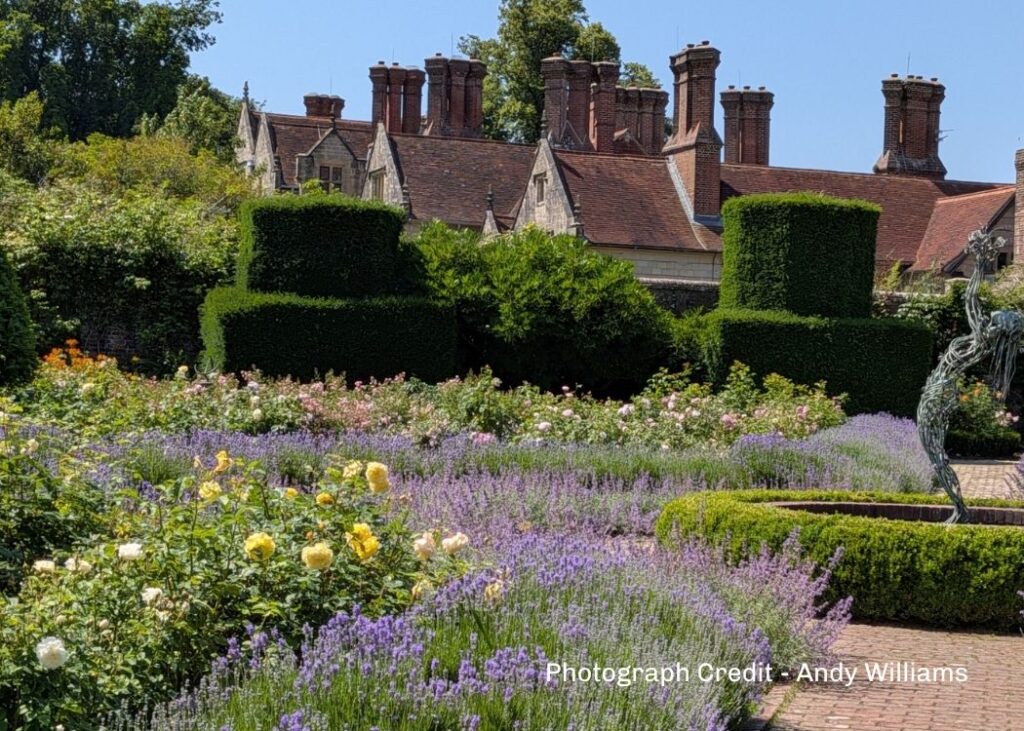
6) Lavender. The classic English garden scented shrub. Its strong perfume will
attract masses of bees to your garden.
7) Osmanthus burkwoodii, a medium sized shrub that produces fragrant white
flowers in spring that will fill the air on a still day.
8) Philadelphus (mock orange). One of the highlights of the summer garden.
It freely produces masses of sweetly fragrant white flowers with very little
care needed.
9) Syringa (lilac). Like ‘dear Ivor’, lilac deserves a revival. This tough shrub
produces generous panicles of lushly perfumed flowers in a variety of colours.
Don’t shun it because they are of little interest afterwards or you will miss out
on one of the best floral scents available.
10) Viburnum. A group of beautifully scented flowering shrubs that flower in
spring.
Dan, our hardy plants guru reminded me to write about including winter
flowering shrubs in any planting plan. Heavily scented winter flowering shrubs
are often overlooked in favour of
But adding some winter-flowering shrubs can transform your garden into
enticing space to spend time during an otherwise bleak season.
Dan’s scented winter shrubs
The must have: Daphne bholua ‘Jaqueline Postill’ carries clusters of pink, highly
fragrant flowers in late winter when most other shrubs are dormant. A slow
growing shrub that is ideal for a small garden.
Worth considering: Mahonia japonica, Lonicera fragrantissima, Sarcococca
(Christmas box), Chimonanthus praecox (wintersweet), Viburnum x bodnantense
and Hamamelis (witch hazels). These offer that illusive winter combination of
flowers and fragrance.
Fourthly, the trees
Not every garden space for a tree. But if your garden does, then why not consider
one with fragrant flowers? Three of the best scented trees:
1) Crataegus, Hawthorn. The common white hawthorn has a powerful scent, it
also produces attractive red berries in winter.
2) Laburnum x watereri ‘Vossii’, golden rain tree. A beautiful tree that produces
tassels of yellow, scented flowers.
3) Magnolia. Many tree magnolias have superbly scented flowers. But do some
scent research before buying one.
Placing scented plants in the garden
Having had a dash through the amazing world of scented plants we will finish by
looking at how best to place them in the garden.
It may seem obvious, but to be able to enjoy scented flowers we need to get close
to them. There is little point in placing you favourites at the far end of the garden
where you rarely visit.
Place plants with aromatic foliage in areas where you are likely to brush against
them as you walk by. In other words, between the front door and the front gate,
along the path, for example.
Low- growing aromatic herbs such as thyme and chamomile can be grown in
cracks and gravel pathways. These robust herbs can withstand being trodden
on, and as you walk over them, they will release a beautiful herbal aroma.
If you have any raised areas, or pots on steps, window boxes etc use them for
growing the smaller scented plants. This means that they will be closer to
nose-level and tempting to sniff as you pass by.
Choose plants that will give you a succession of scent. Mix and match your
shrubs, perennials, bulbs and annuals to create a calendar’s worth of fragrance.
Plant winter flowering specimens close to the house because you won’t want to
venture too far to smell them.
In summer include some night-scented plants. Nicotiana and evening primrose
are especially fragrant during the crepuscular hours. These plants should be
located near to outdoor seating and dining areas. Most working people spend
more time in the garden in the evenings than in the daytime, so make sure
you plant them where you can enjoy them.
Finally, don’t forget you can always bring the outdoors inside. In other words,
remember to cut some flowers and bring them into your home where the
scent will be even more accessible and enjoyable. Not Brugsmania!
Some of the fragrant plants we stock:
- Freesia ‘Fragrant Sunburst’ available at 11.99
- Scented geraniums prices start at £6.99
- Small potted fragrant herbs (including Artemisia ‘Cola’, mint,
chamomile, lemon balm, thyme) start at £2.50 - Lavender Munstead available at £4.50
- Nemesia bedding plants from £5.99
- Matthiola incana start from £2.99
By Ali Barwani, Capital Gardens