Blog
Forsythia: Nice to see you, to see you, nice!

The double seat in front: just out of reach. As the eighty-five bus lurches away from Putney Bridge station I glare at the back of the youth in front. Trying to look out of the window ahead, his broad back and outsized Nike hoodie hide the view. Since setting off from home this morning the chilly fog has dissipated, and it is now sunny. I made a mistake wearing my winter coat. The sound of my anorak crackling is louder than the tinny music accompanying the TikTok videos playing on his phone.
The bus climbs Putney Hill as the interloper presses the bell and heads towards the stairs. I bolt to the most desirable seat on the bus. Sweet rationing is over: acid drops. How can staring at a tiny screen beat the simple pleasure of sitting at the front upstairs and looking out at everything going on outside?
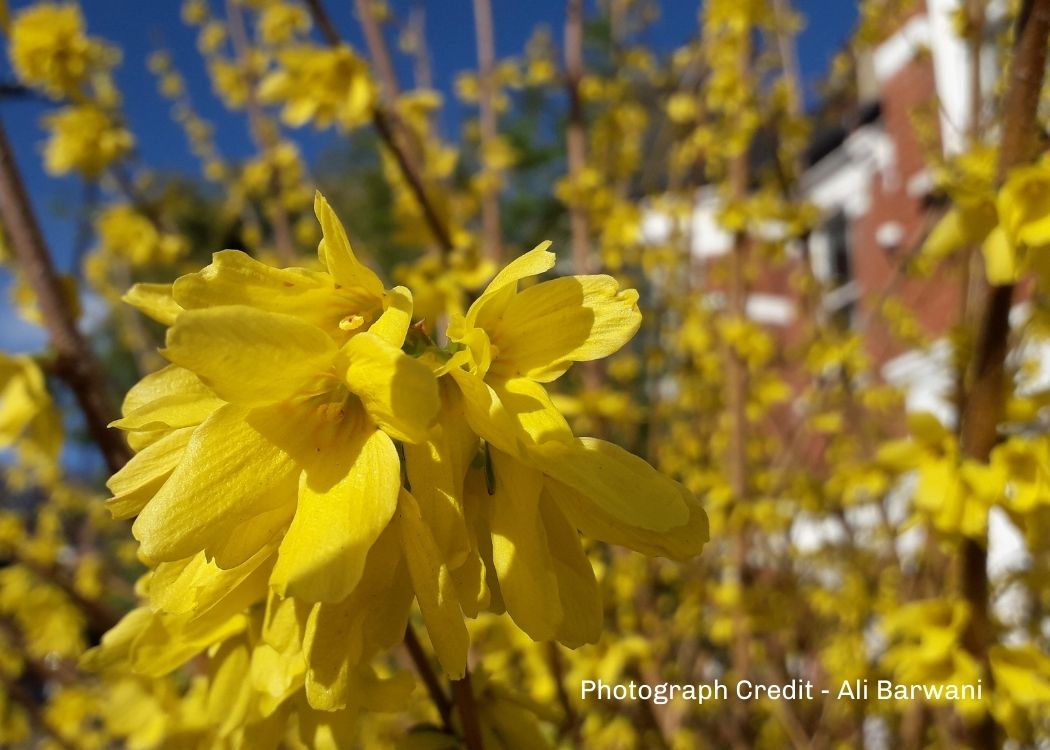
As we leave the high street behind us and venture into a new realm of low-rise flats, parks, and suburban gardens I notice large balls of sunshine resting in the gardens alongside the road. As yellow buds of forsythia open I sense spring slowly slipping in. These are the most eager petals I know. Golden flowers dancing in tune with the birds. These floral light bulbs create a map guiding me towards my destination. Today I am visiting Nick in his nursing home. I am carrying forsythia stems from my garden, a fortnight ago it was daffodils from Morrisons. He is living with dementia, so I bring seasonal flowers for familiarity. When forsythia blooms, daffodils too, in sunny yellows, it tells us spring is here.
Heading up Kingston Vale, I spot a large house with a neglected garden. Here yellow branches of forsythia arch gracefully, carrying masses of golden bells. More acid drops. Why do so many gardeners brutally hack at their forsythias until they end up as a congested cube of enmeshed twigs? These plants are too elegant to be side-lined to hedging. By taking the hedge trimmer to them in late summer you remove much of their flowering potential. All they require is some light pruning in spring, shortly after they have finished flowering, then they will maintain a natural shape and go on to flower their heart out for you next spring. Pruning is simple, cut out the older wood and any congested branches, and leave the thinner, newer shoots to flourish. You wouldn’t treat a Philadelphus or a Weigelia in this manner, so just apply the same pruning technique to forsythia, but earlier in the year.
We take forsythia for granted, mainly because of their ease of cultivation and ubiquity in British gardens. Did you know that forsythias are members of the olive family (Oleaceae)? Their relatives include ash trees, lilacs, jasmines, privets and olive trees. There are about thirteen species of forsythia, which mainly originate in east Asia, with one (Forsythia europaea) from south east Europe. Their ornamental cultivation started long ago in China, where they featured in the gardens of the wealthy. Their journey to the West started in the mid-1770s when the Swedish naturalist Carl Thunberg discovered and named Syringa suspensa growing in a Japanese garden. In 1804 botanists decide that this shrub had too many differences to remain in the lilac genus (Syringa). A new name was required.
In 1804 the royal head gardener, botanist, and founding member of the RHS, William Forsyth died. A new genus, Forsythia, was created in his honour to contain the former Syringa suspensa. And, yes, this Scottish gardener was a distant ancestor of the all-round entertainer Sir Bruce Forsyth. Another important year for forsythia was 1878, when the botanist Herman Zabel recognised a new hybrid growing in the Botanic Garden of Göttingen, Germany. This discovery was named Forsythia x intermedia, and it is the most commonly grown type of forsythia you will encounter in UK gardens today.
Although all forsythias are yellow, there is much variation between the dozen or so species and more than seventy cultivars. They come in a myriad of yellows, from pale primrose to the rich gold of a free-range egg yolk. Some forms are much more floriferous than others. Look closely and you will see that the petals vary. Some are long, others are short. Petals can also be straight, twisted, thin or broad. The flowers may hang demurely or stare back at you with bright eyes. If you want to see a large range of forsythias in full bloom then hurry to Sculpture by the Lakes in Dorset, home to a National Collection of Forsythia.
A strange coincidence occurred when I started researching this article. I discovered that the mansion, now Nick’s nursing home, was built on land that once formed part of the Veitch Coombe Wood Nursery, on Kingston Hill. This famous Victorian family once ran the largest group of family-run plant nurseries in Europe during the 19th century, including their more famous locations at Chelsea and Exeter. The Veitch Nurseries played a significant role in the introduction and popularization of forsythia in Europe during the 19th and early 20th centuries.
As I leave the home I slowly turn to catch my shadow at noon, every day it appears shorter as the sun climbs higher in the sky. These sun-coloured shrubs will quickly turn green as they develop the first fresh leaves in the spring garden. Soon spring heat will bring larger leaves to the bare shrubs around them, a plethora of surrounding foliage to overwhelm the sappy-green of these favourite firsts. Yellow sunshine swallowed up by green dragons. Golden blooms brought to a quick demise. However, they will hurry back next year.
Further reading:
Learn about Bruce Forsyth’s gardening ancestry here
Did you know?
Forsythias are proponents of heterostyly. This means that on any plant the flowers are either pin-eyed or thrum-eyed, just like primroses. To learn more about this unusual evolutionary mechanism that guards against self-pollination read our blog on primroses:
Where to see Forsythia: