Blog
Single But Not Ready to Mingle: Solitary Wasps

Time to water some plants in “herbaceous perennials”. I start by unwinding a long hose from its wall-mounted reel. Turning the tap full-on merely results in a few drips from the spray gun; it always takes several minutes for the pressure to build up to a meaningful flow. Drip… a pause… Drop…
I find myself staring at a nearby plant table, thinking of nothing, as I wait to feel the first pulse of water arrive. A pair of flies busy copulating on the wooden table top piques my interest. No, they are not flies. I notice that the upper one has the cinched waist of Audrey Hepburn, and its dress is a series of chitinous black and yellow hoops.
Looking more closely, I see they are not mating. The “partner” held upside down in a tight embrace is a small bee. Its compound eyes are no longer black and shiny, they are the cloudy blue of a dewberry, and it doesn’t move. The hairy bee has already been paralysed by a venomous sting. In contrast, the wasp constantly shifts her feet and feelers as she hugs the zombie, her mandibles locked in the prey’s neck.
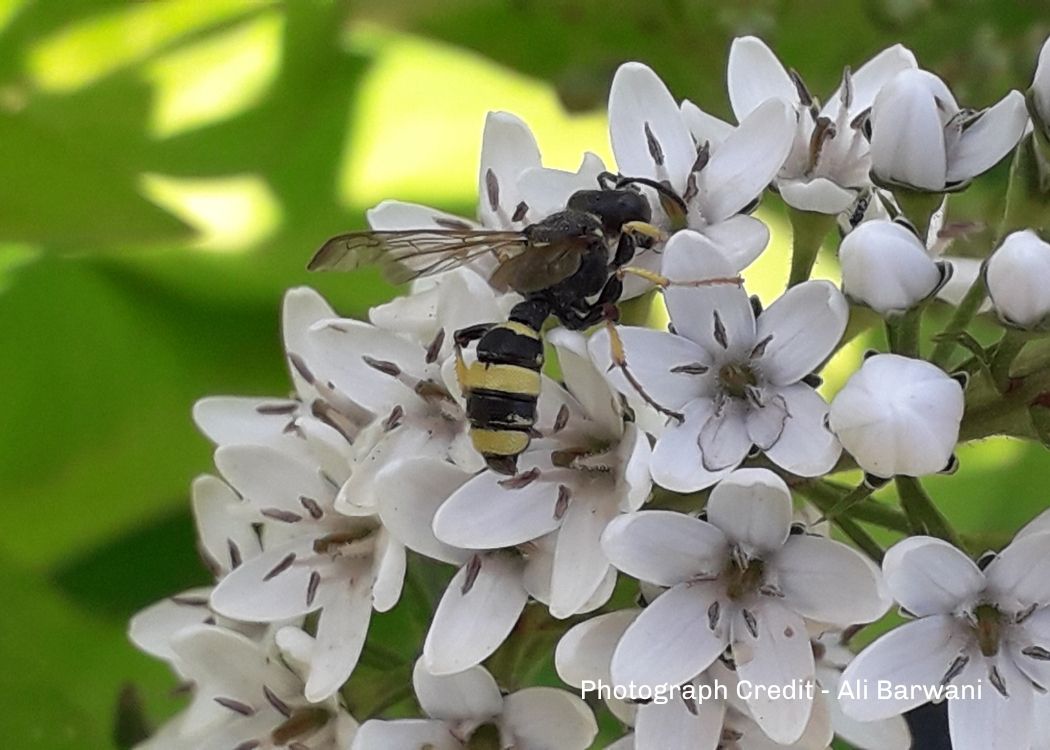
For most people, wasps mean only one thing. The aggressive late-summer social insects (Vespula vulgaris) that ruin picnics and barbeques, capable of delivering a painful sting when disturbed or threatened. However, did you know that there are around seven thousand wasp species in Britain, and only nine of these are social wasps – the majority are solitary wasps. Solitary wasps are not collaborators. In general, each female makes her own nest for her own young. The wasp-like wasp I am observing is one of these – it is the ornate tailed digger wasp, Cerecis rybyensis.
Wasps have a bad press thanks to our experiences with yellowjackets. Honeybees sting, but they pollinate flowers and give us honey. Fuzzy bumblebees are enigmatic and universally adored. But many gardeners fail to appreciate the work of the common wasp as it hunts down other insects (including many garden pests) or scavenges carrion to feed their young. Adult wasps are important pollinators as they search for sugary liquids for energy, such as flower nectar. Too often when people find a wasps’ nest in their garden, they resort to using environmentally harmful sprays to eliminate it.
If you have yet to learn to love social wasps in your garden, then the place to begin is with solitary wasps like the one I am watching. Wasp taxonomy is complex, but solitary wasps can be divided into two major groups; parasitoid and hunting.
Parasitoid wasps are a diverse group whose members lay their eggs in or on their prey. As gruesome as John Hurt’s “chestburster” scene in Ridley Scott’s Alien, the wasp’s offspring eat their host from the inside out while it is still alive. To do this, female parasitoid wasps have a long needle-like organ at the end of their abdomen, called an ovipositor. This structure is used to pierce surfaces and lay eggs directly inside or on host insects. In other words, it functions as a precision drilling and egg-delivery tool. The ovipositor is often called a “stinger”, but these wasps are completely harmless to people. In fact, some species of parasitoid wasp are very helpful to us, as they are widely used as biological controls in commercial greenhouses, rather than spraying pesticides.
There are around 76,000 species of parasitoids in the world. Numerically, the two largest superfamilies are the Ichneumonoidea and the Chalcidoidea. With perhaps the former being the better known. Charles Darwin famously mused: “I cannot persuade myself that a beneficent and omnipotent God would have designedly created the Ichneumonidae [a family within the superfamily] with the express intention of their feeding within the living bodies of caterpillars.”
Hunting wasps too are not a biological taxon but similarly consist of a diverse group of wasps that have evolved similar ecological strategies. To give an idea of their diversity, more than three hundred species of these have been recorded in Great Britain. Hunting wasps catch live prey, which they paralyse and transport to a nest for their young to feed on. Unlike common wasps (which are generalist hunters that will take most prey dead or alive), solitary hunting wasps are often specialist hunters, catching only certain prey. For example, Pompilid wasps hunt spiders. Members of another family of hunting wasps might favour caterpillars, another aphids, and so on. Solitary hunting wasps are the gardeners’ friend, responsible for reducing the numbers of plant-eating and sap-sucking pests.
So, what does this particular hunting wasp tell us about the ecology of the garden centre I work at? Their presence shows that we have a healthy and diverse ecosystem established here. To put it simply, you won’t find the ornate tailed digger wasp if their prey species aren’t present in the area. And if their prey species are present then there must be ample flowers for them to feed on as well as undisturbed nesting habitats. The adults of this wasp feed on nectar, so act as pollinators. In this case, I later find her sipping nectar from the flowers of Lysimachia ephemerum, the willow-leaved loosestrife. The small, long-lasting white flowers of this sun-loving perennial are carried on long, slender terminal racemes. The starry flowers attract a wide variety of solitary bees, solitary wasps, and hoverflies. This beautiful loosestrife provides flowers from the start of June to the end of September, followed by decorative brown seedheads for winter interest – so choosing solitary wasp friendly plants can also help make your garden beautiful.
In conclusion, if you have solitary wasps in your garden then both your plants and the local wildlife benefit. The thousands of solitary wasp species help control pest populations naturally, without the need for environmentally harmful pesticides, by laying their eggs inside or on other insects and minibeasts. These slim-waisted allies help naturally regulate populations of many pests including aphids, caterpillars, whitefly, moths, and beetle larvae. So, as important pollinators, pest controllers, and food sources for other animals, it is surprising most people don’t try to make solitary wasps welcome in their gardens.
Further Reading:
Are you an RHS member? If so, then next month’s edition of their journal ‘The Garden’ September 2026 will soon be dropping through your letter box, or into your inbox.
This volume contains an article by Josie Stuart, an RHS entomologist and co-author of RHS Plants for Pollinators. The article ‘Beauty and the Minibeasts’ is all about how to make a beautiful garden to help our precious garden pollinators (pages 36-44).
Blood bees – a group of cuckoo bees, also spotted at Alexandra Palace Garden Centre
https://www.capitalgardens.co.uk/blog/bands-beats-and-blood-bees/
Things to do to encourage solitary wasps into your garden:
Depending on the species of solitary wasp, their nest might be a hole in some rotting wood, the gap between bricks, or perhaps a burrow in sandy soil. Stranger still, some solitary wasps are architects. For example, potter wasps fashion mud nests in which they lay a single egg along with its paralysed provision.
So, gardeners can offer nesting and overwintering sites, such as bee hotels, or leave piles of cut bamboo stems in a shady spot and provide undisturbed patches of sandy soil for them to dig into.
Pollinators face a decrease in the supply of nectar and pollen as the days shorten and we head towards autumn. Grow more late summer flowering plants with simple flowers. This week, I observed solitary wasps visiting the flowers on the Allium varieties ‘In Orbit’, ‘Cliffs of Dover’, and ‘Lavender Bubble’. Other popular sources of nectar for them included, Astrantia major ‘Pink Button’, Gypsophila ‘Summer Sparkles’, Scabious ‘White Kudos’ and ‘Pink Mist’, Solidago ‘Crown of Rays’, and Geranium ‘Dreamland’.
Don’t use chemical insecticides when you first spot a pest, instead plant tiny-flowered plants in spring, like dill, fennel, and alyssum for nectar to attract adult solitary wasps. Tolerate a low level of pest presence on plants. The wasp’s prey needs to be available in your garden, so wasps have food for their eggs.
Make an insect water station to give pollinators somewhere to safely drink without the risk of drowning: Read Here