Blog
Bands, beats and blood bees


On St Swithin’s day, July 15th, I am walking around Alexandra Palace Garden Centre taking photographs of plants for our Instagram account.
“St Swithun’s day if thou dost rain, / For forty days it will remain. / St Swithun’s day if thou be fair, / For forty days ’twill rain nae mare.”
If the old rhyme is correct, then we are likely to get yet more days of hot dry weather. I am distracted from this thought by the beep-beep of a reversing forklift on the road outside as it relocates a heavy security barrier to allow a truck to enter. Alexandra Palace Way, the road through the park, has been closed to us from one direction for much of the month, but even in our green setting we still hear the sound of helicopters thundering overhead, together with lorries and other vehicles coming and going as the various acts make their Get-ins and Get-outs.
Partial road closure means that we have fewer customers than usual, but on the plus side the beautiful plant displays now resemble a private garden. Moving around the flower-filled tables, shaded by the mature trees flanking our boundary fence, I am at peace. Then, the silence is shattered as the soundcheck starts. It begins with the band plugging in their gear and checking individual instruments and concludes with a full play-through to balance the final mix. Overwhelmed by the cacophony, I focus on observing honeybees taking to the air, living embers glowing in the sunshine as they dance between blossoms.
We all know that bees and other pollinating insects play an essential role in our environment and are crucial to much of our food production. But did you know that there are about two hundred and fifty-four species of bee in Britain? Not all of them are large like honeybees and bumblebees, and only a few of them can sting you. Whilst there is just one species of honeybee in Britain, there are some 24 species of bumblebee. All the other bee species are known as ‘solitary bees’ because none of them construct communal nests.
The May heatwave seemed to bring the bees out in large numbers, and the first unusual species to catch my attention was Britain’s smallest bee, the Harebell Bee (Chelostoma campanularum), which is dependent on bellflowers. Observing this specialist pollinator in action inspired me to write an article about Campanulas in the hope that more people would plant them in their gardens.
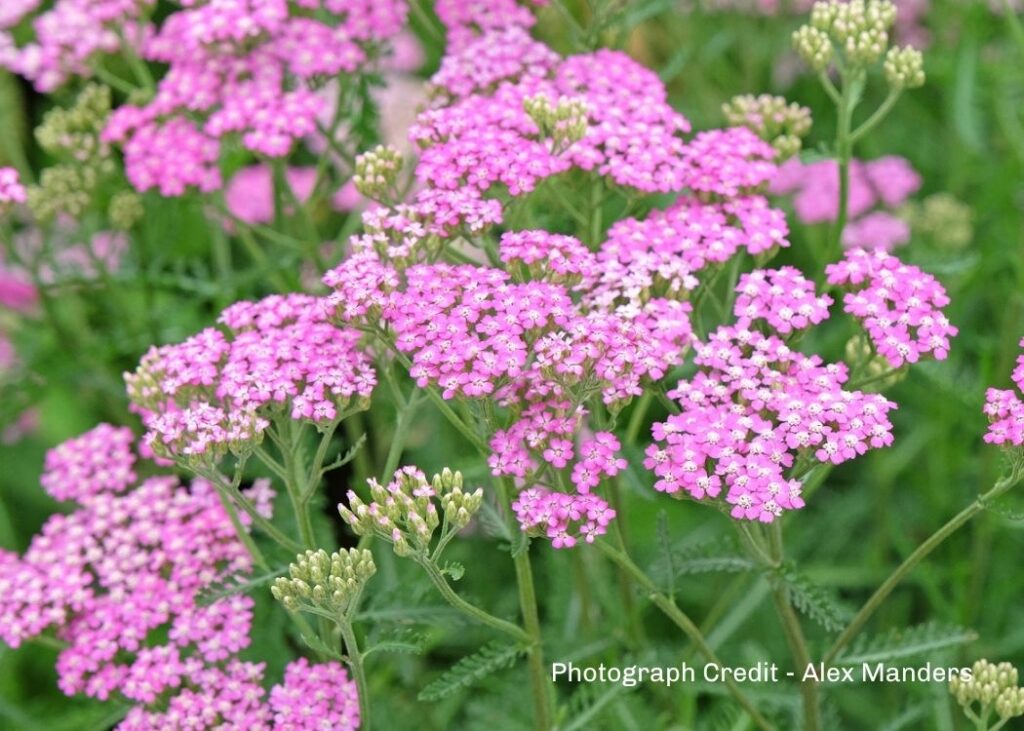
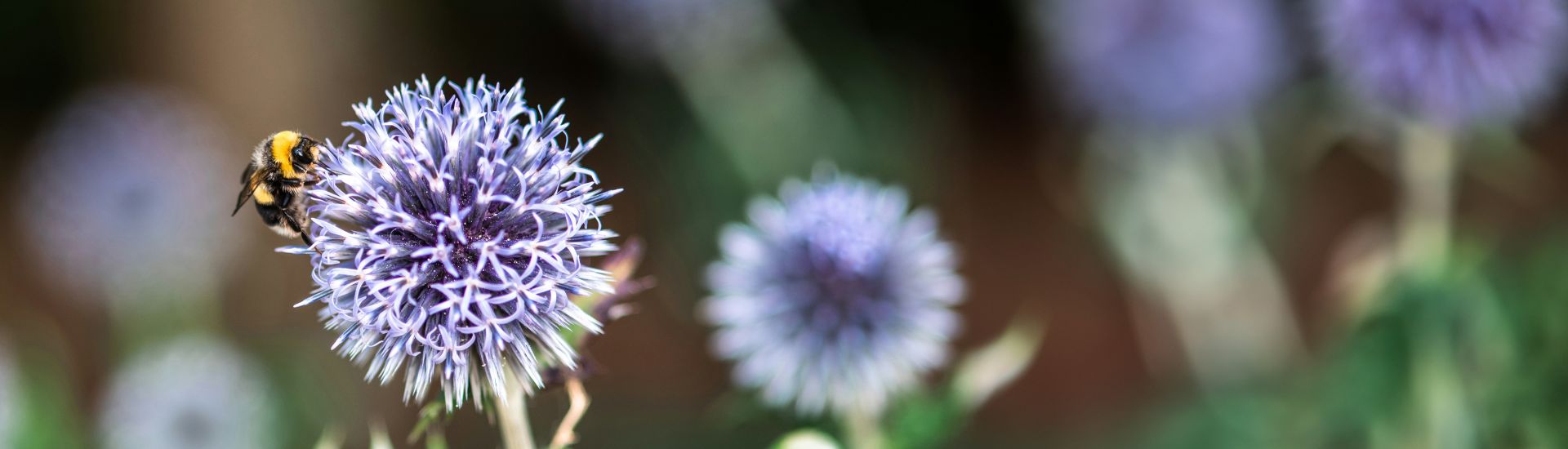
Now, as we rush towards August there is a new suite of flowers available to pollinators. While the tubular flowers of salvias and penstemons attract bumblebees and honeybees, it is the flower heads composed of dense clusters of tiny flowers (called florets) packed together to look like a single, large blossom that appeals to a wide range of smaller pollinators. Noteworthy among these are members of the daisy family (Asteraceae) including Achillea, Astrantia, Echinacea, and Rudbeckia, and two members of the honeysuckle family (Caprifoliaceae) Scabiosa and Knautia.
Today, on the Astrantia flowers, I spotted a bee that is new to me. My attention was drawn to them by their vivid black and red abdomens. This pollinator, I later discovered, is the ‘blood bee’ or scientifically, a member of the genus Sphecodes. Blood bees don’t suck blood, prosaically the name derives from their distinctive colouration. Their small size, ranging from about 5mm to 15mm, means they generally pass under the radar of even the most ardent nature lover.
Blood bees don’t live a respectable life like honeybees. Instead, they follow a different set of rules. Blood bees are parasites, or more accurately, cleptoparasites. To put it simply, they rely on other species of bees to provide shelter and food for their offspring. If you are familiar with the lifestyle of the cuckoo, then this is the bee equivalent. They are a type of solitary ‘cuckoo’ bee.
Female blood bees typically follow their victim back to her nest, and once they have infiltrated it, they start destroying the host’s eggs and lay their own eggs in the prepared cells before sealing them back up. Depending on the species of blood bee and its host, sometimes the response is aggressive, whereas on other occasions it is completely tolerant.
The blood bees I spotted on the compound flowers were foraging and thereby acting as pollinators. They might not gather provisions for their offspring, but they still need to search for nectar and pollen to feed themselves. In fact, blood bees visit a wide range of plant species when foraging, unlike the Harebell Bee which relies on a single family. This broad pollinating behaviour makes them important to the local ecosystem.
Because of their parasitic lifestyle, many people might regard them as being harmful to other bees and the environment. However, this is a false perception that misunderstands their ecological value. Blood bees play a critical role in the population control of other ground nesting bees. In other words, if you spot blood bees in your garden or local park then it is a good sign that the biodiversity of that area is healthy. To put it another way, you won’t see blood bees if their host species aren’t present in the area, and if the host species are present then there must be ample flowers for them to feed on and undisturbed nesting habitats. Blood bees matter. They are part of a natural ecosystem that has evolved over millennia. So, if you see a flash of red and black near a flower this month, take a moment to look more closely – you too might be lucky to glimpse this parasitic pollinator in action.
Further Reading:
What can I do to help bees in my garden?
Plant a diverse range of bee-friendly plants in your garden to support all pollinators. Try to include some native flowers in your planting mix. Aim to provide a steady supply of food for bees throughout the year, rather than one big summer banquet.
Visit your local garden centre, it is a great place to see which plants the bees are visiting.
Build a bee hotel. Bee hotels are a great way to attract solitary bees.
Supply water. Bees drink, especially during summer. Water is essential for honeybees to make food for their young and keeping their hive cool during summer. If you don’t have space for a pond, then fill a glazed pot saucer with water and place a few large stones inside as safe landing pads for the bees.
Ground nesting bees require areas of undisturbed and loose soil to nest in, so leave a patch of bare soil for ground-nesting solitary bees to use.
Avoid using pesticides and herbicides as these will disrupt delicate ecosystems. Garden with nature.
Support your local bee-keepers by purchasing their honey and beeswax products. North London Early Summer Honey 2026 can be bought from the Alexandra Palace Garden Centre café. This premium honey comes from hives less than a mile from the Garden Centre. It is hand extracted, with a medium gold colour, pollen rich with the taste of citrus from lime tree flowers.
Plants to attract bees –
https://www.bbka.org.uk/gardening-for-bees
Blood bee identification –
https://www.inaturalist.org/taxa/61891-Sphecodes
What’s on at Alexandra Palace 2026 –
Campanulas –