Blog
Snake’s head fritillaries

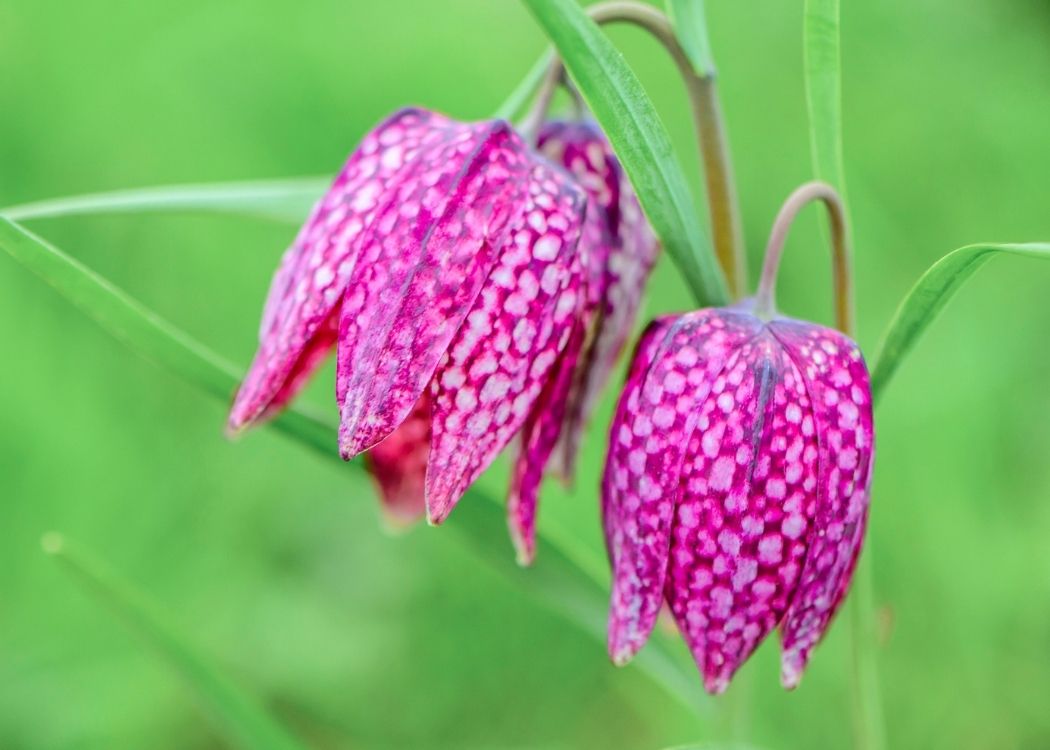
The nodding, bell-like flowers of snake’s head fritillaries were once widespread in England, seen growing in their thousands in the wild on riverbanks and in flood meadows and other grasslands. So abundant were they along the banks of the Thames that local children would gather them by the basketful and take them to be sold at Covent Garden flower market, where they would be bought by city dwellers eager for the touch of the natural world.
In the wild Fritillaria meleagris is primarily a plant of central and southern England. It’s distinctive and easily recognisable, with delicately checked flowers in shades of plum and iced blackberry and wiry stems arching elegantly, swan-like (or perhaps snake-like), at the top. Their pattern is often compared to snakeskin, hence their name. The golden stamens are rich in nectar and pollen and targeted by bees. Once the flowers are pollinated, the stems straighten up to form seedheads which allow the seed to be spread as widely as possible. Occasionally the equally beautiful white form appears. Their chequerboard pattern is so subtle as to be barely visible but the insides of the petals sport dainty lime green streaks.
Snake’s head fritillaries are often described as a native plant, however, there is some debate as to their origins. For they were first recorded growing in the wild only in 1736, although they’re known to have been in gardens as early as 1578. So perhaps these early wild specimens were escapees who found their new habitat very much to their liking. Sadly, they’re now classified as vulnerable in the wild on the Red List of Threatened Species. This is partly because of changes in agricultural practices, such as the draining of flood meadows, as well as habitat decline of their main pollinators, bumble bees. But they can thankfully still be found in a number of nature reserves including meadows in Wiltshire, Suffolk and Oxfordshire, as well as Iffley Meadow in Oxford itself. And citizen science plays its part in their conservation. The Floodplain Meadows Partnership has, historically, held annual fritillary and bumble bee counts with members of the public participating as volunteers.
Snake’s head fritillaries in the garden
Flowering around April, these inhabitants of naturally damp areas like sun or light shade and moist but well-drained soil that doesn’t dry out in summer. Use them in containers, at the front of beds and borders and naturalise in lawns or wildflower meadows. They can be bought as bulbs in autumn or in spring in pots as their flowers begin to emerge. The bulbs are small and seasoned growers say they’re likely to bed in better and spread more quickly in grassed areas if planted in spring ‘in the green’. (Snowdrops, bluebells and winter aconites also prefer this method of planting.) Monty Don demonstrates here
Like many flowers they spread by seed. Traditionally, in wildflower meadows, this would fall to the ground in late summer when the grass was cut for hay. So leave the grass to grow without mowing until late August at the earliest, by which time the seed will have set. If growing in pots and borders, let foliage die down completely before tidying – it’s the food for next year’s growth.
Plant bulbs in early autumn at three or four times their depth. Scatter and plant where they fall if destined for grass or borders. In grass the best tools for the job are a bulb planter – which digs out a core of soil, or a bulb trowel – which has a blade longer and slightly thinner than that of a standard trowel.
Plant with…
Place snake’s head fritillaries and their white form F. meleagris var. unicolor subvar. alba at the front of the border with spring flowering dog violets and forget-me-nots. Add cranesbill geraniums for later colour and low-growing evergreen grasses for some winter interest. In lawns naturalise with primroses, cowslips and polyanthus, pale pink cuckoo flower Cardamine pratensis and of course, daffodils.
Other fritillaries to grow
Snake’s head fritillaries have some relatives also well worth growing for a spring display of a showier kind.
Majestic Fritillaria imperialis, at 1.2m tall, has large, dramatic orange bell-like blooms, shaded dark at the base with visible white stamens. These are topped by a crown of upright bright green leaves, hence the common name, crown imperial. Needing full sun and well-drained soil, it generally flowers in April or May but in some places is blooming early this year and currently impressing visitors to the sub-tropical garden at Scotney Castle in Kent. ‘Lutea’ is bright yellow. The more compact F. persica provides a striking contrast with deepest purple, almost black, downward-facing flowers clothing greyish-green stems.
Fritillaries are part of the lily family. Although generally trouble-free, larger types may be susceptible to the attentions of the red lily beetle. Relatively easy to spot because of their colour, they’re best dealt with by picking off and crushing, along with their larvae. It’s not the most pleasant of garden jobs so the wearing of rubber gloves is advised.
Small of stature, with a tendency to wobble tremulously in breezes and a sometime association with sorrow because of their drooping heads, snake’s head fritillaries appear fragile but are robust plants. Folk names include the gloomy-sounding weeping widow and doleful bells of sorrow, but also the more upbeat guinea hen flower, toad’s head and bizarrely, turkey’s eggs. They spread slowly so will take a while to carpet the garden in an echo of their proud, wild past as watermeadow crowd pleasers. But planting them, as well as giving a delightful spring boost to the garden, also contributes to the restoration of this long-beloved plant.
How to make a wildflower meadow – Read here
Wildlife trust snakes head – Read here
Where to see Fritillary – Read here