Blog
Kew’s groundbreaking Carbon Garden.

Recently, Colin Campbell-Preston, founder and Managing Director of Capital Gardens, and I were talking about the resilient garden. Or more specifically, planning future planting for unpredictable weather.
‘Ali! Come here!’ commands the stentorian voice. My ears prick up, and I rush to the balcony overlooking the shop area at Alexandra Palace Garden Centre. ‘We need to talk about writing an article discussing how London gardeners cope with the ever-changing climate’.
‘Hear, hear’, I reply as I scurry downstairs to talk with the Boss. Hadn’t I been thinking about just this for the last few years? A short discussion follows about the trees that have done well this year (magnolias and gingkoes) and several shrubs too (including lavender and Perovskia).
‘Tell them about the problem of wetter winters too. It’s not just hot dry summers’, prompts Colin. ‘We’ll have another talk about it later.’
Inspired by the sun shining today, there’s no better time than this afternoon for a visit the Carbon Garden at the Royal Botanic Gardens, Kew. Not only can I enjoy visiting a beautiful garden, but I can increase my knowledge of carbon’s crucial role in Earth’s climate.
Kew’s Carbon Garden opened around a year ago, on Friday 25 July 2025. This ambitious horticultural and educational project combines stunning planting and cutting-edge design to allow visitors to visualize the crucial role carbon plays in sustaining life on our planet. The Carbon Garden tells us about the scale of the climate crisis and suggests some of the frost-hardy, drought-tolerant plants from regions with a Mediterranean climate that are likely to become more common in London gardens over the next quarter of a century. Carbon is the basis of all life on Earth. As every schoolboy knows, carbon is also the central atom in every molecule of carbon dioxide, but did you know that this gas only makes up about 0.04 percent of the composition of the atmosphere? It is estimated that ninety-nine percent of the planet’s carbon is locked away in rocks, the soil, and fossil fuels. An exposed coal seam showing fossilised plants and the unseen world of carbon underground can be viewed near the entrance.
The problem arises when human activities rapidly increase atmospheric levels of carbon dioxide, for example by burning fossil fuels and deforestation. Increasing carbon dioxide in the atmosphere enhances the natural greenhouse effect, raising global temperatures, and driving widespread environmental and biological changes.
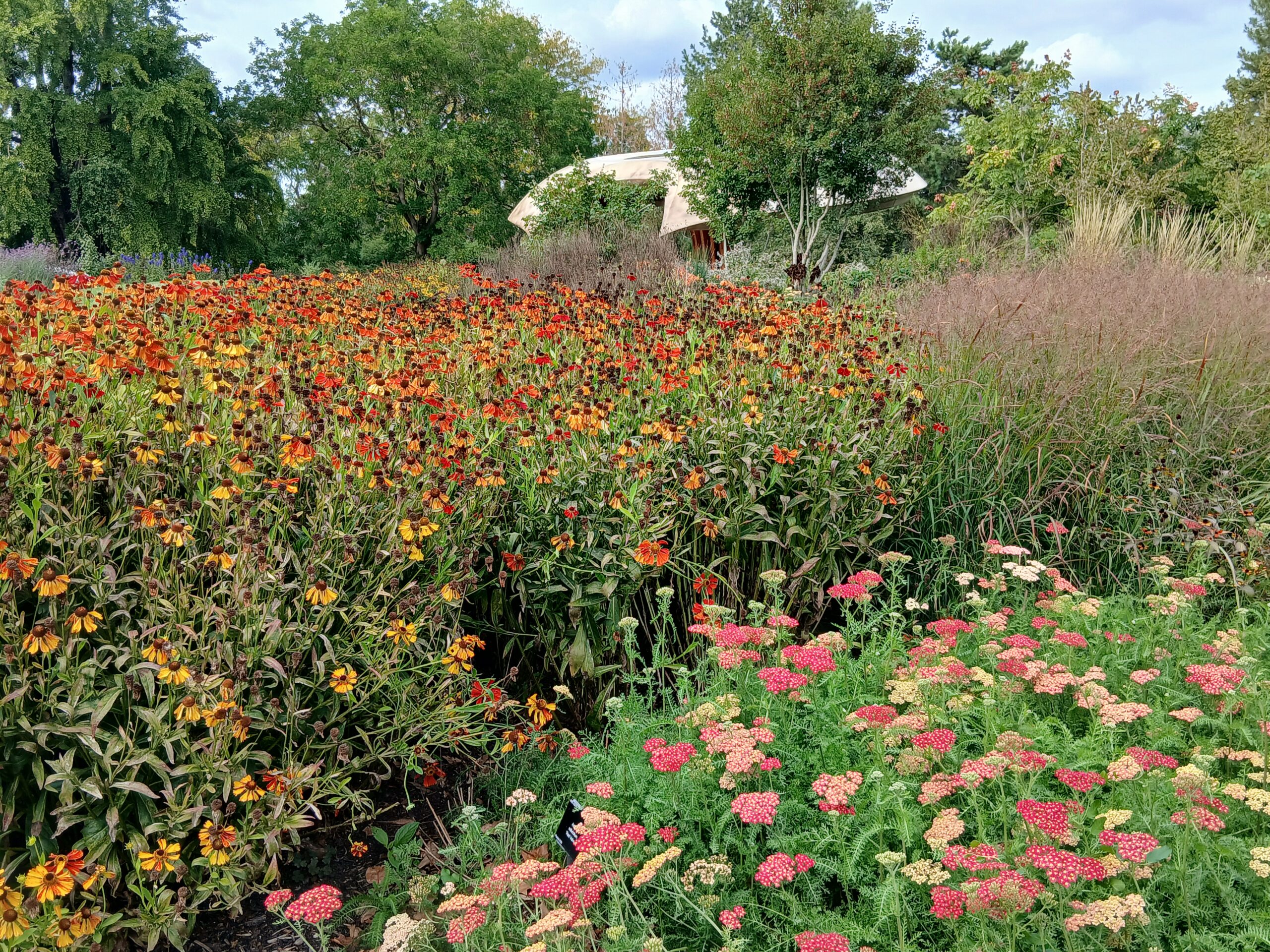
The key to unlocking the planting design in the garden can be found on the information board at the garden entrance. It shows a sequence of colourful stripes, like a polychromatic barcode, that progressively transitions from shades of blue through pinks and salmon into reds. This visual representation of changes in UK temperatures from 1850 to 2024 was created by Professor Ed Hawkins, Reading University. Horticulturalist Richard Wilford took this image as his design inspiration, planting swathes of perennials that begin as bands of cool blues, passing into hot oranges and burning reds as you move around the garden.
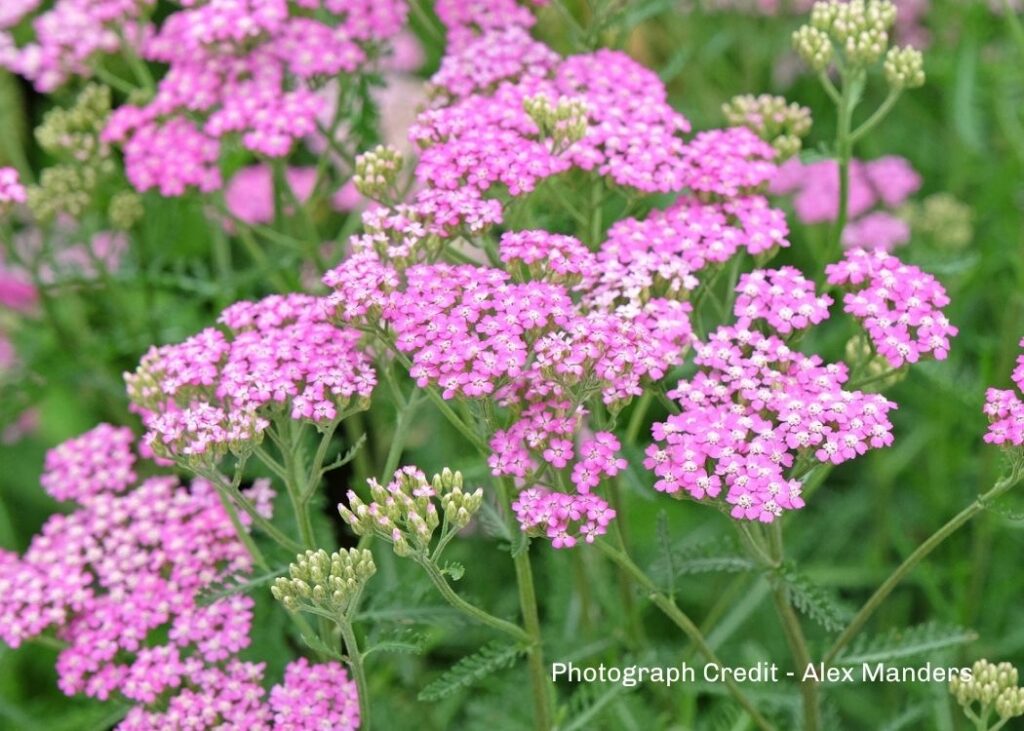
I love the way the designer has used drought-tolerant plants to represent the temperature stripes, carefully selecting plants that London gardeners may well have growing in their gardens. Most of the plants in this space are from the Mediterranean biome: rosemary, lavender, salvia. The hotter colours come from prairie-style border plants such as Achillea varieties like yellow ‘Moonshine’ and scarlet ‘Paprika’ and ruby ‘Red Velvet, and the russet Helenium ‘Moerheim Beauty’. Prairie- style plants are low-maintenance with a long season of interest and are valuable to garden wildlife as well. Prairie plants are more forgiving in fertile garden soils, making them easier to establish than native wildflowers.
If the colourful bands employ herbaceous perennials that do well in today’s climate, then the next zone of drought tolerant plants shows what we might be growing in twenty-five years, when London is predicted to have a climate like that of Barcelona. In addition to rosemary, salvia and lavender, this planting also includes cypress trees, ornamental grasses, and Parry’s agave (Agave parryi).
Trees are integral to the garden. Thirty-five new trees, that have been carefully selected for their resilience to projected future climate change patterns, have been planted. Trees play a vital role in helping urban areas adjust to future climate conditions. Trees don’t just absorb and sequester carbon from the atmosphere as they grow, but they also provide shade and shelter for wildlife, other plants and us. Perhaps, this summer, you noticed how much cooler it felt walking along a tree-lined road rather than a bare, sun-exposed urban street?
How do trees do this? Well, tree canopies block direct solar radiation, preventing asphalt, concrete, and paving stones from absorbing the sun’s heat during the day. Also, as trees draw moisture up from the soil and release it as water vapor into the air through their leaves, a process called evapotranspiration, this actively cools passing air. In other words, trees are nature’s air conditioners.
A further adaptation to the changing climate is the inclusion of a rain garden. Put simply, a rain garden is a shallow, planted depression designed to capture, filter, and absorb stormwater as it runs off from hard surfaces like roofs, drives and pavements. In other words, rain gardens stop storm water flowing into the drains, instead channelling it into a depression where it can soak back into the soil. Planting in the rain garden includes grasses and wildflowers to boost biodiversity and lock in carbon.
At the centre of the Carbon Garden is a giant sculptural pavilion. Does it represent the fruiting body of a fungus or maybe a tree? Designed by Mizzi Studio, the ambiguity is deliberate. It symbolises the symbiotic relationship between plants and fungi. Mycorrhizal fungi form a mutually beneficial relationship with the roots of nearly all British trees and many other plants. The fungi pass water and nutrients such as nitrogen and phosphorous to the tree, and in return the tree supplies the fungi with a significant portion of the carbon they fix from the atmosphere by photosynthesis, in the form of sugars. This transfer of carbon from trees means that mycorrhizal fungi act as an important carbon sink in the soil. Mycorrhizal fungi also help bond soil particles together, making it more stable and resistant to erosion.
The pavilion structure is made entirely from natural materials. For example, it is covered by a natural fibre canopy made from flax, and the base is constructed from granite which has a low-carbon footprint compared with concrete. It is practical too, providing a covered area for school and community group visits. The canopy gathers rainwater and then directs it into the rain garden.
Kew’s Carbon Garden illustrates the carbon cycle, and the role carbon dioxide plays in climate change. And finally, if you want to know what plants have stood up best to London’s 2026 summer drought, then you can read the results of Colin’s research when it is published here: https://www.capitalgardens.co.uk/blog/
Further reading:
Kew Gardens. Entry to the Carbon Garden is free with a ticket to Kew Garden.
Mycorrhizal fungi.
https://www.capitalgardens.co.uk/blog/mycorrhizal-fungi-the-treasure-trove-beneath-your-garden/
Rain gardens.
https://www.capitalgardens.co.uk/blog/managing-water-in-your-garden/
Four practical things you can do to turn your garden into a carbon sink:
1) Resist the urge to tidy. Allow fallen leaves and branches to decompose on your flowerbeds. Many fungal species are decomposers and need dead organic material to feed on. Native fungal decomposers play an important in recycling nutrients and enriching the soil.
2) Boost plant diversity. Having a wide range of plants in your garden will help boost insect biodiversity. For example, let your lawn become a wildflower meadow by not mowing in summer. If you let wildflowers such as clover and dandelions flower you will be supporting native bee, moth and butterfly populations. It will also help increase fungal diversity too. https://www.plantlife.org.uk/campaigns/nomowmay/
3) Go no dig. Digging breaks the soil’s surface, exposing stored carbon to the oxygen in the air allowing it to convert back into carbon dioxide. Digging also damages the soil’s structure and harms or upsets soil dwelling organisms.
4) Make your own compost. Compost your vegetable peelings and garden waste and use this as a mulch. Not only will it lock the moisture in your soil, but it reduces the amount of organic matter going to landfill.