Blog
Exploring the New Winter Garden at Kew

Exploring the New Winter Garden at Kew
Kew’s Winter Garden is a delight for all the senses. Upon entering the gardens by the Victoria Gate, turn left and follow the Camellia Walk, admiring these beautiful winter-flowering shrubs en route. Don’t take the first path you come across directing you into the Winter Garden. Continue walking a bit further until you arrive at a second entrance, just before the Shirley Sherwood Gallery. I promise you the experience is better exploring from this direction.
The clockwise route leads you along a wide gravel path that wraps around a man made knoll. This hill conceals layers of hidden history. Originally constructed as the base for the architect William Chambers’ Temple of Victory. The folly, built in 1759, commemorated the pivotal battle of Minden during the Seven Years’ War. The structure didn’t last long, and the site was redeveloped to accommodate a series of flagpoles, with the last one erected in 1958, then the world’s tallest. Unfortunately (but fortunately for the Winter Garden) it had to be removed in 2007 due to rot. Construction of the Winter Garden required remodelling using tonnes of soil brought in from other projects occurring at Kew. The Winter Garden was opened to the public after completion of the first phase in 2022. The recent finishing of the second phase has further enhanced the beauty of the garden.
Let’s begin our journey! The gently rising path starts out sheltering under a copse of winged spindle trees (Euonymus phellomanus). This small tree (or large shrub) is a good choice for small gardens, providing both height and multi-season interest. Its leaves turn blazing colours in autumn accompanied by clusters of lipstick-pink fruits that reveal contrasting bright orange seeds. These deciduous sentinels, with tactile cork-like bark, have been underplanted either side of the path with drifts of gorgeous hellebores, clumps of white snowdrops, patches of demure Cyclamen coum, and clusters of green-fringed golden winter aconites (Eranthis hyemalis). These delightful woodland plants have been carefully lifted and replanted from various areas in the Arboretum.
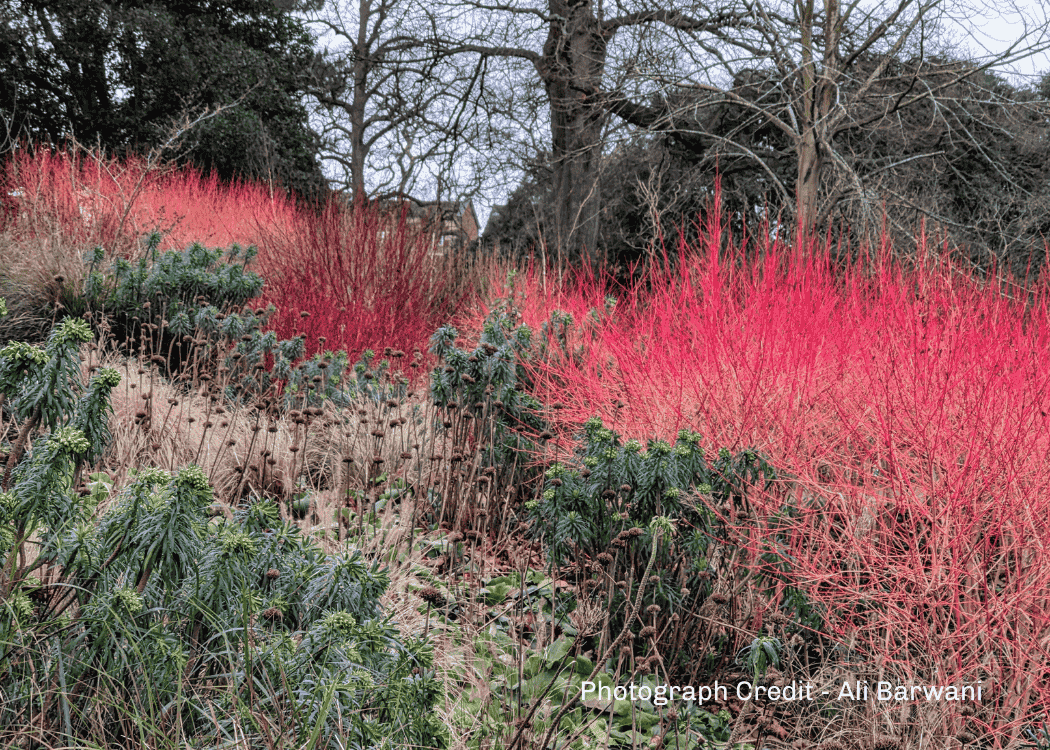
As you head up the mound you emerge into the light, discovering changes in planting. Stands of green ferns (Polypodium vulgare) appear and then yield to flames as Cornus sanguinea ‘Anny’s Winter Orange’ thrusts up its fiery wands. Meanwhile, on the lower slopes there are mass plantings of Helleborus ‘Ice Breaker’, each plant carrying a myriad of creamy lime-green flowers. The dogwoods higher up, in shades of red, orange, and yellow melt into a rustling and rattling prairie of herbaceous perennials dominated by straw-coloured grasses. Raised above the grasses are stout stems bearing tiered whorls, the seedheads of Turkish sage (Phlomis russeliana). Brown sage stems mirror the silhouette of the Pagoda, which along with the Temperate House appear in a vista best seen from the mound. The desiccated leaves are enlivened by mounds of blue-green Euphorbia characias subsp. wulfenii and luminous stems of Cornus, as shown in the photograph accompanying this article. This section has an undersea feel, as if we have dived to a pacific reef. Birds become fish darting between waving seagrass stems and ramifying red coral. A strong, sweet fragrance twitches the flanks of my memory. It emanates from clusters of cherry-pink flowers on the branches of Daphne bholua ‘Jacqueline Postill’. Find one of these shrubs close to the path and inhale. It is a scent you won’t forget; reminiscent of jasmine but lacking its cloyingness, sweet as citrus blossom but free of acidic zest. Another fragrant superstar is the witch hazel (Hamamelis). There are yellow, peach, orange and red flowering varieties of witch hazel to be discovered dotted along the trail. My attention was drawn to the red flowered Hamamelis x intermedia ‘Diane’, sadly it lacks the powerful scent of its yellow siblings, but its spidery flowers glow scarlet in the winter light. Finally, Winter sweet (Chimonanthus praecox) must be mentioned. It is often overlooked due to the waxy look of its small maroon and yellow flowers. I saw many people walk straight past these shrubs, and the plants aren’t far from the path! Pause and admire. The flowers produce a powerful sweet scent with hints of cloves and cinnamon.
At the top of the mound is a stunning black and white winter horticultural fantasy. Ghostly-white multi-stem Himalayan silver birch trees (Betula utilis subsp. jacquemontii ‘Doorenbos’) are underplanted with black grass-like Ophiopogon planiscapus and clumps of white snowdrops. As we pass by, descending on our way out, there were a couple of outstanding plants that made me stop. One was the multi-stem Tibetan cherry (Prunus serrula ‘Tibetica’) with its smooth, tactile, burnished copper bark. With the sunshine behind them, their peeling stems appear to be on fire. The second was a small spreading shrub still in bud, the laurel-leaved currant (Ribes laurifolium). Their long, yellow-green racemes were just beginning to push out from sheathes of protecting purple bud scales. I plan on returning in late February to see the open flowers, along with those of the paperbush (Edgeworthia chrysantha) which were also in bud at the time of my visit. The inflorescences of the paperbush will open to reveal clusters of tiny yellow flowers that emit a delicious honey-like scent. As you leave, if the air is still, you will be enveloped by the scent of honey, this time coming from sweet box (Sarcococca confusa), a powerfully scented evergreen shrub that conceals its tiny flowers underneath glossy, deep green leaves.
In conclusion, the new Winter Garden at Kew is testament to the beauty and resilience of nature during the winter months. It shows that winter doesn’t need to be a dead season in the garden. Careful plantings can give you texture, colour, fragrance, sound and interest. As the garden continues to evolve and grow, is sure to become increasingly well-known and popular with visitors. A visit to Kew’s Winter Garden is sure to leave a lasting impression on all who make the effort to discover this hidden gem.
Further information:
For more information about Kew Gardens, including admission prices, opening hours and accessibility:
https://www.kew.org/kew-gardens
Sweet Box:
https://www.capitalgardens.co.uk/blog/sarcococca-sweet-box-or-christmas-box/
Winter stems and seedheads:
https://www.capitalgardens.co.uk/blog/finding-beauty-in-winter-stems-and-seedheads/