Blog
Karma Camellias

Karma Camellias
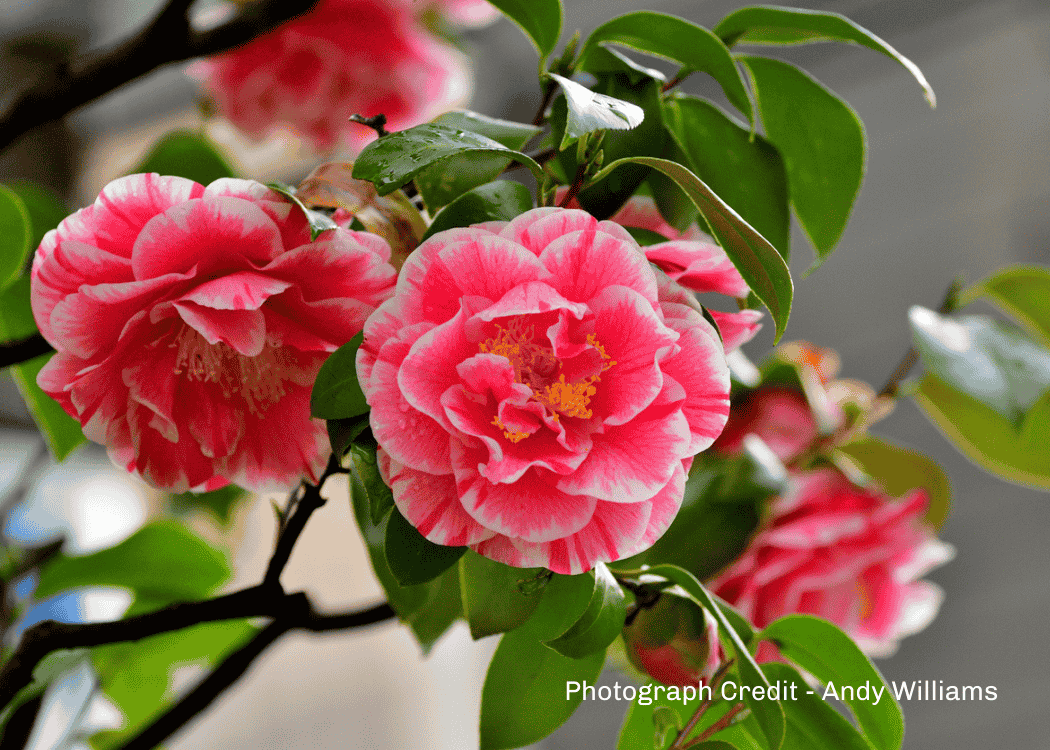
Said to be a symbol of good luck and love in China, camellias add much-needed bursts of warmth and colour to the garden in late autumn, winter and early spring. Their red, pink or white flowers are strikingly offset by glowing yellow centres and shiny evergreen leaves and the blossoms come in many forms, single or double; some are like roses, others like paeonies. Many provide a boost for bees too, at times when flowers are scarce. Some become magnificent specimens if given free rein, reaching up to 5m in height, while others have more modest aspirations and are suitable for pots on balconies and patios.
Camellia likes and dislikes
Preferring dappled or part-shade and acidic, free-draining soil, camellias are woodland plants in their South-East Asian natural habitat. If your garden doesn’t have acidic soil, smaller varieties should be perfectly happy in a pot with peat-free, ericaceous compost. Or if your soil has a neutral pH, try digging a hole at least twice the size of the rootball of the plant, backfilling with ericaceous compost and feeding from spring through to midsummer. The RHS has some good tips, including a simple guide to choosing a pot of the right size: https://www.rhs.org.uk/plants/camellia/growing-guide
Discovering whether your soil leans towards the acidic is simple; pH testing kits are usually available in garden centres. Casting your eye over neighbouring gardens and seeing what’s doing well is also a good indicator. Rhododendrons, azaleas, pieris and summer/autumn flowering heathers all like acidic conditions.
Although the plants themselves are fairly hardy, flower buds are delicate and can be damaged after a frost by strong morning sun, so it’s wise to avoid an east-facing position. They’re not fans of cold winds either so place in a relatively sheltered spot if you can.
There are two main types of camellia:
Spring-flowering, from February to April. Usually hardy from -10 to -15 degrees C, these include Camellia japonica and C. x williamsii cultivars.
Autumn and winter-flowering, usually known as ‘sasanquas’ although the group includes a number of species. These are generally a little less hardy but tolerate temperatures between -5 and -10 degrees C.
Wildlife value
Mature plants have a dense network of branches and nice, solid leaves which create an ideal communal shelter for small birds like sparrows to gather and noisily chat. Hang a bird feeder as close as you can and you might be rewarded with regular visitors or even residents.
Bees may still be out and about when camellias are in flower, squeezing in a few last autumn drinks or supping on their first after waking up in spring. In the depths of winter too, some may be active, particularly if there’s a sudden warmer day. Best for bees are the single-flowered varieties. The dense, complicated, flouncy petals of double blooms make it difficult for them to get to the centre of the flower where pollen and nectar await.
Grow your own breakfast beverage
- sinensis was one the first wild forms of camellia to be cultivated, its young leaves and shoots carefully plucked to create a drink many of us feel we’d be hard pressed to get through the day without. Autumn/winter-flowering, its smallish, white blossoms make less of a dramatic statement than some other camellias but are still quietly beautiful, and it’s small enough to be grown in a pot. To harvest your own tea, pick the young leaves in spring. You may need more than one plant though!
https://www.rhs.org.uk/plants/articles/misc/grow-your-own-tea
Did you know?
- We drink about 165 million cups of tea a day in the UK. It’s so important to us that there were genuine concerns during the Second World War that morale would flounder disastrously if supplies were cut off. So contingency plans were put in place by Prime Minister Winston Churchill to grow it here should such an emergency arise.
- The feeding grounds of some elephants in the Western Ghats of India have been taken over by tea plantations. This hasn’t put the elephants off though, they continue to parade through in family groups, looking for food. You might think this would cause some difficulty. But the elephants are careful to follow laid out paths, avoiding the tea bushes, and the tea leaves are too bitter for their taste. Instead, they focus on the wild plants that they love, which still grow in the tea gardens, under and around the crop. To the growers, of course, these are weeds which steal water and nutrients from the tea. And so a beautiful relationship has developed in which the elephants help with cultivation and the growers are happy for them to remain undisturbed, keeping to their traditional, inherited routes.
Camellia care
Watering: Keep soil or compost slightly damp but don’t allow plants to sit in water for too long. Watering well during the first year will help to give them a good start and keeping them hydrated in summer is particularly important as this is when flower buds form. If they dry out they’re liable to drop. This is particularly the case for plants in pots which dehydrate much more quickly. Rainwater is preferable as tap water can be quite alkaline in some areas, but tap water is better than nothing!
Feeding: If in fertile, acidic soil, plants in the ground don’t generally need liquid feed unless showing signs of ill-health. But they’ll benefit from mulching with bark, leaf mould, ericaceous compost or even composted pine needles if you happen to have some, all of which will improve soil structure as well as adding nutrients. Give plants in pots a dose of ericaceous fertiliser in early spring and mulch. Don’t feed them after the end of July though. They can be a little sensitive and have a tendency to drop their flower buds in protest.
Yellowing leaves (chlorosis) are a sign that the compost or soil is too alkaline and that the plant isn’t getting enough iron. In the ground, mulch with leaf mould and feed with sequestered or chelated iron. In a pot, repot using new ericaceous compost or feed with ericaceous feed.
https://horticulture.co.uk/camellia/feeding/
Frost and snow: Although camellias are hardy, the flowers and their buds can be damaged by frost or snow. So you may wish to cover with horticultural fleece in colder areas or if very cold weather is predicted.
Pruning isn’t really necessary except to control size. If required it’s best done after flowering. This allows enough new growth to form before summer when flower buds are produced.
Camellias on show
Visit wonderful Marwood Hill Gardens in Devon (judged as a Garden of Excellence by the International Camellia Society), the Lost Gardens of Heligan in Cornwall (which holds the National Collection of over 70 veteran specimens), or Chiswick House in London for an indoor display (the conservatory contains around 30 rare and historic varieties).
These wonderful plants are sometimes given as a gift at Chinese New Year because of their association with good luck and love. It’s just too late for that this year but there are always birthdays, and Valentine’s Day is on the horizon too. The world can seem a rather dispiriting place at the moment but bright and glossy camellias, like other plants, are guaranteed to raise the spirits.