

Blog
10 Hardy Colourful Summer Herbaceous Perennials


10 Hardy Colourful Summer Herbaceous Perennials
Do you want easy-to-grow plants to fill your garden with summer colour but don’t know where to start looking? Don’t worry, now is the perfect time to brighten up your garden. Ali Barwani suggests a selection of hardy perennial plants that will bring long-lasting beauty to any garden.
What Are Herbaceous Perennial Plants?
Perennial Plants (or simply perennials) are plants that live for more than two years. In comparison, annual plants complete their lifecycle in one year and biennial plants in two growing seasons.
Perennial plants can be divided into two types:
1) Herbaceous Perennials – These have a non-woody structure and may die back to the ground during winter and reappear in spring. For example, Verbena bonariensis and Achillea millefolium.
Some herbaceous perennials can be evergreen, for example Ajuga reptans.
2) Woody Perennials – form a light woody structure that does not die down over winter. They can be subdivided into:
Evergreen woody perennials (that keep their leaves in winter) such as rosemary; and Deciduous woody perennials (that drop their leaves in winter) such as a rose.
In this blog we will be looking at herbaceous perennial plants.
Why Plant Herbaceous Perennials?
Herbaceous perennial plants have several advantages, including:
Firstly, they don’t need to be planted every year because they can live for many years.
Secondly, they are diverse. In other words, herbaceous perennials offer the gardener plenty of choice.
Finally, they can be planted on their own in a classic herbaceous border, in cottage gardens, as prairie planting, or used to fill in between shrubs. Herbaceous perennials can be grown in patio pots as well as in the ground.
With so many lovely plants to choose from we are going to look at some of the hardiest performers that flower in summer and into autumn.
Our Summer Top Ten Herbaceous Perennials.
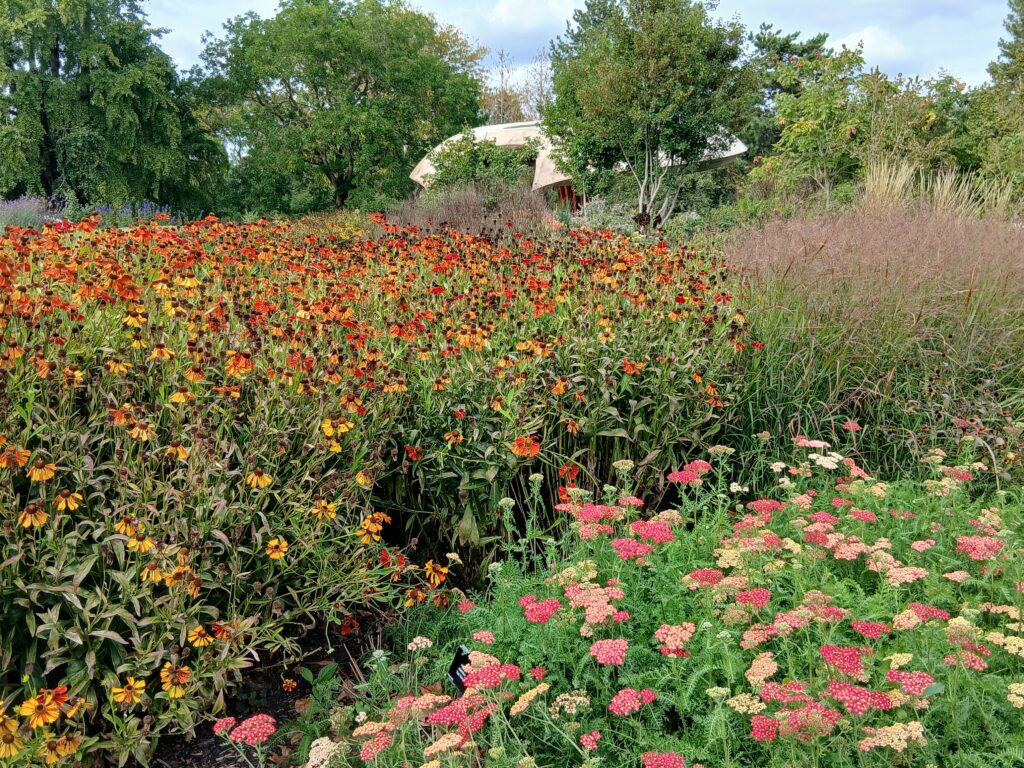
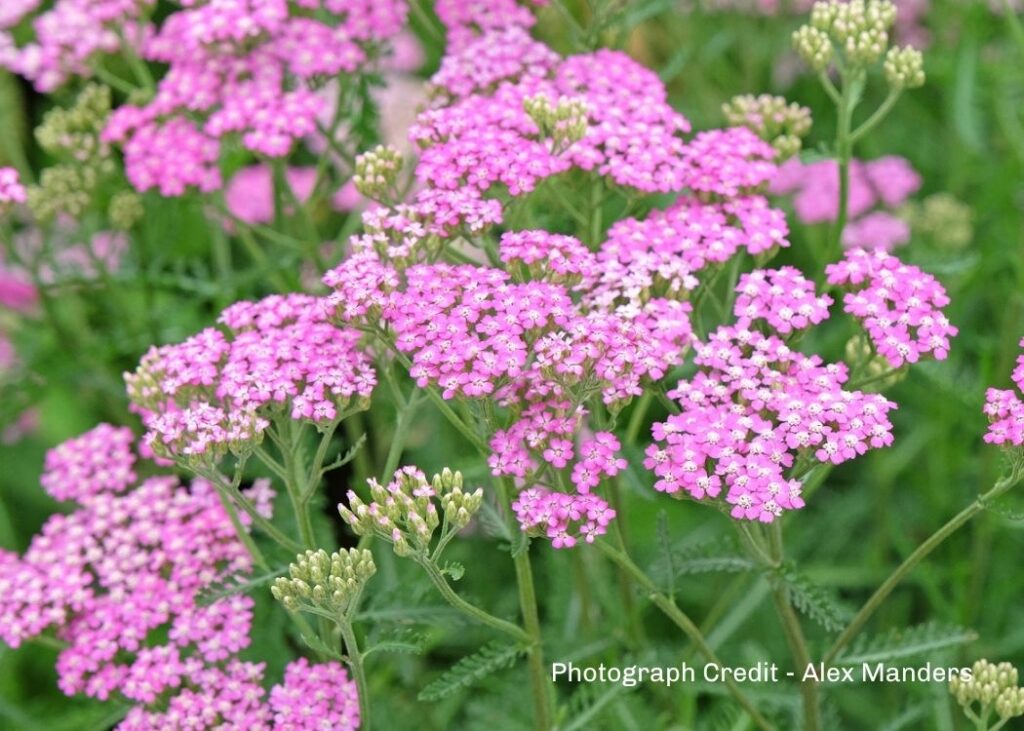
1) Achillea sp. – The flat flowerheads of Achillea (also called yarrow) are carried on tall stems above feathery foliage. These floral landing platforms are loved by pollinators such as hoverflies and bees. There are many colours to choose from, including pink, red, orange, yellow and white.
Achillea millefolium ‘Paprika’ has long-lasting bright red flowerheads that fade to pink with age, and grey-green leaves. Achillea ‘Moonshine’ has plate-like pale yellow flowerheads. Achillea ‘Terracotta’ has orange flowerheads that fade to yellow. In contrast to these flat flowerheads Achillea ptarmica ‘Peter Cottontail’ produces clouds of white, button like flowerheads over green foliage.
Achillea prefers full sun and well-drained soils. They flower from June to September.
2) Echinacea purpurea – You are probably already familiar with the name echinacea from its use in herbal medicine. However, this plant is not just useful, it is a beautiful herbaceous perennial. Its pink daisy-like flowers have a central orange – brown cone, hence the common name ‘coneflower’. These hardy herbaceous perennials flower from July to August. There are many cultivars of E. purpurea – they vary in height and colour, and cone size.
The large-flowering variety ‘Magnus’ with its deep pink flowers lends drama to any herbaceous border or prairie planting. Echinacea ‘Cleopatra’ produces golden yellow fragrant flowers with a large orange cone.
Echinacea sp. like a rich, well-drained soil in full sun.
Top Tip: Deadhead the flowers as they start to fade to keep them flowering for longer.
To learn about the herbal health benefits of echinacea:
https://www.mountsinai.org/health-library/herb/echinacea
3) Hardy Geraniums – Includes some of the toughest and easiest perennials you can grow. Hardy geraniums, or cranesbills, make great low-maintenance ground cover or edging plants.
Geranium ‘Rozanne’ produces masses of large, violet-blue flowers from June to November if you remember to cut them back after each blossoming period is over. Rozanne will thrive in sun or partial shade in any fertile soil.
4) Helenium autumnale. – Gorgeous late summer perennials with daisy-like flowers that come in a palette of hot colours from yellow, through burnt orange, into dark red. Their flowerheads have a central brown cone surrounded by showy ray-florets. Heleniums planted with grasses help create a prairie planting vibe in the border.
Helenium ‘Moerheim Beauty’ is a particularly fine tall variety, with copper-red flowers.
Top tips: Heleniums thrive in full sun in well-drained soil. Regular deadheading keeps the flowers coming.
5) Japanese anemones – Anemone x hybrida are robust, clump forming herbaceous perennials. They can be grown in full sun or partial shade and are extremely easy to cultivate. Japanese anemones are valuable for adding late season colour in a partially shaded border.
Japanese anemones produce their bowl-shaped pink or white flowers with golden centres on tall, branched stems. Single and double flowered forms are available. Japanese anemones like rich soil and regular watering.
Anemone ‘Prince Heinrich’ has purple-red flowers which are semi-double.
6) Penstemon sp. – Penstemons add a vibrant splash of colour to the garden in summer. Penstemons thrive in full sun or partial shade, in a moist but well-drained soil.
Penstemons of the Phoenix Series, such as ‘Phoenix Apple Blossom’, ‘Phoenix Red’ and ‘Phoenix Magenta’ have large, open bell-shaped flowers with white throats. Planting a group of 3 or 5 of these will inject drama to a dull spot.
Penstemon heterophyllus ‘Electric Blue’ has glowing slender tubular flowers that are intensely blue with a hint of purple.
Top Tip: To get your penstemons through winter don’t cut them back after they have finished flowering, instead, wait until spring to tidy them up.
I have found that penstemons thrive in the shelter of the sunny side of a hedge.
7) Rudbeckia sp.– These cheery, daisy-like flowers come into their own during summer and autumn. They combine well with Echinacea and ornamental grasses in prairie plantings.
Rudbeckias are also known as ‘Black-eyed Susans’ (not to be confused with the annual climber that shares the same common name – Thunbergia alata).
Rudbeckias come in autumnal colours from golden yellow, through orange, into crimson, mahogany and chocolate. Some double forms are available.
Rudbeckia fulgida ‘Goldsturm’ is a popular variety. Its yellow, star-like flowers have deep brown eyes.
8) Salvia nemorosa ‘Caradonna’ – This sage (also known as ‘Balkan clary’) produces masses of purple-violet spires of flowers over textured green leaves throughout the summer months.
Salvia Caradonna prefers moist but well-drained soil in full sun or partial shade.
Expert Tip: Salvias make great underplanting for shrub roses – where they are reputed to keep mildew and blackspot at bay.
Perennial salvias come in a wide range of forms and colours. Two more forms worth making space for are ‘Hot Lips’ and ‘Amistad’.
Salvia ‘Hot Lips’ is a bushy sage with small leaves that smell of blackcurrant. It is free flowering from summer and into autumn until the first frosts.
Did You Know? The flowers of ‘Hot Lips’ change with the season? They start off scarlet in midsummer, changing to bi-coloured red and white flowers in July and August, and finally approach pure white in late autumn!
Salvia ‘Amistad’ is a valuable bushy sage. It produces masses of deep purple tubular flowers out of black calyces.
To learn more about Salvia ‘Amistad’:
https://www.gardenersworld.com/plants/salvia-amistad/
9) Sedum spectabile – also known as the ‘ice plant’ – is a hardy succulent.
This plant is an important late summer feeding station for bees and butterflies. The pools of nectar glistening in the bases of the tiny flowers making up its flat flowerheads always attract colourful red admiral butterflies into my garden to feed and bask in the autumn sunshine.
The variety ‘Autumn Joy’ has deep pink flowers whereas ‘Iceberg’ has flat heads of pure white.
Ice plants do well in a sunny position and can cope with drought. To learn more about growing succulents in the garden read our blog:
https://www.capitalgardens.co.uk/blog/planting-a-container-with-stunning-summer-succulents/
Did You Know? Sedum spectabile has recently undergone a name change, becoming Hylotelephium spectabile – to find out why the name was changed:
https://www.chicagotribune.com/news/ct-xpm-2008-03-09-0803060368-story.html
10) Verbena bonariensis – (or ‘purple top vervain’) brings height and colour to the garden without making it feel crowded because its many branched clusters of lilac-purple flowers are born on tall wiry stems. The flowers attract bees and butterflies.
Verbena bonariensis does best in full sun, in well-drained fertile soil.
Top Tip: Leave the dead flower stalks for winter interest, this also provides the base of the plant with some winter protection.
To learn how to take cuttings of your Verbena bonariensis plants:
https://www.gardenersworld.com/how-to/grow-plants/how-to-take-verbena-bonariensis-cuttings/
In Conclusion:
If you are looking for garden flowers that will come back every year, then herbaceous perennials are the plants that you should be looking at. Our pick of 10 top summer flowering herbaceous perennials is an introduction to this grouping of long-lived plants.
There are herbaceous perennials that will flower in spring, summer and autumn. Planting a selection of these, and mixing them with annual bedding, grasses and shrubs will give you year-round colour and interest in your garden.
For success growing herbaceous perennials in your garden, choose the right plant for the right place. There are specimens to suit every garden, soil type and aspect. Choosing plants to suit the location is the best route to having happy, healthy plants.




Would love to see some photos of these please!