Blog
Planting a Container With Stunning Summer Succulents

Do you want to create a stylish summer container for a sunny location that is easy to care for? Would you like a beautiful planter that you don’t need to worry about watering when you go away? Then Ali Barwani suggests you think succulents!
What Are Succulents?
Succulents are a diverse group of plants that have evolved in many different plant families to cope with living in habitats with low rainfall.
Some are from the mountains such as the alpine sedums and Sempervivum (houseleeks). Many succulents are from desert areas such as cacti, and some are from the jungle.
However, all are adapted to growing in situations without much water – having fleshy leaves that store water to help them survive drought.
Garden succulents are fashionable. 2022’s RHS Plant of the Year competition winner was a new succulent hybrid x Semponium ‘Destiny’ – a hardy patio succulent developed at Surreal Succulents. Semponiums are a cross between Aeonium and Sempervivum (houseleek).
Learn more about the RHS Plant of the Year competition:
https://www.rhs.org.uk/shows-events/rhs-chelsea-flower-show/news/2022/plant-of-the-year
The Plants.
There are many thousands of succulents, including around 2,000 species of cacti, to explore. Most are tender, but some are more robust and may survive outside overwinter in Southern England.
Succulents look different to other garden plants. They give the suggestion of warmer climates to your garden. Succulents often have bold geometric or architectural shapes, unusual leaf textures and patterns, and may have stunning leaf or flower colour. I enjoy the variety in shape and colour of their leaves and treat the flowers as a bonus.
Hardy Succulents.
Succulents found in our alpine and hardy perennial plant areas – such as stonecrops (Sedum, Hylotelephium, & Rhodiola) and Sempervivum – thrive without winter protection provided they have good drainage.
Tender Succulents.
There is a lot of pleasure and interest to be had in experimenting with growing unusual succulent varieties to see if they will survive outside in your area. Some of the more exotic yet robust succulents worth growing outdoors include:
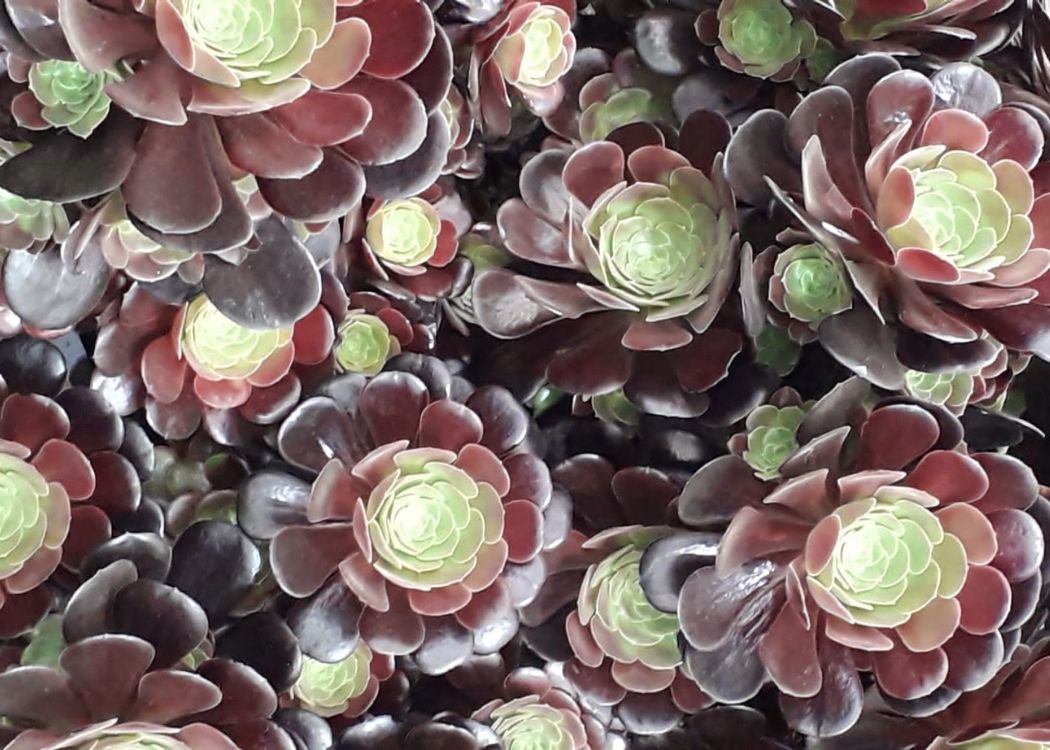
Aeonium – Often shrub like, with plate-like rosettes of leaves. These Canary Islands plants give height to arrangements in pots.
Agave – Large spikey rosettes that require space. Native to the Americas.
Aloe – There are many species of this mainly African plant group. Aloes are usually rosette forming and produce colourful flower spikes.
Aptenia – This fast-growing succulent is an excellent trailer over the edge of pots. Native to Southern Africa. Aptenia usually has bright red flowers, although you can a find white flowered variant.
Carpobrotus – Another Southern African succulent. Its striking pink or yellow flowers resemble giant daisies. Their finger-like leaves have a triangular cross-section.
Cactus – Cacti always enjoy their summer holiday in the garden. Some Cereus, Cleistocactus and Opuntia species may survive outdoors in a sheltered dry position.
Crassula – There are many species of this popular succulent. They make excellent summer bedding plants.
Delosperma – Attractive ground cover from Southern and Eastern Africa. D. cooperi has bold magenta flowers. Mature plants may overwinter in a sheltered location.
Dorotheanthus – This lovely plant is also known as the ice plant or Livingstone daisy. Its crystalline leaves are fascinating, as are its large colourful flowers. The flowers only open in sunshine. Native to South Africa.
Echeveria – Rosette forming succulents that have long been used in formal summer bedding. Some species are relatively hardy and may survive our winters. Hailing from the semi-desert areas of the Americas.
Euphorbia – Many of the succulent euphorbias come from Africa where they occupy the same habitats as cacti in the Americas. Euphorbias can be planted out as summer bedding but must be brought inside during the winter.
Gasteria – Succulent plants native to Southern Africa with distinctive thick, tongue-like leaves.
Graptopetalum – From Mexico and Arizona. Their rosettes often develop into sprawling, trailing stems. G. paraguayense may survive the winter outdoors in a sheltered spot.
Haworthia – A large genus of aloe-like plants from Southern Africa.
Hesaperaloe – Architectural, yucca-like plants native to Texas and Mexico. Drought resistant and hardy.
Kalanchoe – A genus with many species. Mainly native to Madagascar and tropical Africa. The paddle plant (K. thyrsiflora) makes an excellent patio or container plant for the summer – adding a definite wow factor to any succulent arrangement.
Lampranthus – A creeping perennial succulent producing masses of bright, daisy-like flowers in summer. This South African plant is also known as ‘perennial mesembryanthemum’.
Mangave – a hybrid plant between the genus Manfreda and Agave. Mangave leaves are broad with interesting patterning, and softer spines.
Portulaca grandiflora – a flowering succulent hailing from South America. An annual plant that will flower all summer with little care. Drought tolerant.
Choosing Your Container.
It is important to find a pot or trough that compliments your choice of succulents.
Don’t buy a container that is too small. Succulents don’t want to be crammed together – they need space to spread as they grow.
Most importantly – the container must have good drainage. If it hasn’t got drainage holes keep looking!
Unglazed terracotta pots always suit succulents. Terracotta allows moisture to evaporate all over its exterior surface, helping ensure your succulents don’t get waterlogged. If you pick a plastic container or glazed pot then you need to water them less frequently.
Stone sinks and troughs make attractive containers for creating nature-inspired landscapes.
Top Tip: Be imaginative with your containers. At the RHS Chelsea Garden show this year I saw succulents planted into seat of an old chair – and placed into planters made using antiques picture frames, living works of art!
Expert Tips: Tall succulents need large deep pots otherwise they may topple over when the soil becomes dry – also, aesthetically the combination looks more balanced. Low, spreading succulents look good in shallow troughs where they can spill over the sides.
Place your planter on pot feet not saucers, because water will collect in saucer during periods of heavy rain and the soil can quickly get waterlogged.
The Potting Mixture.
Using the right mix is the key to success with succulents in containers. Succulents need a well-drained compost that it not too rich in organic matter. That is to say, they require a poor soil that drains easily.
I prefer to make my own mixture of 1/3 horticultural grit to 2/3 John Innes No. 2 potting compost. John Innes compost is loam based, so it gives the pot weight, and it is less prone to waterlogging. You can also use a grit and peat-free compost mix.
Planting.
Arrange your succulent selection into their planter before you plant them. When you are happy with their positions you can start planting into your potting mix.
Plant them at the same height they were in their pots – in other words, don’t plant them more deeply than they were.
Once your container is planted you might want to add some shells or pieces of rock between the plants to create a mini-landscape.
Finally, add a top dressing of horticultural grit. The grit adds a stylish desert-like finish to your pot, supresses weed growth, and prevents the necks of your succulents from rotting if the compost gets too damp.
Watch Monty planting a bowl with succulents:
https://www.bbc.co.uk/programmes/p08gyhgp
Aftercare.
Water when the top layer of the compost has been very dry for a few days. Remember: smaller containers dry out more quickly than big ones. Once established, succulents can cope with periods of drought. Specialist succulent fertilizer should be applied every two weeks during the summer months.
Towards the end of September, you need to reduce and then stop watering your succulents – and preferably move the container to a sheltered balcony or porch. Many succulents can winter survive outside if their pots are placed by a south-facing wall, and they are protected from the rain by a temporary shelter and the use of horticultural fleece. The more tender species can be dug up, potted and overwintered indoors as houseplants.
Further Reading.
A great introduction to outdoor succulent care:
RHS Wisley Handbooks, ‘Garden Succulents’ by Terry Hewitt.
To see succulents successfully being grown outside all year, visit Kew Gardens – and be sure to check out the planting outside the Princess of Wales Conservatory and in The Rock Garden.
https://www.kew.org/kew-gardens
Looking for a particular succulent, try out our plant finder here