Blog
February in the Garden

February in the Garden
At this time of the year, many people don’t go into the garden, thinking there is little worth seeing. But, if you choose your plants carefully, says Ali Barwani, February is an opportunity to enjoy some amazing winter flowering plants.
The opening of February feels like a continuation of chilly January. Winter might still maintain an icy grip, but its hold is weakening. The Meteorological Office predicts that early February will turn wetter and milder, or that’s the rumour, anyway.
https://www.metoffice.gov.uk/weather/long-range-forecast
As I sit writing this in the warm, looking through the window, the garden appears quiescent. However, venturing out in the garden it becomes obvious spring is around the corner. Don’t believe me? Clumps of snowdrops are already in flower, Cyclamen coum holds her tiny blooms on short stems above a carpet of marbled leaves, and fluffy yellow catkins dance on hazel twigs whenever a breeze shivers.
Looking for something with a twist? Then the corkscrew hazel (Corylus avellana ‘Contorta’) with its extravagantly curly stems is the plant for you. Its twisted branches, which show to their greatest advantage after leaf fall, can be harvested to provide rustic supports for perennials and climbers – and add interest to indoor flower arrangements.
If catkins are your thing, but a bare hazel is too severe, then consider the evergreen silk-tassel bush (Garrya elliptica). Garrya shrubs are either male or female, and although both the sexes produce catkins, the male plants have showier ones. So, choose a named male variety such as ‘James Roof’ which guarantees masses of lengthy catkins, that can reach 30cm or longer.
Top Tip: If you want to add late summer interest to your Garrya then plant a Clematis texensis or C. viticella variety to grow up through it. These Group 3 Clematis can be cut back to 30 cm from the ground in early winter to allow the Garrya to bloom without being swathed in unsightly brown stems and leaves.
February Means Hellebores!
Do you want to add some magic to your winter garden? Then you can’t beat Helleborus orientalis hybrids. Oriental hellebores are long blooming, easy-care perennials. Hellebores are one of those plants that immediately catches the eye due to their bowl-shaped flowers.
The Helleborus ‘Magic Collection’ includes many striking recent introductions, both singles and doubles, ranging from white and pale yellow, through green and pinks, to red, slate-blue and aubergine.
Helleborus x nigercors is a super-strong hybrid with attractive semi-evergreen foliage. Hanging cup-shaped flowers are produced on branching stems that rise above broad, leathery leaves. The flowers age attractively, maintaining interest for a longer time.
Helleborus x ericsmithii (Eric Smith’s hellebore) is another sturdy hybrid. Large creamy-white flowers are carried on branching stems. Both the petals and flower stems are tinged rose-pink. The attractive tooth-edged leaves are grey green in colour, with an almost metallic sheen, and chalky white underneath.
If you want a hardy hellebore that is more architectural, then consider Helleborus foetidus (and don’t worry about the name, it doesn’t stink!). This plantsman’s hellebore has dark green leaves and produces an erect stem of up to 80 cm carrying clusters of small, pale green flowers. Look closely at the edges of the petals and you will notice they are stained purple. The variety H. foetidus ‘Wester Flisk’ is worth seeking out for its grey green leaves and red tinted flower stems and petioles. H. foetidus ‘Bowles Form’ is a more compact form with contrasting deep blue-green foliage.
Hellebores mix well with spring flowering bulbs and woodland plants. If you forgot to plant spring bulbs in autumn don’t fret, pot grown bulbs are available.
https://www.capitalgardens.co.uk/blog/pot-grown-spring-bulbs/
Top 5 Shrubs For February
Even in February you will find a range of flowering shrubs to tempt you. My favourite five for this month are:
- Sarcococca confusa. People always pause to try and locate the source of the honey-like scent emitted by this evergreen on a still day. But few realise that the sweet perfume comes from this shrub because its tiny, cream-coloured flowers are hidden under dark leaves.
- Jasminum nudiflorum. What winter jasmine lacks in scent it makes up for in colour. Bright yellow flowers appear as winter is ending. Apart from the occasional trim to keep it neat, winter jasmine requires minimal care.
- Camellia japonica. Camellias are evergreen shrubs with a wide range of flower forms and colours. The first flowers appear towards the end of winter and can continue appearing for several months. The beauty of the flowers makes them a must-have for any winter garden.
- Skimmia. Neat evergreen shrubs that come into their own during winter and spring. Female plants produce plump, long-lasting red or white berries that the birds rarely plunder. The male bushes carry clusters of tiny buds in autumn that open to scented white blossom in spring. Skimmia ‘White Globe’ (white flowered) and S. ‘Rubella’ (dark red) carry beautiful panicles of buds for a long period during the winter months, that open to fragrant flowers in spring.
- Hamamelis (witch hazel) with tousled blooms that look like tinted strands of shredded coconut. The unusual flowers appear on bare stems, and can be yellow, orange, or red. These mini floral-fireworks produce a warm, sweet spicy perfume. Hamamelis ‘Arnold Promise’ is a deep yellow form, H. ‘Diane’ has red and marmalade tones, and H. ‘Ruby Glow’ is a good coppery variety.
Bonus shrub for the ‘plantaholic’: Edgeworthia chrysantha ‘Grandiflora’ (paperbush). This bushy deciduous shrub is covered in tightly closed, rounded bunches of buds during winter that open to reveal clusters of highly fragrant bright yellow flowers in late winter and early spring before its leaves appear. The buds and the backs of the flowers are covered with a protective fuzz of silky white hairs. Edgeworthia makes an unusual addition to the winter garden.
10 February Jobs:
If admiring beautiful plants isn’t enough, and weather permitting, here are some jobs to get on with this month:
- Winter digging on bare ground such as empty flower beds and vegetable plots. Add a generous layer of rotted organic matter over the bed first and incorporate this layer into the soil as you dig. Don’t attempt this if the ground is frozen or waterlogged.
- Organise your seed boxes. Put any expired packets into a separate pile. Remember, expired seeds will have a lower germination success rate. Dispose of any long-expired packets and draw up a list of those you need to buy. Now is a good time to visit your local garden centre to stock up on seeds, seed potatoes, and summer flowering bulbs.
- Sow sweet pea seeds indoors. Place pots on a bright windowsill. If you have a heated propagator or warm windowsill, you can also start sowing chillies, sweet peppers, and tomatoes later in the month.
- Start chitting (sprouting) seed potatoes ready for planting in mid-March to April. A cool, frost-free, bright location is best. And don’t forget to label them if you are growing more than one variety!
- Keep off your lawn as much as possible during the winter, especially if frosted or waterlogged.
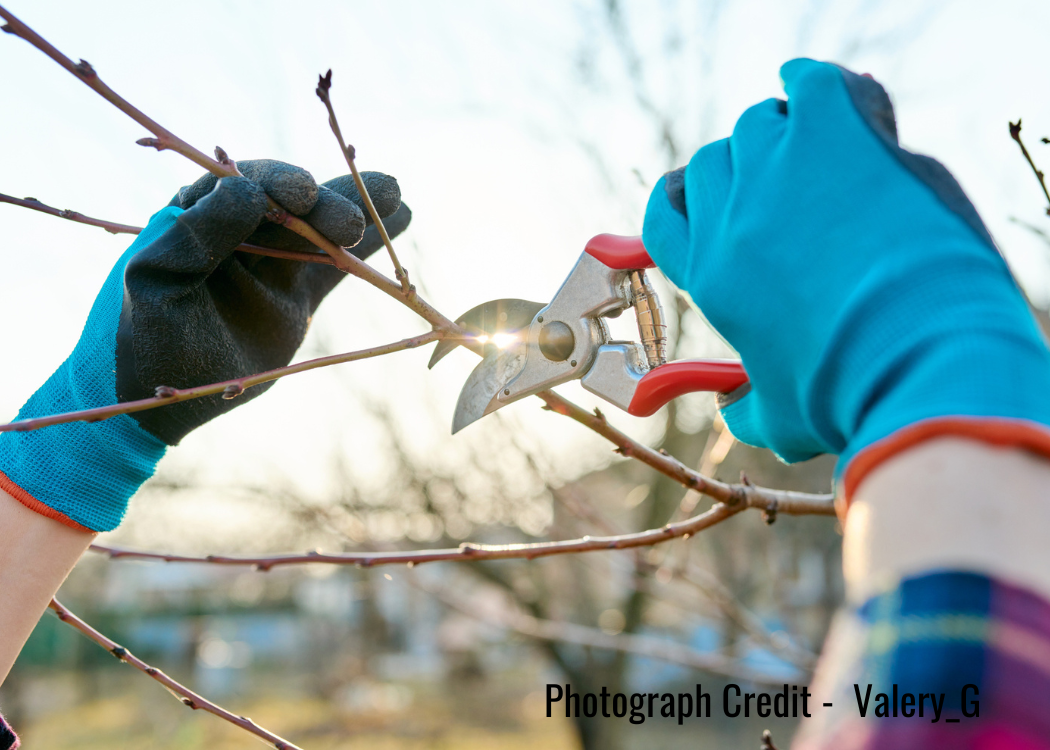
- Prune Group 3 clematis such as Clematis texensis, viticella and C. jackmanii. Wisteria should also be winter pruned this month while still dormant.
- Prune autumn-fruiting raspberries. They produce fruit on this year’s new canes, so you can now cut back the old, fruited canes to the ground.
- Winter prune free standing apple and pear trees to keep them productive and under control.
- Freshen up dull containers by adding potted bulbs, violas, and pansies. Don’t forget to continue deadheading winter bedding to encourage new flower production.
- Finally, don’t forget to keep feeding the birds and providing them with clean drinking water.