Blog
Pot Grown Spring Bulbs


Pot Grown Spring Bulbs
Life is beginning to return to our gardens, and now is the perfect time to think about adding some pot grown spring bulbs, says Ali Barwani.
Better In Than Out!
For a short moment this morning I was tricked by the sunshine into believing it would be pleasant to go into the garden, so wrapped up warmly I headed out. But standing in the biting wind I realised quickly that it was not as inviting as it looked. Some days it is better to view the garden from a window.
The Long View
In many ways January is a positive month. The days are getting longer, with many dormant plants beginning to return visibly to life. And the greatest spectacle in the gardening year, the flowering of spring is starting to get underway.
As Algernon Charles Swinburne observed,
‘And in green underwood and cover
Blossom by blossom the spring begins.’
From my kitchen window, I can see a generous clump of the giant snowdrop, Galanthus elwesii, with wide glaucous foliage and numerous graceful white blooms nodding on long stems. If you look closely at the inner segments of the flowers of this early snowdrop you will notice green markings that resemble a pair of eyes and a downturned mouth, earning it the sobriquet, the ‘Grumpy snowdrop’! Here and there early daffodil flowers are already out. These vibrant splashes of yellow look as though they have no right to be blooming so early.
Time to Plug in The Bulbs!
Spring bulbs such as snowdrops, daffodils, and crocuses are the floral leitmotif of the garden at this time of the year. But do you have enough of them? Your garden, like mine, will have lots of bare spots. Can these spots still be filled with spring flowering bulbs?
The general rule when planting dormant bulbs is daffodils, snowdrops, crocus, and hyacinths by the end of September, and tulips in November. Luckily, this rule doesn’t apply when you buy pot grown bulbs. Potted bulbs, available now, can be used to add colour wherever you want it. Our potted bulbs are already showing green shoots and are ready to be plunged straight into containers, or into the border.
Where to Place Your Bulbs
The first question to ask is, will I be able to enjoy them if I don’t go out into the garden? I can’t do without my spring bulbs, but some days I don’t want to venture out in the cold just to see them. Therefore, I have plenty of spring flowering bulbs lining the front garden path, where I can enjoy them every time I leave the house. I also like to have pockets of bulbs in the back garden planted in strategic spots where I can look at them from the windows of the house.
In Containers
If you buy pot grown bulbs for filling empty containers, then you are in luck. Containers can easily be moved to a quiet spot after flowering has finished, allowing the leaves to build up the bulbs before they fade. Don’t forget potted bulbs can also be used to underplant in mixed spring pots and window boxes.
Many people treat pot grown bulbs as annuals, disposing of them after flowering. This might be your best option if your growing space is limited to a small balcony or a large doorstep pot.
In The Ground
Another good question to ask is, what will happen in that empty space later in spring and summer? If you intend to plant bulbs in an area that will be dug over or planted up in spring then I would select an alternative location for them. Find a spot where the bulbs can be left to thrive and multiply undisturbed.
Under Deciduous Shrubs.
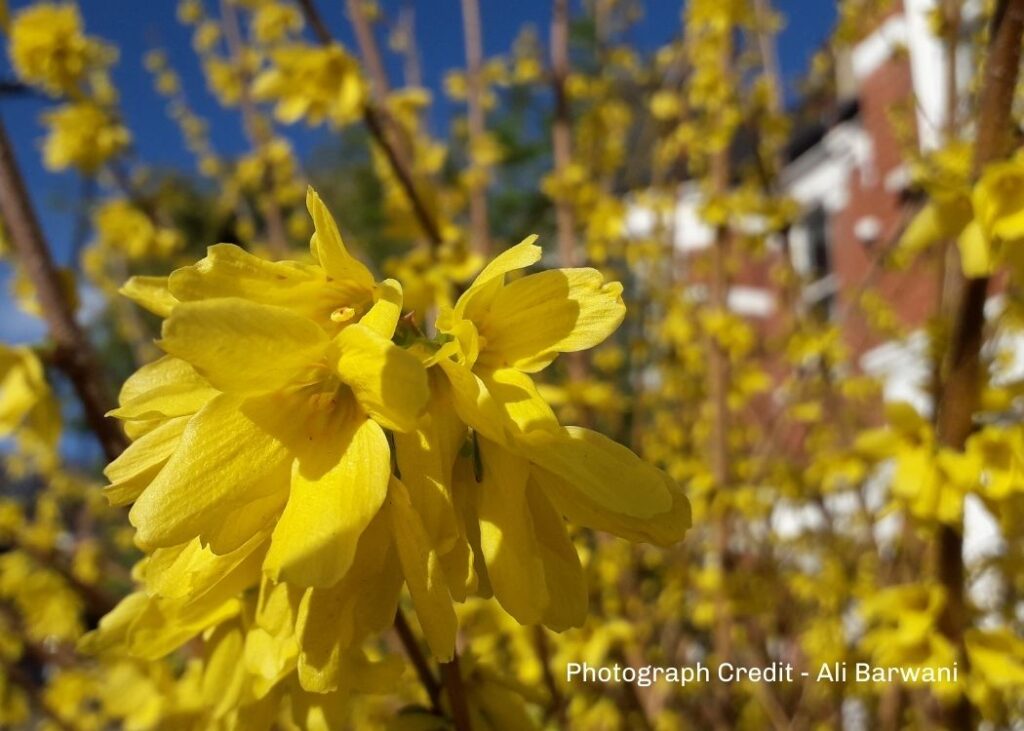
But what if my garden is full and I have no empty space? Well, how about the areas underneath deciduous shrubs? Many shrubs have bare ground beneath them, with full light until the shrubs put out their own leaves. To give your bulbs extra growing space you can remove some of the lowest branches. Chaenomeles, Deutzia, Forsythia, Hydrangea, Magnolia stellata, Ribes sanguineum, Viburnum x bodnantense and Weigelia are examples of deciduous shrubs perfect for underplanting with bulbs. Crocuses and ‘Glory of the snow’ (once Chionodoxa, now reclassified as Scilla) are excellent bee-friendly flowering bulbs for adding spring interest under rose bushes.
Cyclamen coum, a late winter to spring flowering hardy perennial bulb does well at the base of shrubs and small trees, especially if you give them an annual mulch of well-rotted leaf mould or homemade compost. Their marbled foliage, silver lined over dark green, makes a pretty backcloth for violets and primroses.
Between Perennials
Small flowering bulbs are perfect for planting amongst perennial plants you are not planning on disturbing for some time. Patches of bulbs can be inserted between established clumps of perennials such as day lilies (Hemerocallis), ferns, hardy geraniums, Hostas, Japanese anemones, and Sedum spectabile (now Hylotelephium spectabile).
Some Potted Bulbs to Consider.
We have a great range of potted bulbs available, with more arriving all the time. With so much choice, I have selected a few highlights:
Crocus – Low growing plants producing relatively large flowers. Their thin leaves are stiff and grass-like.
Dutch crocus (Crocus vernus). Large flowers appear early in spring. They can be white, yellow, purple, or striped. The fat flowers open wide when the sun is out.
Winter Aconite (Eranthis hyemalis). Early to flower, with yellow, cup-like blooms surrounded by a fringe of frilly green bracts.
Daffodils (Narcissus).
Look out for Narcissus ‘Tête-à-tête’. A very popular dwarf variety that stands up very well to bad weather. Compact and cheerful, and a good spreader. It is early to flower with golden yellow trumpets. Each stalk can carry up to 3 blooms.
Snowdrops (Galanthus). Did you know that snowdrops are scented? On still, sunny days you can catch their delicious honey scent.
- elwesii ‘Beluga’. A large, early flowering form with broad leaves. The inner segments of the flower have a large green mark that resembles a whale’s tail.
- nivalis ‘Flore Pleno’. The classic double snowdrop with narrow leaves. Its nodding, fragrant, double flowers resemble a 1950s retro tutu petticoat.
- elwesii ‘Polar Bear’. This form has large outer petals with reduced inner segments.
- elwesii ‘Snow Fox’. A big, bold form with broad glaucous leaves. The inner segments have distinctive green markings.
- woronowii. A snowdrop with large, nodding flowers. Its leaves are broad and glossy green.
Hyacinth (Hyacinthus orientalis). Heavily fragrant spikes of dense flowers. Hyacinths come in a wide range of colours including, white, cream, pink shades, blues, purple, yellow, apricot, orange, and red.
Iris reticulata. Early and long lasting miniature iris. The delicate looking flowers are scented, their petals are beautifully patterned.
Grape hyacinth (Muscari). Small, blue spring flowers. Their flower spikes resemble bunches of tiny blue grapes. White, purple, and even yellow forms can also be found.
Muscari armeniacum. A vigorous species that will spread. Its grass like leaves produce spikes of dark blue flowers, each with a white lip to the mouth.
Muscari azureum. With soft blue flowers, and less invasive in the garden.
Broad-leaved grape hyacinth (Muscari latifolium). Each bulb produces a single large leaf. The flowers are dark blue topped by a tassel of pale blue sterile flowers.
Places to Visit:
The Ultimate Snowdrop Sale – Myddelton House Gardens.
This is the event for galanthophiles looking to acquire rare snowdrop varieties. After you have bought your bulbs wander around the gardens admiring the stunning snowdrop displays.
When: 28th January
Time: 07: 30 -12:00
Location: Myddelton House Gardens, Bulls Cross, Enfield EN2 9HG
Note: there is £4 entry fee for this event.
https://www.visitleevalley.org.uk/event-listings/the-ultimate-snowdrop-sale
See the Winter Aconites at Compton Verney.
Location: Compton Verney, Warwick CV35 9HJ
Visit the grounds of this Georgian Mansion in January to admire the carpet of Winter Aconites flowering in a grove of lime trees.
Details: https://www.comptonverney.org.uk/
Further reading: Some more jobs to do in the garden in January –
https://www.capitalgardens.co.uk/blog/january-in-the-garden/