Blog
Epimediums

Epimediums
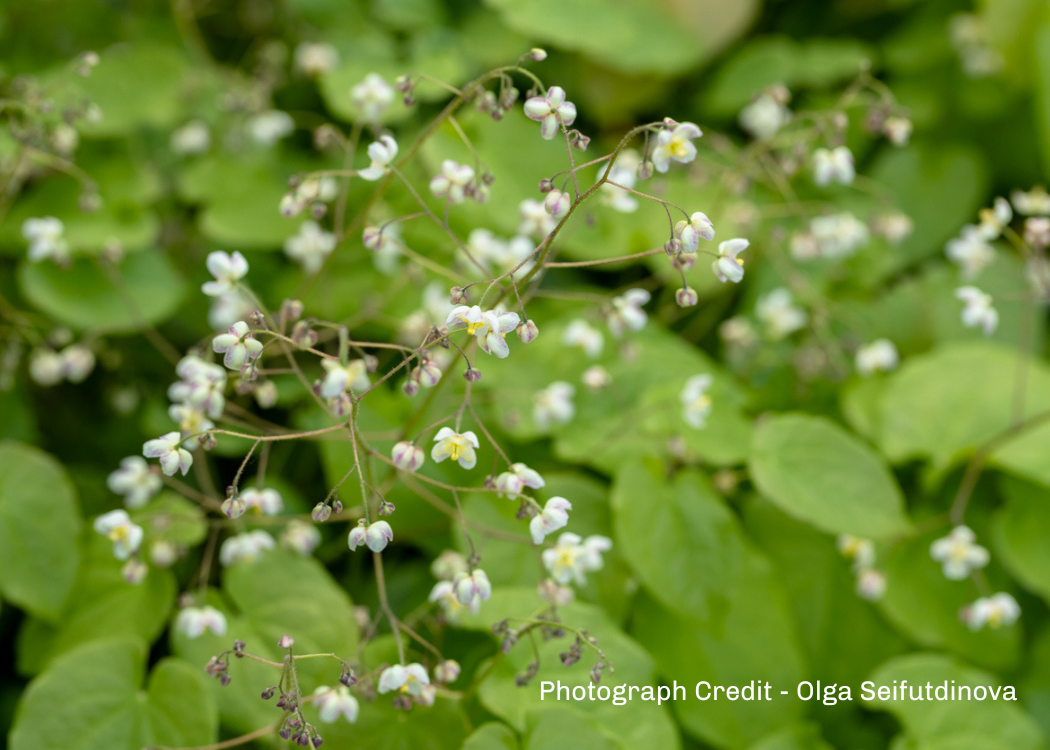
Bishop’s hat, fairy wings, horny goat weed, barrenwort…… The common names for epimediums are sometimes unflattering but always imaginative. And with hanging, four-petalled flowers that dance on slender, wiry stems, some with pointy, elongated spurs, they really do look like hats (albeit jesters’ rather than bishops’) or even jauntily dangling spiders to those in a more fanciful frame of mind.
Spring-flowering in white, yellow, red, orange, pink and purple, their heart-shaped leaves are often bronze or copper tinted in spring, becoming green before darkening again in autumn. Grown for their foliage as well as their flowers, some are evergreen or semi-evergreen and make good ground cover in difficult places.
Woodland plants, they prefer dappled shade and fertile, slightly acidic soil that’s well-drained but will tolerate some dryness once established. Their origins are in China and other parts of Asia with a few from Mediterranean regions. Those from mountainous areas of the Mediterranean tend to be better at coping with dry conditions.
Garden hybrids are generally fairly hardy, to at least -10 degrees C, although a few emerging flowers of some may be damaged by frosts. And a couple, such as Epimedium x versicolor ‘Sulphureum’ and E. x rubrum, are robust enough to deal with temperatures as low as -20. Plant them in groups to see them at their best.
Heights range from about 30 to 45cm. Some are clump-forming while others spread by means of fleshy underground roots or rhizomes. Although generally they prefer their feet in the ground, more compact varieties will be fine in pots. However, these may need some protection in winter. Spreading forms, on the other hand, are more at home with room to grow and lend themselves particularly well to shady slopes.
Epimediums associate well with other fans of part-shade like primroses, tiarellas and colourful, leafy, semi-evergreen heucheras. They’re also good companions for perennial geraniums like the ever-reliable Geranium ‘Rozanne’ and G. x oxonianum ‘Wargrave Pink’ as well as Liriope muscari which flower later on, filling the gaps left once epimedium flowers have faded.
Their perfect situation, though, is in a woodland garden. Plant with blue-flowered bee magnets pulmonaria, brunnera and evergreen Ajuga reptans, delicious lily of the valley, Convallaria majalis, and pretty, white-flowered sweet woodruff, Gallium odoratum, with its many-fingered leaves. Starry-bloomed, white-to-palest-pink wood anemones are perfect too, as are wild violets and erythroniums. Add a few ferns (without which no woodland planting is complete) and finish with some of the smaller foxgloves to punctuate the planting with spires of flowers. Try pale yellow Digitalis lutea or one of the Dalmation series in rose pink, palest peach, purple or white.
[Did you know? The scent of sweet woodruff increases as it dries, giving it a use in pot pourri and as a moth deterrent. (Unfortunately there’s no hard evidence of its success in dealing with that particular problem.) It’s also used to flavour May wine (Maitrank) in Germany, as well as brandy, jellies and ice cream, although it has become less popular since it was found to have a detrimental effect on mice and rats.]
Epimediums’ ability to tolerate the dry shade often found under deciduous trees and next to hedges is one of their most admirable features. These are notoriously tricky conditions but several other dependable plants will put up with them as well, making them fine planting companions. Hellebores provide interest in winter and early spring, paving the way for others to follow. Try Euphorbia amygdaloides var. robbiae and trailing purple vincas – both evergreen. Ferns too, often underrated, are invaluable and finely-cut Dryopteris affinis, Dryopteris filix-mas and evergreen Polypodium vulgare all have their place. Several perennial geraniums – mat-forming, semi-evergreen Geranium macrorrhizum, leggy G. phaeum and long-flowering, self-seeding G. nodosum – also tolerate dry shade, offering blooms in white to mauve-pink and, in the case of G. phaeum ‘Raven’, darkest purple.
https://www.gardenersworld.com/plants/20-plants-for-dry-shade/
A few suggested epimediums
Epimedium x warlyense has coral-coloured flowers with orange/yellow centres and is evergreen or semi-evergreen.
E. x rubrum has deep pinkish-red blooms with beautifully contrasting cream spurs. Young foliage is tinted with bronze and darkens in autumn and it’s a compact form at around 30 x 30cm.
E. ‘Pretty in Pink’ has copper-tinted leaves which darken again in autumn and pale pink, spurred flowers with darker pink centres. Evergreen or semi-evergreen.
Spidery E. grandiflorum ‘Lilafee’ has lilac flowers with long, pointed spurs and bronze-tinted leaves. It prefers more acidic conditions than some other epimediums. ‘Purple Prince’ is darker purple. Both are compact at around 30 x 30cm.
Pale yellow flowers with deeper yellow centres adorn the stems of E. x versicolor ‘Sulphureum’. Whole leaves are often purplish-bronze in spring, darkening again in autumn. Evergreen or semi-evergreen, it’s a good ground cover plant, spreading up to 90cm.
E. x perralchicum ‘Frohnleiten’ has coppery foliage and rich yellow flowers with central burgundy markings. Evergreen or semi-evergreen.
E. x youngianum ‘Niveum’ has small, dainty white flowers. For larger blooms opt for the showier grandiflorum ‘White Queen’.
We may not have all the plants listed here in our stores but our staff will be happy to suggest alternatives.
Maintenance
Epimediums are easy to care for, mostly looking after themselves. Mulching with leafmould mimics their natural growing conditions, adding fertility and helping to keep a healthy, open soil structure. This is best done in in spring and autumn. Bark chippings are a good substitute if leafmould isn’t available.
Chop back tatty, overwintered leaves in spring before flowers appear.
https://www.rhs.org.uk/plants/epimedium
With charming, delicate flowers that gently nod and dance in the spring breeze, and colours that complement each other perfectly, epimediums make a delightful addition to woodland gardens, where they’re very much at home.