Blog
Echinacea


Echinacea
Flowering from mid to late summer or early autumn, echinaceas have large, bold, daisy-like flowers and an architectural beauty which enhances a variety of planting schemes. Once predominantly lilac pink, there are now cultivars spanning the spectrum of colour from their original shade through red, orange and yellow to pale green and white. The petals stand upright as they emerge, gradually flattening out as they open up and then, in some forms, gradually migrating earthwards. The leaves are mid green, elegantly elongated and pointed with distinct concave veining.
Also known as coneflowers because of the prominent, prickly-looking cone anchoring the petals, their blooms are long-lasting, lending themselves well to cut flower arrangements. This central cone is a key feature. Although often ginger, rust or golden, these are not its only hues, with some cultivars even changing colour as the flowers mature. Indeed, a quick check on a popular search engine reveals that the botanical name for the plant derives from the Greek word ekhinos, meaning hedgehog or sea urchin.
These herbaceous perennials are a relatively new introduction to our gardens, finding their niche during the 1980s with the rise of the New Perennial movement, which was inspired by the grasslands of North America.
With their origins in these prairies and along open woodland edges, echinaceas are best placed in a sunny spot. They’ll also tolerate light or dappled shade although don’t flower as well in these conditions. Established plants have some tolerance for drought but the more highly cultivated forms and plants in pots tend to be less able to shrug off dry conditions. Add grit to the planting holes if you garden on clay as they need a free-draining growing medium. What they can’t cope with is waterlogged soil in winter.
Most are hardy down to -10 to -15 degrees C, although again modern hybrids can be less robust than wild forms such as Echinacea purpurea and E. paradoxa.
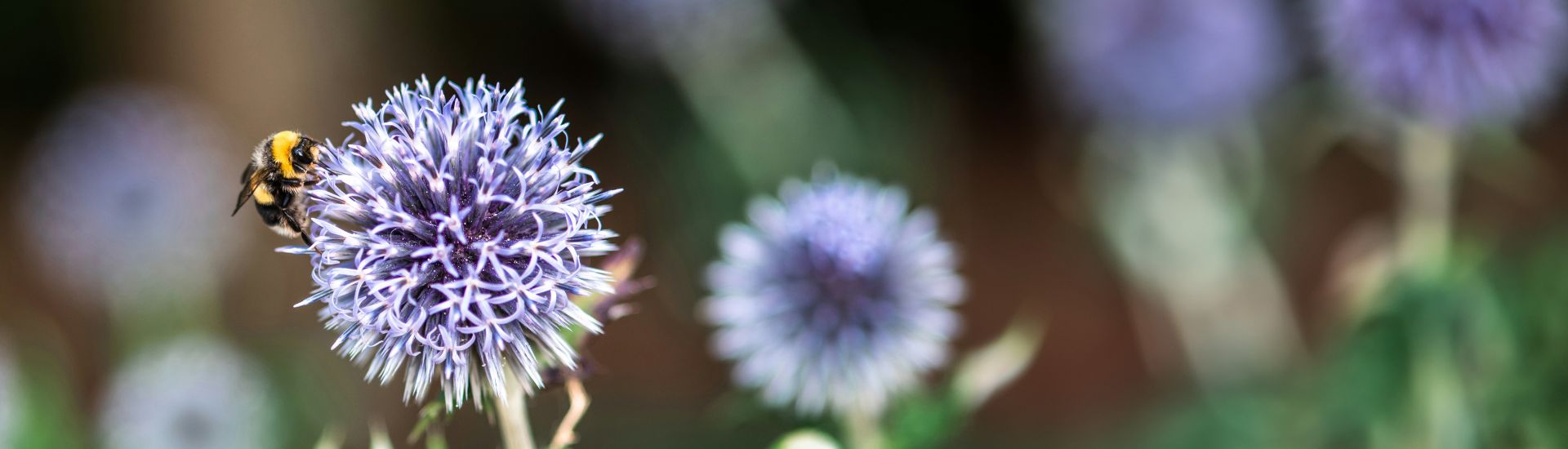
Like those other prickly-headed perennials, eryngium and echinops (whose botanical name presumably has the same origin), echinaceas don’t look as though they’d be particularly attractive to pollinators but bees, butterflies and other pollinators adore them. The cone is where the pollen and nectar are to be found – as well as where the seeds will form – and its prominence makes it easy for insects to access these valuable resources.
Echinacea’s use in traditional medicine by indigenous peoples of North America ranges from insect bites and burns to colds and sore throats and as pain relief. It’s also used an alternative remedy for colds in the UK but so far there’s no scientific evidence in support of its effectiveness.
There are a huge number of varieties with heights varying from a statuesque 1.5m to a less imposing 50cm. Echinacea purpurea, the parent of many cultivars, is the tallest, with downturned lilac pink petals and a burnished orange cone.
E. purpurea ‘Magnus’ has deeper pink flowers with less reflexed and slightly thicker petals.
White forms include E. ‘White Spider’ and E. purpurea ‘White Swan’. Both have golden cones and grow to about 70cm tall. Similar in appearance, they differ in that the mature petals of ‘White Swan’ droop downwards.
E. ‘Green Jewel’ has (sometimes double) rows of white petals with green tints and a greenish cone. To 75cm tall.
The petals of E. ‘Green Envy’ emerge pale lime, undergoing a miraculous transformation to pink from the centre of the flower as they mature. The cone, too, changes from green to purple with orange tints. To 90cm.
E. ‘Tomato Soup’ does what it says on the tin, the flowers emerging tangerine and deepening to scarlet. The petals are slim and delicate, curving gently downwards and the cone orange. Approx 75cm.
E. ‘Lakota Orange’ has petals of rich orange and grows to approximately 50-60cm tall. At first green, the cone gradually becomes ginger.
E. ‘Sombrero Lemon Yellow’ has large flower heads with bright yellow petals and a golden cone. Approx 60cm.
We may not have all the plants listed in our stores but our staff will be happy to suggest alternatives.
Plant with…..
Echinaceas are frequently seen in large groups in prairie plantings but are just as at home in smaller gardens, dotted around or woven through other herbaceous perennials. Classic prairie plantings often include rudbeckias, heleniums, achilleas, kniphofia, sanguisorba and grasses. But echinaceas work equally well with purple Verbena bonariensis or delightful, smaller, airy V. officinalis var. grandiflora ‘Bampton’. Ethereal white Oenothera (formerly Gaura) lindheimeri also creates a gorgeous contrast
of form, as does feathery, wafting fennel. Spiky eryngiums, long-flowering salvias and limey euphorbias will complete the display. https://www.gardenersworld.com/plants/best-plants-for-a-prairie-border/
Maintenance
Although some echinaceas are tall they have sturdy stems so rarely need staking.
Over summer, deadhead down to the bottom of the flower stalk to encourage new blooms to form. But leave spent flowers at the end of the season. The seedheads add considerable winter interest to beds and borders as well as acting as a much-needed larder for birds in autumn. Cut back in spring as new foliage begins to make its appearance.
Slugs and snails can attack seedlings in spring so it’s best to protect them. A number of controls are available but talk to gardeners about this perennial problem and they’ll all have different experiences of what works and what doesn’t. So it’s often a question of experimentation. However, badgers, foxes, hedgehogs, frogs, toads and some birds all love juicy slugs and snails, so encouraging them by providing shelter and breeding and nesting areas can only help, as well as making gardens even more vibrant and enjoyable places to be in.
(Did you know? Among slugs and snails’ predators are glow worm larvae, who feed exclusively on them, biting and injecting them with digestive proteins. Yum!)
https://www.wildlifetrusts.org/wildlife-explorer/invertebrates/beetles/glow-worm
Stars of late summer, multi-talented echinaceas offer gardeners a wide choice of colour as well as size, making them perfectly suited to sunny spots in most outdoor spaces. Looking good in vases as well as borders, they’re easy to grow and also provide essential nourishment for bees, butterflies and birds.