Blog
Abelia: When the Going Gets Tough, the Tough Get Going


I am sweeping up piles of crisp brown leaves in the carpark at Alexandra Palace Garden Centre. The unusually warm and dry summer we have experienced this year has resulted in a phenomenon known as ‘summer leaf drop’. Heatwaves might be tough on trees, but they are appealing for lovers of lazy sunny days on beaches. People are taking advantage of the good weather to squeeze in an extra holiday, so there aren’t many customers in our plant area today. However, there are some vehicles in the car park. Maybe the visitors have gone to the café to enjoy a coffee on the roof terrace? Looking at the planting in front of the office building I can see it needs some pruning. Feeling the warmth of the late summer sun on my neck, I take off my purple fleece and place it atop one of the wooden sleepers of the retaining wall. Looking up, I am surrounded by buzzing life. Bees and flies are spinning around the tubular flowers adorning the arching sprays of one of the car park shrubs. It has been hot and dry for ages and yet this bush looks healthy with shiny leaves. No one ever stops long enough to smell the blooms, but they are emitting a perfume trail that attracts the attention of passing pollinators. I lean forward to smell the dainty flowers, rich and sweet like honey. What is this shrub that possesses beauty, colour, fragrance, and yet is so tough? It is Abelia x grandiflora or ‘glossy abelia’.
Look up Abelia in a gardening book, and you will find that it is a genus of around 30 species of deciduous and evergreen shrubs belonging in the honeysuckle family (Caprifoliaceae). Abelia species are found in the wild from East Asia to the Himalayas and in Mexico, usually growing on hillsides and in open woodland. The genus name honours Dr Clarke Abel (1780 – 1826), physician and naturalist, who accompanied Lord Amherst’s unsuccessful diplomatic mission to China 1816-7. Unfortunately, all the plants and seeds Abel collected were lost in a shipwreck on the homeward voyage. The first living specimens of Abelia chinensis were imported to England in 1844 by the Scottish plant hunter Robert Fortune. However, recent molecular phylogenetic studies by botanists showed that this genus required reclassification, and many Abelia species have been transferred into other genera. But none of this needs to bother us as the horticultural trade continues to call them Abelia, so this article follows that usage.
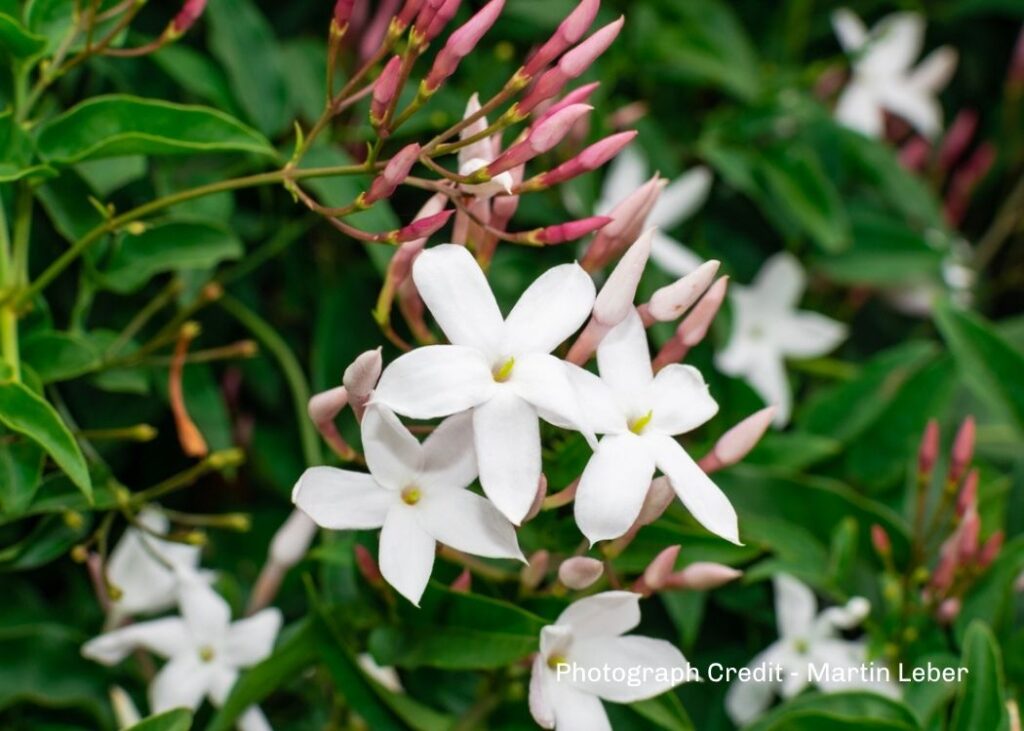
The most widely grown form is the hybrid Abelia x grandiflora, the shrub I was admiring while sweeping. It is an artificial cross of two Chinese species (Abelia chinensis x Abelia uniflora). Its toughness makes it what I call a ‘car park plant’. In other words, plant it in poor soil surrounded by tarmac, and it will grow. The downside of being tough is that it often gets dismissed as being a mere landscaping plant. This is a mistake. It is not just tough; it is beautiful. Glossy abelia with its delicate flowers provides colour and fragrance throughout summer and autumn, when many more popular garden shrubs are without blossom. Look closely at the above photograph and you will see that each flower is surrounded by a persistent pink calyx (a whorl of protective sepals). These colourful calyces are a distinctive and attractive feature of this charming shrub. Another handsome feature is its glossy semi-evergreen to evergreen foliage. A final important characteristic I want to highlight is its drought resilience. Once established, the plants shouldn’t need any extra water. We have not given ours any special treatment during the summer, and it looks fresh and floriferous. Not just surviving but thriving! Various attractive cultivars of glossy abelia have been bred, including forms with variegated leaves. Let’s take a closer look at a few of these fine forms. Most green leaved abelias you find in British gardens are clones of the same cultivar, ‘Lake Maggiore’. Abelia x grandiflora ‘Hopleys’ is arguably the best variegated cultivar. This free-flowering form has green leaves edged with cream and yellow borders. Abelia x grandiflora ‘Kaleidoscope’ is a popular dwarf form with green leaves edged with cream/yellow borders. The foliage colours of this cultivar change as the season progresses taking on fiery orange and red hues in autumn. It is an ideal choice for smaller gardens and containers. The cultivar ‘Gold Spot’ has golden yellow leaves when grown in a sunny position, and flowers that are flushed with violet. If you are looking for a form with outstanding flowers then I recommend Abelia ‘Edward Goucher’, a hybrid between Abelia x grandiflora and Abelia shumanni. ‘Edward Goucher’ is a mound forming shrub that provides good ground cover. It has dark, glossy leaves and purple-pink stems that provide a foil to the raspberry-pink flowers that are carried for many weeks. Whichever cultivar you choose, to ensure it thrives, plant it in a sunny position with well-drained, humus rich soil. And, remember to give it a handful of general fertiliser in spring, such as Vitax Q4, to help maintain its vigour. Summer and Autumn flowering species and hybrids can also be pruned in the following spring, early in the season. This is important to follow, as they flower on the current season’s growth. Typically reaching heights of 0.9 – 1.8 metres, they can even be clipped to form free-flowering hedges or topiary shapes.
In conclusion, Abelia is a versatile and charming shrub that earns its place in any garden. With its ease of cultivation, fragrant flowers, appealing evergreen foliage, and many attractive cultivars to choose from, it adds much needed colour and interest to the garden between July and October. With climatic extremes becoming increasingly common in the UK, gardeners will need to look more closely at drought tolerant plants to make their gardens climate resilient. Abelia x grandiflora is one of the plants recommended by the RHS for growing in a climate that is heating up. So next time you pop into the garden centre for a coffee and a pastry, consider adding a glossy abelia to your collection – you won’t be disappointed.
Further reading:
Why are leaves on trees turning brown in summer?
Inspiration for hot dry gardens – a visit to Hyde Hall