Blog
A Botanical Paradise in the Heart of Crouch End

A Botanical Paradise in the Heart of Crouch End
“Ali, can you come to the tills?” asks the voice on the radio. Why does this always happen when I’m on my break? I leave my mug of tea to go cold and head back to the shop. It has been a quiet day, so I am not going to pass up the opportunity to help. “I will leave you with this customer”, says the manager, “he needs to find a home for a large cactus”. Dennis, the gentleman in question, tells me he has a tall cactus that he has nurtured for decades but it “is now too big and heavy to bring undercover for the winter.” A lightbulb goes off in my head! I know exactly who might provide this venerable specimen with a new home. I give him the contact details of a local couple, Steve Buckley and Liz Roberts, whose garden is packed with exotic plants. It is not surprising Steve and Liz’s Crouch End garden came to mind as it recently featured on Gardeners’ World. I message Steve via Instagram to let him know Dennis will be in touch, and soon receive a thank you, and a reminder, “Don’t forget to visit us before too long…” This couldn’t be timelier; having recently seen their award-winning garden on the television, I am eager to explore it for myself.
The first time I met Steve, several years ago, he was happily furtling around ‘Colin’s landscape’, an area of reclaimed garden rocks and architectural salvage at Capital Garden’s Alexandra Palace Garden Centre. Steve is a renowned contemporary stone sculptor, which explains his enthusiasm for our lithic debris. We fell into easy conversation about stones and plants, and he gave me an open invitation to visit their garden. I was again reminded about visiting Steve and Liz’s garden after reading the glowing seven-page article by Matt Collins about it in ‘The Garden’, the RHS magazine (July 2024). And I missed visiting it in July this year, when it was open for charity as part of the National Garden Scheme, because I was working on that Sunday. But today, I have made it. His partner Liz opens the door, welcoming me, and explaining that Steve is at the end of the garden working at his sculpture bench and probably hasn’t heard her calling. She steers me through the house to the garden, picking up a small spin drum which she rotates in her hand. The rhythmic sound of the drumming brings Steve out of the exotic foliage surrounding his bench. Threatening thunderclouds hang ominously in the sky, and my first impression is of the approaching feline in Henri Rousseau’s famous painting ‘Tiger in a Tropical Storm (Surprised!). After a welcome cup of coffee, Steve offers to show me around the garden, the clouds having lifted and the sun returned.
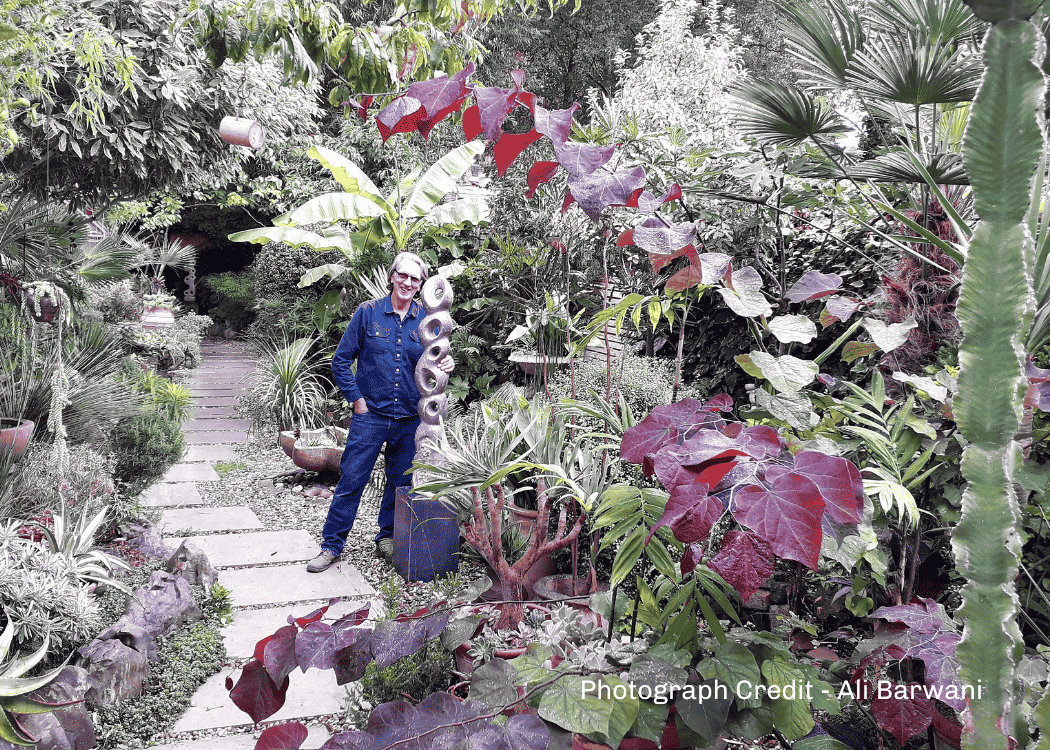
Everywhere I look there is something surprising to discover in this adventurous garden: sculptures, rocks, cacti, spiky aloes, plate-like aeoniums, exotic shrubs, cycads, palms, tree ferns, architectural masonry, and much more. “Where to begin?”, I ask. “Think glaucous and star-bursts”, says Steve, “Mediterranean, spikey, lush, and evergreen. He continues, “Everything may look tender, but around 90 per cent of the plants remain outside all year… only 10 per cent goes undercover over winter”. The garden is an experiment in hardiness, “with this style of planting becoming increasingly at home in Britain all too soon, due to the onslaught of climate change”. In any case, many of the exotic-looking plants are much hardier than you might first suspect. For example, Steve tells me that the aristocratic-looking silver-grey Yucca rostrata I am admiring can survive temperatures as low as -10°C as long as it is given good drainage. He points to the impressive-looking large saguaro cactus, saying that the trick to growing it outdoors in a North London garden with clay just below the surface is to plant it on a mound of bricks, grit, gravel and a modicum of John Innes No.3 potting compost, topped off by heavy rocks – and orient it to the South. I notice his subtle use of repetition as we move along the limestone pathway, for example Pittosporum tenuifolium ‘Silver Sheen’ and the rigid-leaved palm Trachycarpus wagnerianus occur repeatedly in the garden, providing background and rhythm to the other plants. Steve proudly shows me the waxy-silver undersides of the huge leaves of a larger palm, Trachycarpus princeps – a far neater species than the more widely encountered Chusan palm (Trachycarpus fortunei), which gets battered by winds.
I ask Steve about the synergy between sculpting and gardening. He explains that “there is a relationship between shaping plants and carving stone, of course. And my love of geology means the garden is full of interesting pieces of stone, some of which get turned into sculptures.” As Steve declares on his website, “I make stone sculptures (and the odd exotic garden)”. The abstract sculptures in the garden are powerful. It is impossible not to caress their smooth surfaces. And, viewed through the rounded window of a blue-and-beige Ancaster weatherbed limestone sculpture, the garden takes on a dream-like air. One of the plants that draws my eye is the bamboo palm (Chamaedorea microspadix), whose fronds sail on bamboo-like masts. I also admire the quiver tree (Aloidendron dichotomum), a plant I recognise from the Karoo Succulent Garden at this year’s Chelsea Flower Show. Steve informs me that he’d just sold a sculpture and treated himself.
Our progression down the garden is leisurely, with so much to see and talk about. When we finally reach the end, I realise there is more to explore. We pause a moment to admire a rarity, a mature Sichuan pepper tree (Zanthoxylum simulans), whose berries cause a tingling sensation in the mouth as if you had placed your tongue across battery terminals. I can now see that the garden is T-shaped, and to the left are Steve’s outdoor sculpture benches, and to the right is Liz’s domain, the vegetable area. As if on cue, Liz arrives to see how we are getting on – relieved to find that we have managed to get that far. The vegetable area consists of neat, oak, raised beds and a greenhouse. In the warmth of the greenhouse, I admire chillies, peppers and tomatoes that flicker red and orange as flames and feel the heft of one of the last cucumbers of the season. Liz informs me that the harvest has been good this year, and the sun-warm tomato that she plucks and hands me to try is so sweet and flavoursome. I wonder how gardening decisions are made. “Liz runs the fruit and veg area,” Steve informs me, “and I design and have ideas for the main garden,” adding that “Liz has veto, she edits my ideas.” I wonder to myself if this is a continuation of their professional background in publishing. As we head back towards the house, I remember to ask about weeding. “Easy,” replies Steve “I don’t allow them any room”. I also wondered what it is like to open the garden in summer for the National Garden Scheme. Liz tells me in her gentle voice, “It’s a nice thing to do. We have as many as 250 people and everyone seems to have lovely sociable time, chatting over tea and cake.”
Over tea and some delicious sandwiches back in the house, I ask what inspired him to create this botanical fantasy, which when they moved in 15 years ago was a conventional back garden with a central lawn, and an overgrown patch of brambles at the back. “It’s created out of an enthusiasm for the exotic, my love of architectural plants and my lifelong passion for stone.” “Volunteering at Myddelton House Gardens, I particularly enjoyed working with succulents in the old conservatory. I am also grateful for the advice given to me by my friend, the designer Paul Spracklin, the oracle on hardy exotics. Curious, with so many unusual plants to choose from, I wonder which one he is most proud of. Pausing to cogitate, Steve responds with a twinkle in his eyes, “That young cedar of Lebanon tree I planted next to my workbenches. It was a gift from my daughter and could possibly be the finest tree in Crouch End in two thousand years!” Getting ready to depart, I pause, casting a final look around the beautiful garden and only now noticing a tall, branching cactus hiding in plain sight in a display of cacti and succulents all growing in terracotta pots. “That’s the one from Dennis. He and his wife, Brigit, are coming for tea this afternoon and to inspect its new home. Happy ending!”.
Learn more about the garden and Steve’s sculptures: Click Here
View the garden on Gardeners’ World: Click Here
or
Further reading:
Dry Exotic Garden: A Gardener’s Guide to Xeriscaping with Succulents, by Paul Spracklin. 2024, The Crowood Press Ltd. Read Here
‘Taking it to the Limit’ – a story about Steve and Liz’s garden in ‘The Garden’, July issue, 2024, published by the Royal Horticultural Society (RHS).
A visit to Myddelton House Gardens:
National Garden Scheme. Discover private gardens near you that are open under this scheme. The details for next year’s openings are not yet available. https://ngs.org.uk/find-a-garden