Blog
Five Design Tips for a Small Garden


Small spaces are sometimes difficult to get right. And if you’re a beginner it can be a bit daunting to be presented with a blank canvas, or garden that’s been ignored by its previous caretaker, or just a garden that you really don’t like. But with some basic knowhow you can create an outdoor space that you love with ease. We’ve put together some design tips to help you.
Design tip number 1.
Right plant right place
This is the number one gardening adage. First coined by the utterly brilliant gardener and writer Beth Chatto, it’s become the go to gardening advice for its sheer simplicity, wisdom and basic common sense. Beth Chatto was a pioneer, transforming an unused wasteland that had been designated virtually useless for horticulture into a series of gardens. The conditions within the plot vary dramatically from very dry to very wet and each garden is an example of working with nature instead of against it. The gardens are near Colchester and are open to the public. They’re really stunning and well worth a visit: https://www.bethchatto.co.uk/garden-nursery/gallery/
If you’re new to gardening and haven’t heard it before, right plant, right place means, very simply, put your plants in a place they will like and fit. Most of us have at some point been overwhelmed with love and desire for a particular plant when visiting a garden centre and bought it without really thinking about whether it belongs in our gardens. Or we’ve realised that it doesn’t and been unable to resist anyway. Sometimes it works but often this isn’t the case. All plants have evolved to be happy in particular conditions.
Aspect:
This refers to the amount of sun or shade a particular area gets. You can’t force a sun-loving Mediterranean plant to like deep shade, it just won’t do it. You’ll end up with a sickly and poorly performing plant and both you and the plant will be unhappy. You can adapt or get round some potential problems – for example you can add lots of organic matter to make your soil more crumbly, nutritious and better draining – but the one thing you can’t do outdoors is provide sun in a shady area. Unless of course you take drastic action such as taking out your neighbour’s fence or chopping down a tree. Neither of these is necessarily a wise move.
So think about where a plant would grow naturally and work out whether you can provide this. Olive trees, for example, grow on scorching Mediterranean hillsides in full sun, so won’t thank you for planting them somewhere that only gets a few hours of direct sunlight a day. Ferns, on the other hand, tend to grow in woody, shaded cool areas and will quickly burn when exposed to too much sunlight or heat. Fortunately lots of plants like a mixture of sun and shade. You can usually find information about what conditions a plant needs on the back of its label, or feel free to ask one of our staff for help.
Size matters:
Think about the size of your space and don’t be tempted to put something that will grow huge in a small garden. There are two reasons for this:
- a) it will look out of proportion and dominate everything else, and
- b) it may take over, causing problems with other plants and your neighbours, and potentially triggering structural problems to buildings too
So check the height and spread on the back of the plant label. Think about how much work you’re prepared to do to keep things under control and whether that particular plant responds well to regular pruning. That sweet little Eucalyptus with its lovely leaves and bark and divine smell that brings back memories of your Australian trip all those years ago? Most Eucalyptus when planted in the ground shoot up, blocking light, sucking up water and spoiling your view. Likewise that fabulous pink Clematis montana that would cover that ugly wall? It will, but it might also take over really quickly, smothering everything else, unless you keep it under control.
Some big things can be kept in check with work and will still do well. Others just need space to grow and their shape and health will be spoilt if chopped back too much.
Think ahead:
Don’t block the view of your garden by putting a shrub or tree that’s going to get rather bigger than it is now between your window and your garden. Unless of course you’re prepared to intervene in a timely manner later on and move it before it becomes overwhelming. And digging up shrubs and trees can be quite stressful for the plant, especially once it’s well-established. I know it sounds obvious but it’s an easy mistake to make if you’re new to gardening. The tiny bay tree that a friend planted in my garden 20 years ago has grown beyond belief. I didn’t get round to digging it up and transplanting it and now, even with regular pruning, it blocks the view of the right hand side of my garden.
A good general design tip is to put tall things at the back and small things towards the front. Some tall, delicate things though, such as Verbena bonariensis, look good at a sort of halfway point, creating a hazy extra layer or screen through which you can view other plants. If you’re working to a tightish budget however, you’ll probably want to buy small plants and let them grow.
So you have a choice. You can put the plants that are small now but will get big at the back, and accept that they may be a bit hidden for a while. Or you can put them where they look perfect right now and move them later.
Design tip number 2.
Mind the gap
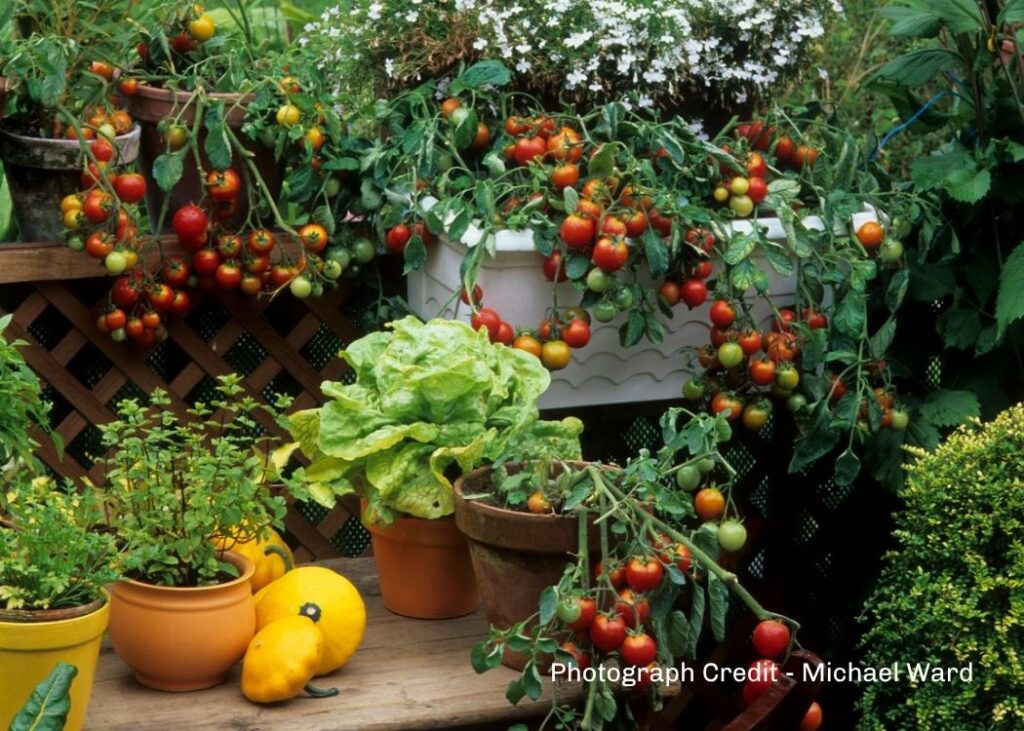
Plants in a small garden or on a balcony need to work hard. If you only have space for a few plants, they all have to multi-task. There’s no room for slackers! Evergreen shrubs and other plants will provide year-round interest and background structure so you’re not left looking at bare patches in winter. Go for plants that have a long flowering period such as geraniums, and/or buy a variety of plants so that you have blooms in every season. Bear in mind too, that we (and all garden centres) stock a lot of things seasonally, so don’t expect to buy all your plants at once.
Design tip number 3.
Extend the space
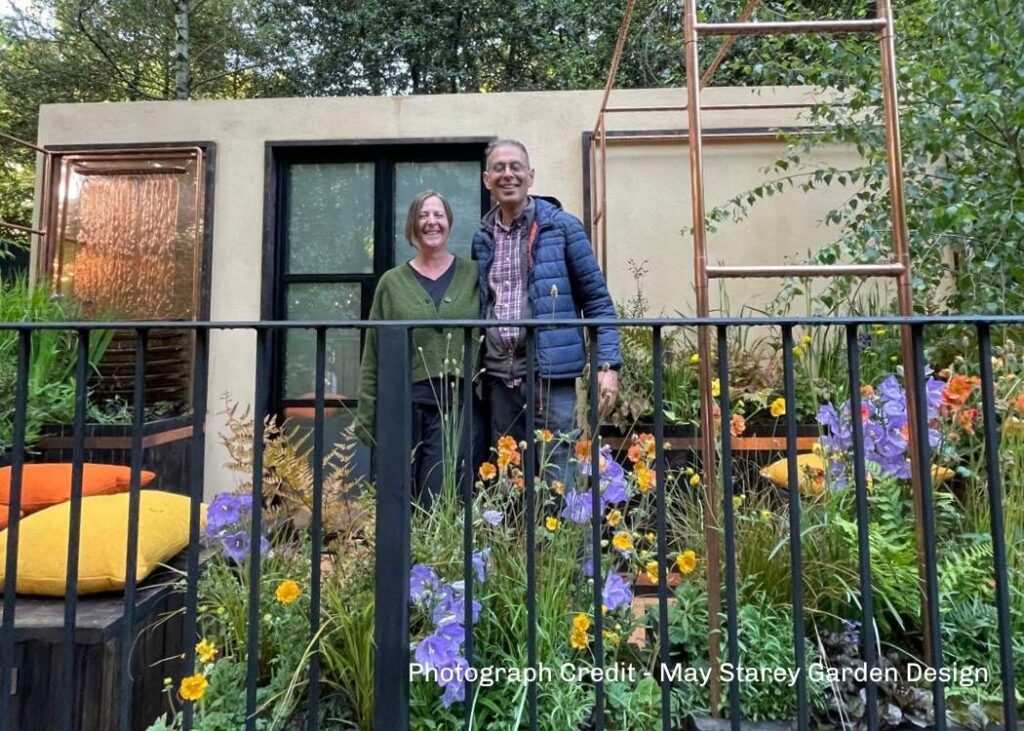
Climbing plants scramble over fences and walls to add height, extend your garden and create privacy. Trailers are great for tumbling over window boxes and pots. Hang pots on walls or fences or perhaps create an outdoor plant shelf using an open ladder with planks placed between the steps and struts.
A small tree, such as the frothy-flowered Amelanchier lamarckii, or a large shrub forms a focal point to draw the eye and gives your garden a dramatic lift.
https://www.gardenersworld.com/plants/20-trees-for-small-gardens/
Try to avoid straight horizontal lines. Diagonal paving or a wavy path will create the effect of a bigger garden.
A mirror can create the illusion that your garden is bigger than it really is.
You can find some good ideas here:
https://www.idealhome.co.uk/garden/garden-ideas/small-garden-ideas-2-174377
Design tip number 4.
Keep it simple
It’s really tempting, when you have a love of plants, to cram in as many different things as possible. (I’ve been guilty of this myself despite my knowledge to the contrary. As so often in life, love trumps rationality and common sense.) But in a small space, this may mean that you end up with one sample of each small plant and actually this can make it look overly busy and unsettling.
It depends what you want from your garden but a restful look is achieved through repetition. This creates a feeling of harmony and a unified whole. It’s a basic principle of design. So one trick is to scatter, for example, a few samples of exactly the same plant, for example Heucheras (such as ‘Lime Marmalade’), or Hebes (such as ‘Silver Queen’) in different places in your garden, to create a repeating pattern and link the space together.
Similarly it’s better to have a few larger pots than lots of small ones. The latter tends to look bitty and can make your garden look smaller.
Design tip number 5.
Use every aspect of your plants – colour, shape and height
Colour:
As humans, we have emotional responses to colour, in our own individual ways. (These emotional responses actually show up in brain imaging and it’s thought that there are complex evolutionary reasons for it.) Colour can be put to good use to create different effects in your outdoor space.
As a basic general rule, ‘cool’ colours – on the blue spectrum – are tranquil and calming. They look good in evening light, and recede, so if you plant them around the edges or at the back they can add a feeling of depth and space to your garden.
‘Hot’ colours – on the red spectrum – are said to be lively and stimulating and look larger and closer. They show up best in full midday sun and also as summer moves towards autumn and the natural light takes on a more yellowish hue.
White and pale colours show up better in a dark space because they reflect more light. So bear this in mind when deciding what to put in dark corners.
And don’t forget foliage colour! Green is said to be cool and restful, perhaps because a verdant landscape bodes well for food production and so for survival. It certainly makes your garden look lush and is also a really important foil for flower colour in the garden. Pinks and reds that would otherwise clash can come together well when separated by swathes of green. And there are many different shades of green and many different colours of foliage. Silver leaved plants, burgundy leaved plants and black leaved plants can all be used to provide contrast and dramatic effect.
Shape:
Whilst it’s good to repeat one or two plants to link your space together, it’s also good to try and get a bit of contrast in. Variety, as well as unity and harmony, is important; a bit like any community really. You can achieve this by placing different shapes next to each other in your garden. So try, for example, the big round leaves of Bergenias with the finer, serrated foliage of Astilbes, or the small, thin leaves of lavenders with the larger, rounder, rough-textured leaves of Geums.
Height:
Try to buy plants that will reach different heights. A garden or window box that has plants that are all on the same level looks a bit flat and boring. You’re aiming for a wave-like, uppy-downy effect.
Keeping an open mind
Gardening is an art as well as a science and gardens are living, growing things that change over time. Planning is helpful and can be really exciting but you can’t plan for everything. Gardens aren’t set in stone. That’s part of their joy. So it’s likely that you’ll have to move plants around as they mature, to allow them to give of their best.
And the unpredictable frequently happens. Sometimes things fail to thrive in the ‘right’ place and do really well where they shouldn’t. This applies not only to things we’ve deliberately planted, but things that self-seed. That shade-loving foxglove, for example, that pops up in the hottest area of the garden and thrives. Those sun-loving oxe-eye daisies that don’t actually get much direct sunlight now that the Pyracantha has grown? Their stems are a bit wavy but actually that looks rather interesting and they’re flowering like crazy. Sometimes nature likes to be left alone to break the rules and do its own thing. I think that some of the most beautiful gardens have grown up organically, forming their own natural and wayward curves.
So read the label and ask for help if you need it. Plan and think ahead, but observe what happens over time too. You’ll discover what you think works well in your garden. It’s one of the best ways to learn.
If you ever want more information on plants, please feel free to use the Capital Gardens Plant Finder here.