Blog
Attracting Beneficial Insects to Your Garden


We all know by now why pollinating insects are so crucial to our own well-being.
The bottom line is that we humans depend on them for our source of fruit as well
as many vegetables and other crops. And it is not just the bees who pollinate.
Hoverflies, small flies, moths and butterflies all feed on nectar, helpfully carrying
pollen from flower to flower as they do so.
Other insects are beneficial too, eating the pests that eat your plants. The UK is
home to more than 600 species of aphids – including greenfly, blackfly and woolly
aphids. Many can give birth to live young without a mate. And each one can produce
up to 80 aphid babies over 25 days. The horror! However, rescue is at hand in the
form of hoverflies, ladybirds and lacewings whose larvae all eat them.
How do I encourage them?
One of the best ways to bring your new plant besties in is to create a nectar café
(or bar).
- Ideally plant your beneficial insect magnets in sunny and sheltered areas.
- If you have room, plant in groups or drifts so that the colour and scent are
easy to detect. - Choose plants so that you have flowers from early spring to late autumn.
- Go for flowers with a simple structure, as they’re the easiest for insects to
feed from. - Remember to provide a night-time feast for moths.
- Use troughs and window boxes, walls and fences and green roofs as well
as the main area of your garden.
Don’t forget to leave an untidy patch. My garden’s only small but there’s a neglected
area in a corner. This provides a hiding place and hibernating site. It’s also a great
excuse for a welcome bit of slothfulness. What you have in there will depend on the
size of your garden and how much maintenance you want to do. It’s a question of
wild versus undisturbed.
Wild patches contain things like nettles and comfrey which you’ll need to keep on top
of if you don’t want them to take over and get on top of you. (Nettles are, in their way,
brilliant and loved by lots of different caterpillars – red admirals, commas, peacocks,
and small tortoiseshell butterflies, as well as several moths including the spectacular
Jersey tiger.)
An undisturbed patch, on the other hand, can just be a few shrubs that you’ve omitted
to cut back, leaving a dark and cosy place in the middle.
Leave seed heads on in winter
Apart from their architectural beauty, lots of seed heads provide handy nooks and
crannies for beneficial insects such as ladybirds, lacewings and others to shelter in
over winter, (as well as providing food for finches and other birds).
Avoid pesticides unless plants are overrun and then use carefully
They will kill off the pests that are snacking on your plants but they’ll kill off the beneficial
insects too. And even the baddies have their place. The sparrows and great tits that visit
my garden are currently shunning the bird feeder in favour of snacking on tastier things
that have taken up residence (although not for long!) on the rose and pyracantha. Many
birds that normally eat seed feed insects to their chicks. In addition, without pesticides
plants will develop some resistance, and if you attract enough insects they’ll tempt in
wildlife that will then eat most of the insects. It’s all part of the great circle of life and
interdependency.
If you don’t want the bother of a lawn (and a lawn consisting of nothing but grass is not
good for insects), a patch of gravel is attractive to butterflies which like to bask in the
warmth provided. You can plant plants through the gravel and wildflowers will self-seed
too. It’s also an easy way to keep unwanted weeds at bay.
Alternatively you could create an insect-friendly lawn:
https://www.nhm.ac.uk/discover/how-to-grow-a-better-lawn-for-wildlife.html
Bee and bug houses
Do what they say on the tin (or wood) and provide homes and resting places for beneficial
insects. They’re particularly useful if you have a balcony or a patch of garden that’s too
small for a deliberately unkempt area, or if you just want your garden to look really neat
and tidy. You’ll find a range of them in our shops.
Ponds
Some hoverflies lay their eggs in ponds. Dragonflies, too, need water to breed. Although
they’re not big predators of insect pests, they do eat gnats and mosquitoes so personally
I’d define them as beneficial. And you don’t need a lot of equipment to build one. Just a
pond base or washing up bowl, some pond liner or plastic sheeting, gravel/stones, and a
couple of small aquatic or marginal plants. But make sure it has a slope or a large stone
on the inside edge so that any larger wildlife you attract along the way can get in and out.
This is a simple guide:
https://www.wildlifetrusts.org/actions/how-create-mini-pond
Which plants are most attractive to beneficial insects
Native plants are the most valuable as they’ve evolved in tandem with native insects.
This mutual support system has created pairings of insects and plants with matching
characteristics. So if you look closely you’ll see that different bees and butterflies have
tongues of different lengths to match flower tubes of different sizes. In the same way,
caterpillars specialise in feeding on one particular species or group of plants. (And how
comforting to find out that this symbiotic evolutionary process is still going on. A recent
study has shown that foxgloves taken to the Americas 200 years ago have evolved to
have bigger flowers to allow pollination by hummingbirds.)
Pollinator-friendly plants have certain characteristics: nectar-rich, single and open
flowers, as well as many-headed, tiny-flowered umbellifers like cow parsley. As a general
rule, more highly bred plants tend to be less attractive to pollinators as many of these
have been chosen to have big or very colourful flowers without the usual amount of
nectar. Wildflowers are perfect; you can buy packs of specially selected seed for different
types of insects at our garden centres. And if you plant flowering herbs as well, you’ll
create a rich environment for both human and insect foraging.
Some plants for butterflies and moths
Butterfly favourites include:
- Buddleia
- Verbena bonariensis
- Veronica
- Heleniums
- Flowering herbs, especially thyme and oregano
Moths are particularly fond of night-scented plants such as:
- Night-scented stocks
- Evening primrose
- Night-scented tobacco plant (Nicotiana alata)
As well as:
- Honeysuckle
- Sweet rocket (Hesperis matronalis)
https://www.sundaygardener.co.uk/plants_for_butterflies.html
https://butterfly-conservation.org/how-you-can-help/get-involved/gardening/gardening-for-moths
To maximise your butterfly and moth population you’ll also need to nurture their
caterpillars. Ah, I hear some of you say, every path has its puddle, every rose has its thorn
(in fact this is no longer true). But although some caterpillars will munch on some of your
plants, actually most of them eat very little. It’s a few greedy species like cabbage whites
that have given all caterpillars a bad rep. And the butterflies and moths will help with
pollination. And hedgehogs, birds and bats will eat some of the caterpillars. The circle
of life again.
Some plants for caterpillars
They will enjoy:
- Galium odoratum (sweet bedstraw) for hummingbird hawk-moths
- Holly and ivy for holly blue butterflies
- Fuschias for elephant hawk-moths
- Hops for comma butterflies
- Ornamental thistles for painted lady butterflies
https://www.gardenersworld.com/plants/caterpillar-food-plants/
Some plants for bees
As is the way with nature, most things have their niche and bees will be active between
February and November according to their species. With our increasingly bonkers
weather you can even see them sucking on cyclamen in December and January. So it’s
important to provide them with food for as much of the year as you can.
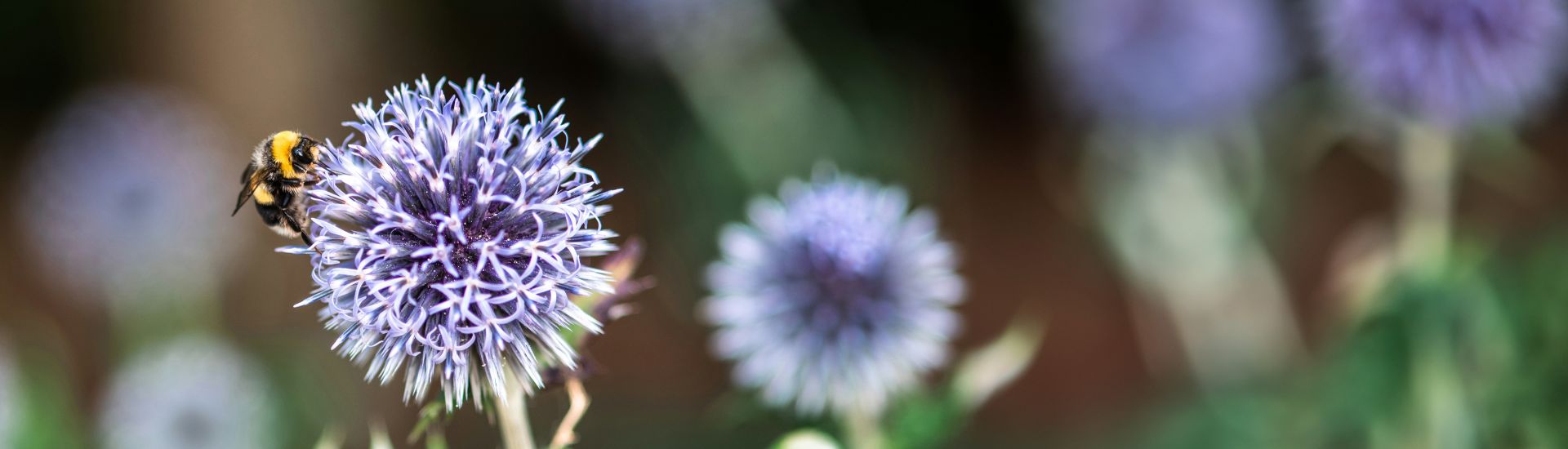
Bees prefer purple flowers and scientists have known for some time that they can see this
colour more clearly than others. However, it’s recently been shown that flowers in the
blue/purple spectrum are more nectar-rich than others. It seems likely that the two are
connected! Butterflies
seem to be keen on purple flowers too, presumably for the same reason. I couldn’t find
any studies, but perhaps they’re less accommodating than bees when it comes to research
https://beemission.com/blogs/news/the-secret-reason-bees-love-blue-and-purple-flowers
Bees can also see patterns on flowers visible only in ultraviolet light which direct them to
the flower’s centre and to the nectar. These are invisible to humans.
https://www.beeculture.com/bees-see-matters/
But these beneficial insects will go for anything suitable, purple or not. And a good basic
rule is that if you can see the pollen in a flower then it’s probably good for bees.
Try some of these:
- Purple flowers like lavender, alliums, catmint and asters
- Foxgloves and other tubular flowers
- Early-flowerers such as crocus, cowslips and other primulas, and rosemary
- Climbers such as passionflower (Passiflora caerulea) and climbing hydrangea
(Hydrangea petiolaris) - Cranesbills (hardy geraniums) and Erysimum Bowles Mauve (a perennial wallflower)
which can be in bloom all summer
You can find a really useful list of suggestions here:
https://www.gardenersworld.com/plants/plants-for-bees/
Hoverflies, lacewings and ladybird
Sweet and friendly hoverflies, beautiful and delicate lacewings and colourful and somehow
comical ladybirds… But it’s their dark side which really helps us gardeners.
- Ladybirds can beat aphids hands down for breeding speed with adults laying 20-50
eggs every 24 hours. Both adults and larvae consume aphids with some of the latter
eating up to 100 a day. They also eat scale insects. To jump start your aphid control
project you can even buy ladybirds and their larvae online. - Lacewing larvae are also voracious predators and a single larva can clear 200 aphids
a week. You can buy these online as well. - There are hundreds of species of hoverfly in the UK and about a third of them have
larvae which work their way through aphid populations with ease.
Earwigs, parasitic wasps and predatory beetles will all feed on aphids too as well as other pests.
Game over.
Some plants for lacewings and hoverflies:
They’ll home in on:
Pyracantha, fennel, rudbeckia, yarrow (achillea), alyssum, knapweed (Centaurea) and cosmos.
Build it and they will come. And watch. Go out into your garden or onto your balcony and
observe who lands on what to feed. You may have some plants already that beneficial insects
love. If not, and if you want to build up your beneficial insect population, we hope our
tips will help.
You can find a longer list of good nectar plants here:
https://www.rhs.org.uk/science/pdf/conservation-and-biodiversity/wildlife/plants-for-pollinators-garden-plants.pdf
Written by Andy Williams