Blog
A Very Berry Christmas

A Very Berry Christmas
By late autumn most flowers have faded but their place has been taken by berries, both in the wild and in the garden. They offer much-needed interest in the run up to Christmas and beyond. As well as the red and white that we associate with the festive season, berries wear coats of many colours including pink, purple, orange and black. Frosted by winter chills they glint and glisten in the low winter light like tiny globes of fruit sorbet. And even on warmer days they spread good cheer like Santa Claus distributing gifts.
Berries for birds
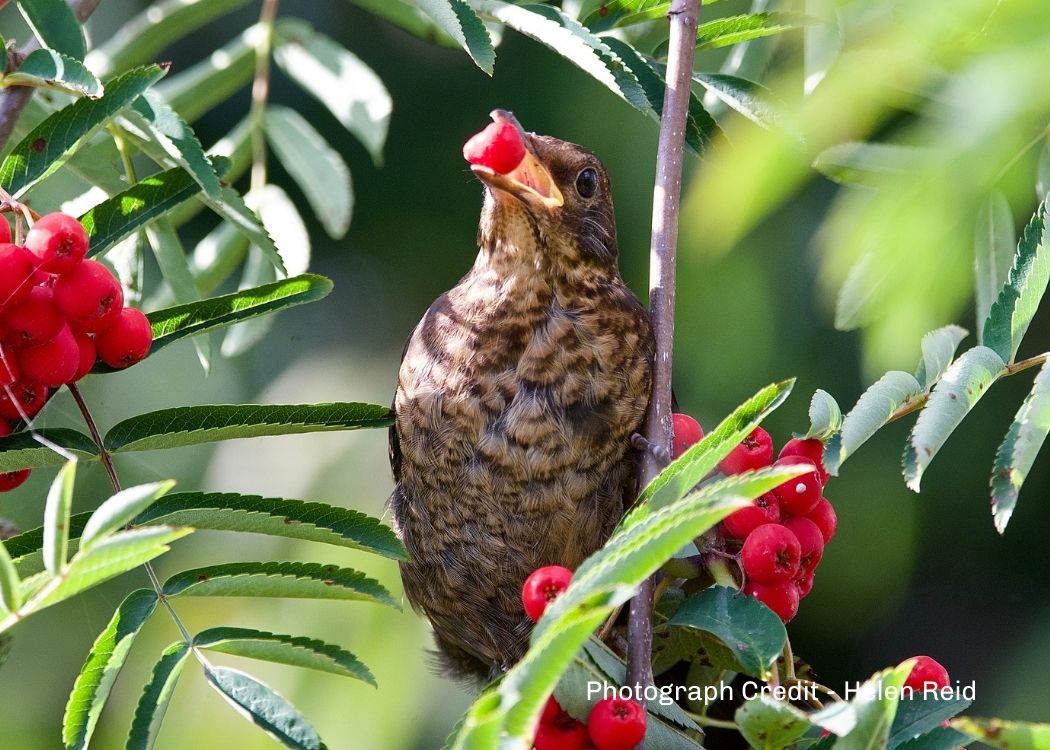
If you’d like berries in the garden why not plant some that birds will appreciate too? They have hearty appetites in winter and need calories by the bucketful to keep warm, yet food is often scarce at this time of year. Berries are high in sugar and fat so are an excellent source of nourishment which many birds rely on. Some are high in antioxidants too, which help birds deal with long periods of high energy use. They’re also a good source of water with a lower freezing point than water itself, providing hydration when other natural sources might be frozen. What nicer Christmas gift could there be than watching them feast on your patch? And it works both ways. These berries are a gift from you to the birds too.
They don’t appeal to all birds. But thrushes and finches, robins and blackbirds as well as winter visitors like fieldfares, redwings and waxwings love them. Woodpigeons, starlings and some warblers will have a nibble and even bluetits won’t say no to the odd holly berry. And like us, birds have their own tastes. Close observers say eating habits vary from year to year in their own gardens. So if you can, plant a variety and see who comes to sample the menu.
Rowan: our native Sorbus aucuparia has scarlet berries but grows up to 15m tall, so may not be the wisest choice for a small garden. However, there are several other, more compact forms with berries in a variety of colours. Sorbus vilmorinii is about half the size with berries that fade from red to white. S. huphensis ‘Pink Pagoda’ has fabulous pink berries which gradually pale to white. Or opt for creamy S. cashmiriana or golden Sorbus ‘Apricot Queen’. Most have fiery autumn foliage too.
Pyracantha: this sturdy all-rounder is evergreen, thrives in part-shade as well as sun and can either be grown as a shrub or trained against a wall. Most have red berries but there are also glowing orange and yellow forms.
Ivy is often seen as the bane of the gardener’s life because of its unfortunate habit of taking over. But the small black berries contain about the same number of calories weight for weight as a bar of chocolate. As well as plenty of sun, ivy needs to be mature to bloom and then produce berries. This can take about 10 years and cutting it back regularly will keep it in its juvenile, non-flowering state. However, if you have plenty of space or a wildlife area in which it can wander fairly freely, the birds will flock in. The good news for those with limited space is that some cultivars, such as Hedera helix ‘Ice Cream’ and ‘Arborescens’ are sold in their adult state but are compact and remain so, while flowering every year in the right conditions.
If you’re planting a hedge, consider going native as several of our hedging plants produce a harvest that your local bird population will be grateful for. Think hawthorns, with masses of white flowers in spring and hanging crimson berries, or the guelder rose, Viburnum opulus, which bears glossy red, jewel-like fruits. Euonymous europaeus, the spindle bush, has psychedelic, candy pink berries which split to reveal orange seeds, and holly, of course strongly associated with Christmas, is an excellent hedging plant, its shiny, spiny evergreen leaves helping to deter intruders both animal and human. Bear in mind that it’s the female hollies that produce the berries – they need a male within about 100 m. All can be planted as stand-alone shrubs or trees too, and wild roses, allowed to twine through, will produce an array of scarlet hips if the spent flowers are left in place. And if you like your hedges simple, even non-native, workaday laurel has black berries that birds love.
Once the hedge is established, reduce the pruning regime if you can. It’s been shown that cutting back even 10cm less than in the previous year can double berry production. https://www.suffolkwildlifetrust.org/news/winter-berries-birds
And as a bonus, several of these plants – pyrancantha, hawthorn, rowan and the guelder rose – also have spring blossom that bees and other pollinators adore.
https://www.bto.org/our-science/projects/gbw/about/background/projects/berries/about-berries/list
Did you know?
Berry interesting facts:
- We think of red as a highly visible colour and it frequently indicates that berries are ripe. However, some are black when ready to eat and dull rather than shiny. You’d think this would make them less easy to spot. But actually, their waxy coating reflects ultraviolet light that birds (like bees) can see. In fact, it’s thought that black fruits, when ripe, contain higher levels of antioxidants than those that are unripe, and that birds are able to understand this from the colour and so are attracted to them.
https://besjournals.onlinelibrary.wiley.com/doi/10.1111/j.1365-2435.2007.01363.x
- Some seeds actually need the abrasion caused by birds’ stomach acids in order to germinate.
- The mistle thrush is named after mistletoe, whose berries is has a passion for.
The only drawback to offering a feast for the birds is that they (the berries) could all be gone by Christmas. So here are some others that they’re generally less keen on but that add oodles of winter interest to the garden.
Callicarpa bodinieri: this gorgeous shrub has royal purple berries clustered along the stems. These appear after the small, lilac flowers. Happy in sun or part-shade, it grows up to 2.5m tall. There’s also a white cultivar, ‘Magical Snowstar’.
Hypericum: a tough shrub with berries in a range of colours including blushing strawberry and dramatic black. Thrives in sun or part-shade.
Nandina domestica: compact evergreen or semi-evergreen shrubs with several cultivars. All produce a profusion of small scarlet berries which follow clusters of white flowers. The young foliage often has bronze tints which become green as they mature and fiery again in autumn. Sun or part-shade.
Cotoneaster: loaded with red berries, these old garden favourites differ considerably in size as there are many varieties. Some are evergreen while others lose their leaves in winter. Whichever one you choose, its white flowers will be a pollinator magnet. It’s worth noting that some are now considered invasive in the wild; you’ll find a list using the link below. There are still plenty to choose from though. C. procumbens ‘Queen of Carpets’, for example, is evergreen and very low growing as the name suggests, so provides useful cover for banks and walls. C. ‘Cornubia’, on the other hand, will become a small, spreading tree up to 6m tall.
https://www.gardenersworld.com/how-to/grow-plants/how-to-grow-cotoneaster/
For pots and window boxes consider skimmias and gaultheria, both evergreen. Skimmias sport red or white berries although many need a male plant nearby to produce their fruits. There are self-fertile varieties however, such as S. japonica subsp. reevsiana or S. japonica ‘Pabella’ – both scarlet. Gaultheria are acid-loving plants so prefer ericaceous compost. Red-berried G. procumbens is self-fertile, while G. mucronata has cultivars with pink or white fruits, but these need pollination.
We may not have all the plants listed here in stock but please ask our staff who’ll be happy to suggest alternatives.
‘Christmas is coming, the goose is getting fat’, according to the nursery rhyme. The berries have plumped up too and make a fine addition to the winter garden.