

Blog
Miss Willmott’s Ghosts.

Miss Willmott’s Ghosts.
Looking out at the garden, through the kitchen window, the shrub roses are still, in mid-October, blooming in the beds. The morning sky is fine, and the low sun is shining on the lawn.
The garden looks tranquil, trouble free. But things are on the turn. By early afternoon, the dark shade that hid in corners and under bushes during summer emerges with preternatural speed and subjugates the garden. Leaves are already changing colour on deciduous trees, shrubs, and climbers. Once storm Babet arrives there will be more leaves on the ground than those remaining on stems and branches. Nature restores herself. Fallen leaves return fertility to the soil, rotting down, ready to feed next year’s growth.
Gusting winds swoop up a murder of crows from a venerable sycamore tree in a neighbour’s garden. The rising black crows scatter like pages torn from a discarded Metro outside a tube station. The dancing birds seem to foretell that it will soon be Halloween.
Modern Halloween requires little imagination.
We are far from the Celtic festival of Samhain when people would light bonfires and wear costumes to keep the ghosts away. Children’s costumes now come from supermarket pegs. Trick-or-treating is an organised affair with parents shepherding offspring around to collect plastic-wrapped sweets in plastic pumpkin buckets from friendly neighbours. But like the velvet shadows that hid away during the sunny months, ghosts are out there biding their time. And who doesn’t love a ghost story at Halloween?
The ghost in my garden.
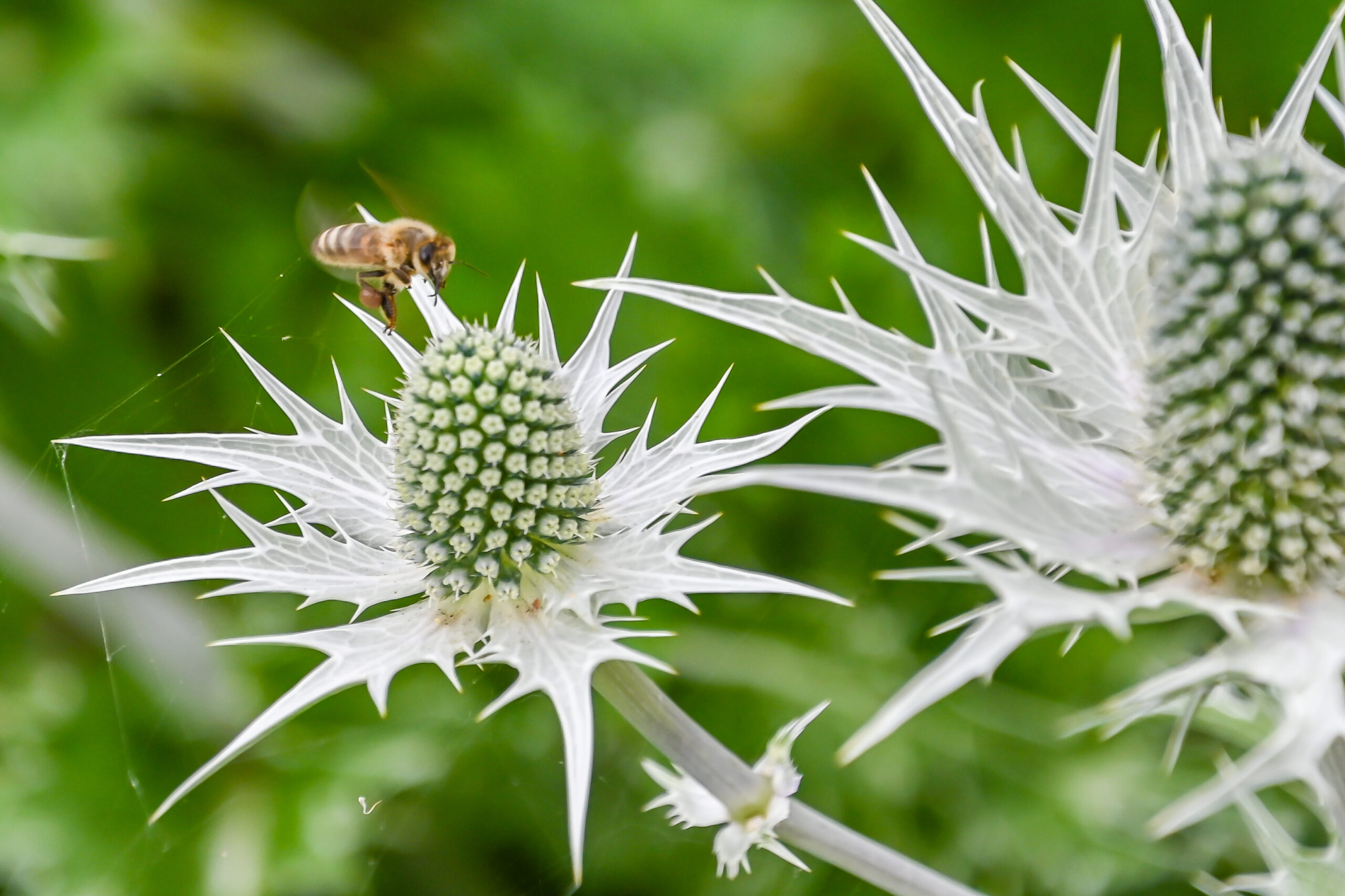
Miss Willmott’s Ghost lurks in a rough corner of my garden. It branches like a candelabra, with many metallic heads all dressed in silvery-white bracts, each resembling an Elizabethan ruff. It was at its peak as July ended. But if moonlight falls on them, the silvery white skeletons remain wonderfully spooky.
This ghost is, of course, a plant. But who was Miss Willmott, and
how did the giant sea holly, Eryngium giganteum come to be known as ‘Miss Willmott’s Ghost’?
Ellen Willmott (1858 – 1934) was an English heiress who became the leading plantswoman of her generation. It is claimed that Miss Willmott grew over 100, 000 different varieties of plants at her estates, the principal one being Warley Place in Essex.
To give you an idea of the scale of her inherited wealth and horticultural ambitions, she employed 104 gardeners at Warley Place. It was claimed that if she spotted even a single weed when walking through her gardens, then the gardener responsible for that bed would be instantly sacked.
At her peak, Ellen Willmott, supported plant-hunting trips to China and the middle east, and created two notable gardens in France and Italy. Over 60 plants have been named after her or her main garden at Warley.
Ellen Willmott became an influential member of the Royal Horticultural Society, joining it in 1894. Miss Willmott and Gertrude Jekyll were the only two women amongst 58 men to be awarded the RHS Victoria Medal of Honour (VMH) in 1897, the year of its institution to mark Queen Victoria’s Diamond Jubilee. Ellen didn’t turn up to collect her prestigious medal, causing a scandal. Some unkind voices said it was because she had a falling out with other members.
Ellen was infamously as prickly as an Eryngium. She certainly regularly upset and alienated influential people. The stories about her behaviour are manifold, and some of them might even be true.
Such was her passion for plants and gardening that later in life Miss Willmott managed to spend most of her vast inheritance. Today Warley Place exists as ruins and is run as a reserve by the Essex Wildlife Trust.
https://www.essexwt.org.uk/nature-reserves/warley-place
What about her ghost?
Miss Willmott’s Ghost is the most famous tale associated with this pioneering and eccentric gardener. The story exists in different forms.
The gist of the tale is that Miss Willmott was a vindictive visitor to other people’s gardens. It was said that she always kept the seeds of this tall spikey thistle in her handbag (together with a pistol and a knuckle duster) and would surreptitiously scatter them around when her hosts were not looking, just to sabotage their horticultural efforts. Others say that her early guerilla gardening was an attempt to add interest to gardens that she felt were boring.
Needless to say, garden owners were surprised to find drifts of this the giant sea holly appearing a couple of years after her visits, and this is how the plant earned its popular name of Miss Willmott’s Ghost.
Miss Willmott has not been treated kindly by history. Her many horticultural achievements and phenomenal plant knowledge have been overlooked in favour of scandalous tales of her unbecoming behaviour and financial profligacy. Much of what has been written about her is either untrue or a distortion of the truth. Her gardens have all vanished, returned to nature. But her ghost remains in the elegant form of sea holly, unofficially known as ‘Miss Willmott’s Ghost’.
Further reading:
To learn more about the obsessive and brilliant Ellen Willmott I highly recommend Sandra Lawrence’s wonderful book, ‘Miss Willmott’s Ghost: the extraordinary life and gardens of a forgotten genius’. Publisher: Manilla.
How to get Miss Willmott’s ghost to visit your garden:
The seeds of Eryngium giganteum ‘Silver Ghost’ are available at your local Capital Gardens.
The seeds can be sown indoors from January to April in trays of seed compost and transplanted to 7.5cm individual pots when big enough to handle. Once acclimatized they can be planted out in the garden where you want them to flower.
The plants are biennials, or short-lived perennials, taking two growing seasons to flower.
Does Ellen Willmott deserve her ‘bad girl’ reputation?
https://www.bbc.co.uk/news/stories-61388646







Love the descriptions in this piece. I love good writing and this was rich and evocative with the sensuality of the garden and nature in autumn .
I’m growing Miss Wilmott’s Ghosts for sure next year. Hadn’t realised they were biennials and the eryngium I used to have disappeared a few years ago. It must have self seeded before that and was hugely missed when it didn’t last year.