Blog
Lawn alternatives: Creating a tapestry lawn

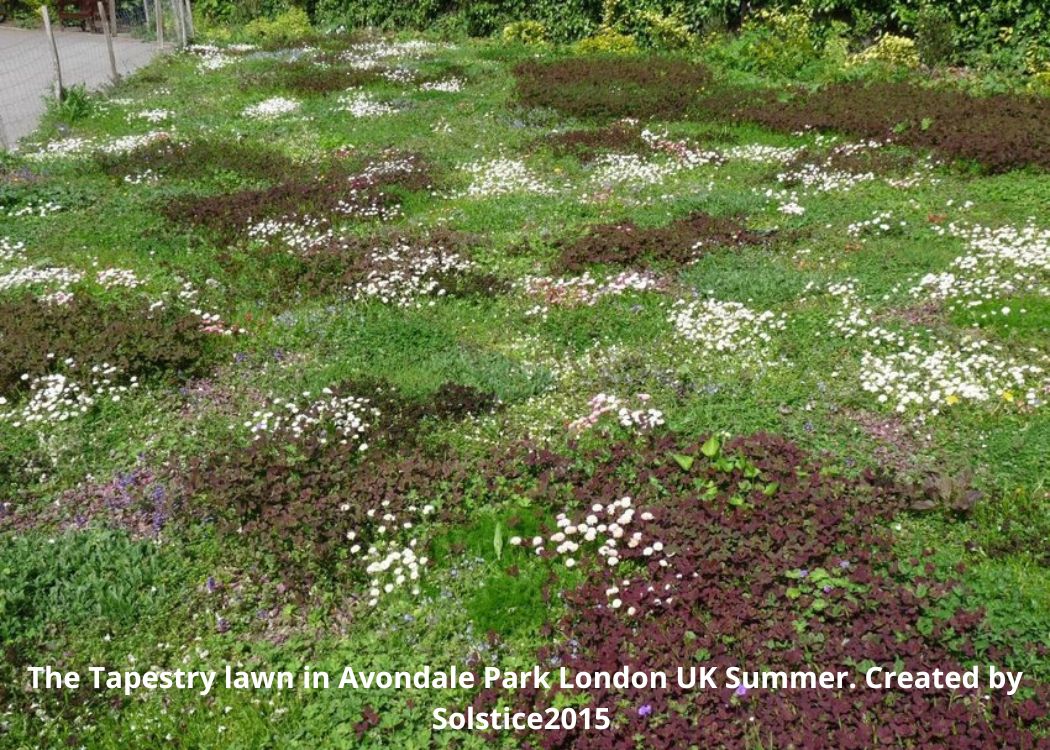
This photograph is licensed under the Creative Commons Attribution-Share Alike 4.0 International license.
A tapestry lawn is something of a contradiction in terms. Consisting entirely of low-growing flowering plants, there’s not a blade of grass to be seen. Imagine looking out on to a vibrant patchwork of colours and textures instead of a plain patch of green and you have some idea of the effect.
Tapestry lawns are not only a winner visually, they also need less maintenance and use less water than traditional lawns and don’t need feeding. They absorb water twice as fast as turf too. So they’re much better able to cope with extreme and changing weather conditions.
A standard lawn is more or less a monoculture (depending on how much time and effort you put in to feeding, weeding, scarifying and other normal maintenance activities.) These ‘green deserts’ look beautiful but there’s really nowhere for pollinators and other insects to live and nothing for them to eat. And let’s face it, they’re hard work!
A tapestry lawn is a biodiverse environment. The presence of flowers rather than just regularly mown grass means a larger habitat and more food for insect life. And using the right combination of plants means you can extend nectar and pollen availability over a long season. This will encourage birds which feed on the insects as well as amphibians like frogs and toads which may be in the area – they’ll love the hiding places. You may even attract a (sadly critically endangered) hedgehog; insects and other invertebrates are their staple diet.
It’s also a good alternative if you have very dry or very wet areas within your lawn – this can lead to patchy grass which isn’t necessarily the best look! A tapestry lawn gives you the option of tailoring your plants to suit different conditions.
And yes, you can still walk on it! In fact, depending on what you decide to plant, a stroll on the tapestry lawn – especially if you do it barefoot – can be an intensely sensory experience as the heady scents of chamomile, thyme and mint waft into your nostrils. These lawns will tolerate light wear and tear and although they won’t survive regular games of football, they should recover if one takes place occasionally.
The first public tapestry lawn opened in summer 2013 in Avondale Park, West London. It’s the result of four years of research by Lionel Smith at Reading University. You can watch Dr Smith talking about his project and see the stunning results here. It really is dazzling.
https://www.bbc.co.uk/news/av/science-environment-22846419
What plants should I use?
A mixture of plants, including those that provide evergreen ground cover as well as flowers, should ensure you have year-round interest. The plant mix you use, and what will establish well, depends on the aspect (sun or shade) and the soil. Dr Smith recommends starting with native plants, such as yarrow (Achillea millefolium), yellow-flowered creeping Jenny (Lysimachia nummularia), white clover (Trifolium repens) and self-heal (Prunella vulgaris) with its tiny deep purple flowers. Feathery-leaved brass buttons (Leptinella squalida) and blue oxalis (Parochetus communis), although not native to the UK, are also recommended. Wild violets and pink clover should work well too.
You could also try:
For evergreen ground cover: creeping buttercup (Ranunculus repens) and lawn lobelia (Pratia angulata).
For a range of foliage colours: cultivars such as Ajuga repens ‘Artropurpurea’ (bronze leaves) and ‘Black Scallop’ (dark chocolate leaves) or golden creeping Jenny.
For aromatic leaves: lawn chamomile (Chamaemelum nobile), creeping thymes such as the glorious lilac-flowered Thymus serpyllum and Corsican mint (Mentha requienii).
You can buy plug or larger plants or – depending on which plants you choose – have a go at sowing your own seeds in autumn for planting out in spring. Sometimes it’s a question of experimenting and seeing what works in the area you have in mind (or even different parts of it).
https://www.gardenersworld.com/how-to/grow-plants/how-to-sow-fresh-seed-in-autumn/
Tapestry lawn tips:
- If it’s a small area, a smaller variety of plants will make it look less bitty. Similarly you may want to plant in groups of three or more of the same plant.
- Try to ensure that most, if not all, of the plants you use are evergreen; this will help avoid disappointing bare patches in winter.
How do I plant my tapestry lawn?
First prepare the ground well. Preparation is key to giving your plants a good start and helping them to thrive.
If you’re planting on an area that’s already grassed :
- Remove the existing turf, slicing under it with a spade
- Clear any remaining bits of root that you can see
- Dig or fork it over to a depth of approximately 15cm (6 ins), removing any stones, roots or twigs
- If your soil is heavy clay or very sandy add a layer of good quality topsoil at least 15cm (6 ins) deep
- Rake it level
On an unturfed area:
- Remove any existing plants
Then follow steps 2-5 above.
Now it’s time for the most exciting bit – the planting! You’re aiming for an informal, natural look. Place the plants before you put them in the ground to give you an idea of what the final effect will be.
Maintenance
These small perennial plants don’t object to the mower, and indeed your lawn needs it to maintain the balance of plants. But it only has to be cut about three to five times a year, once it reaches 12-15cm (5 or 6 ins) high. (‘…when you put your foot in it and it disappears,’ suggests Dr Smith.) This minimalist routine also helps wildlife as many insects and their eggs are removed or killed in the mowing process.
Put the mower on a high setting – about 8 to 10cm (3.5-4 ins). You’ll lose some flowers, but they’ll grow back quickly. A trim helps the lower-growing plants such as Corsican mint get enough light and stops them being out-competed by the slightly taller ones such as ajuga.
It’s best to remove the clippings to stop them from rotting. Pull out any grass seedlings as they appear.
More beautiful, some would say, than a traditional lawn, a tapestry lawn is also better for the planet. And once established it liberates you from the palaver of all that maintenance, leaving you with more time to sit and enjoy a picnic with your loved ones or loll about on it with a book inhaling its life-affirming aromas.
If you are looking for a particular plant or would like to know more about any of the plants above, why not visit our Plant Finder