Blog
Buying and caring for your Christmas tree

Buying and caring for your Christmas tree
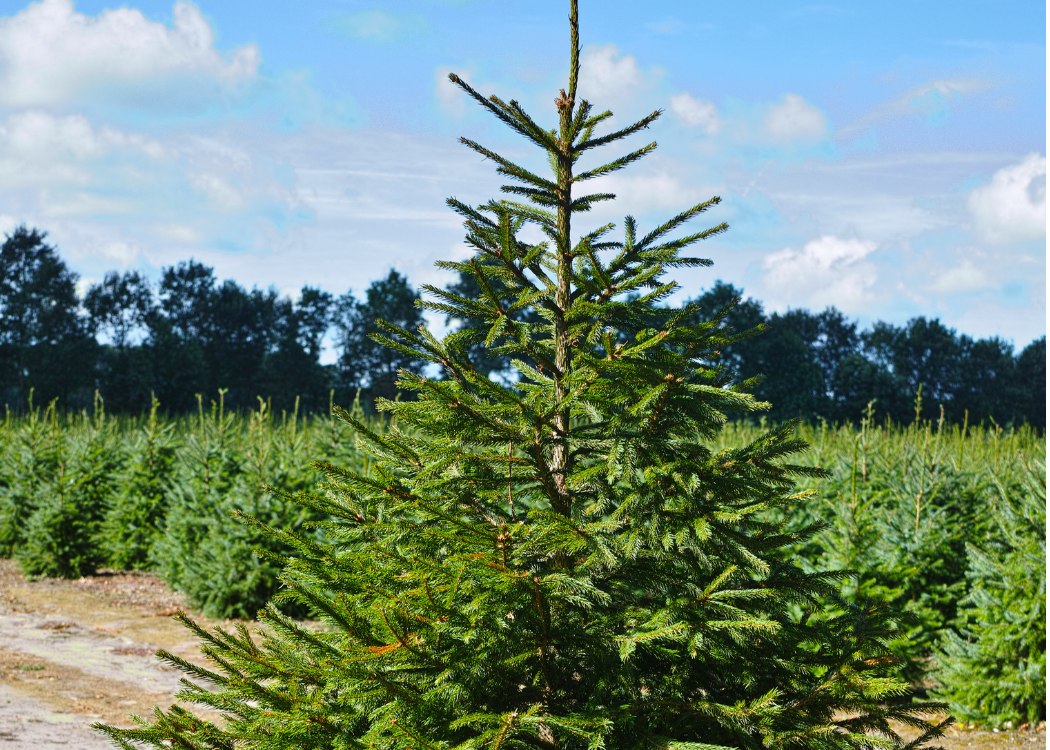
Early or mid-December is the time to buy your Christmas tree if you haven’t already done so. Tempting though it is to rush in enthusiastically and bag one as soon as they arrive, your tree (depending on what you buy) may have passed its peak by the turn of the year if you bought it at the end of November. It’s actually better to leave it until a bit later if you can contain your excitement!
We usually stock several different species of trees, each with their own characteristics. Firs, for example, will keep their needles more readily than spruces but are often less aromatic. All our cut trees are UK-grown so haven’t travelled far, although some of those that are pot grown come from the continent. But their origins are global.
Our 2021 Christmas trees
Nordmann Fir:
From the Caucasus mountains where Europe and Asia meet, Nordmanns are really rather magnificent and hold onto their needles well. Their scent is only faint, but the flexible, shiny needles are slightly rounded at the ends and dark green on top with silvery undersides. Fuller and wider at the bottom than other trees, they take up a bit more space. The most expensive of the trees we stock but worth it for the impact if it’s within your budget.
Fraser Fir:
From Canada and the northern USA, Frasers have softish needles with rounded ends. These are a brighter green than those of a Nordmann but slightly shorter, which gives each branch a thinner, more compact look. However, the trees themselves are slightly narrower at the bottom so work well in a smaller space. With good needle retention, their strong, pine -like scent is also reminiscent of pineapples and oranges. Although occasionally slightly in uneven shape, this adds to their character and individuality.
Blue Spruce:
Hailing from the Rocky Mountains in the western USA, Blue Spruces are distinguished by their silvery-bluish foliage, the colour of which varies from tree to tree. They’re quite prickly so may not be the best choice if you have young children. But in a way, this could be useful in teaching young children to be wary of plants. However, they do have a sweet, fresh pine scent as compensation for what at first appears to be a mildly unwelcoming attitude to humans! They keep their needles reasonably well in the right conditions, although less reliably so than Nordmanns and Frasers.
Omorika Spruce:
From Serbia and Eastern Bosnia. Another species with a relatively narrow base, the foliage of Omorika Spruces is greeny-blue with festive silvery tones. With their longer, slightly sharper needles, they’re spikier than Frasers and Nordmanns. Their well-spaced, slender branches are easy to decorate, but they’re more flexible than some other trees, so may bow under the weight of heavy decorations. If you’re a minimalist though, this is the tree for you. Their needles will drop more than those of the firs, but they have a fresh, pine-like scent.
Choosing and caring for your tree
Our helpful staff will guide you through your purchase but here are some tips:
Signs of a healthy tree
Look for flexible, green needles and branches. These indicate that a tree has a good moisture content. Browning needles on the outside branches are a sign of dryness. It’s best to avoid trees with this tell-tale symptom. Some of the old needles further in may have a few brown needles but this isn’t necessarily a problem.
Try tapping the cut end on the ground, giving the tree a gentle shake, or carefully pulling your hand through a branch (or ask one of our staff to do this for you). The old, brown needles on the inside of the tree and a few of the green ones may come off but this is to be expected. If, however, you get a positive cascade of green needles, move on to another tree.
Care
It’s important to look after your purchase so that it stays green and full for a good length of time. Then you won’t end up frantically hoovering around it when you should be basting the turkey. Or making your children do it (the hoovering) because they were up and shouting outside your bedroom at 5am despite strict instructions NOT TO DISTURB YOU UNTIL 6!! Your tree’s natural environment at this time of year is outside with nice fresh, cold air. While we like a warm and cosy atmosphere in winter, your tree doesn’t. It’s a bit of a shock for it to go from outside to inside, so minimise the impact and lengthen its life by keeping it as cool as possible. If you buy early then ideally keep it outdoors for as long as you can. It can always be decorated to add a cheerful touch to your porch or garden.
Once indoors, don’t keep it near the radiator or other heat source. Central heating in particular dries out the air. The hotter the environment, the more water will evaporate from your tree’s needles and that’s what you’re trying to avoid.
Christmas trees are grown and harvested in different ways and this, along with the type of tree you buy, will affect their durability.
Cut trees:
Your tree will last longer if you saw half an inch off the bottom of the trunk. This gets rid of any dried sap on the end and means your tree can drink the water you provide more easily so it stays fresh through the Christmas period. You can either do this yourself when you get home or one of our staff may be able to do it for you when you buy. Only do this if you are going to put the tree in a stand containing water.
(Top tree tip: If you buy your tree early but don’t want to put it inside yet, keep it outside in a bucket of water.)
Cut trees are thirsty beings, so treat yourself to a good stand with a decent-sized well. Check the well every day and top it up when you need to. Some trees can drink 2 or 3 pints a day, especially if you keep your home really toasty.
Potted trees:
These have been grown in the ground, lifted when they reach a certain size and replanted in a pot. They’re unlikely to last from year to year as some of their roots will have been cut when they were taken out of the ground.
Check the compost regularly and water when necessary; keep the compost damp but don’t drown it.
Container-grown trees:
These have been planted in their containers as seedlings and grown on to their present size. This means they have full root systems to take up water. Again, keep the compost damp but don’t let it become waterlogged.
Container-grown trees last longer than cut and potted trees and if you plant them out after Christmas and care for them correctly you have a good chance of being able to keep them going for a few years. So the good news is that they’re much more sustainable. They can be a bit more expensive but with the right care you should get a few years of tree instead of just one.
https://www.gardenersworld.com/how-to/grow-plants/how-to-look-after-your-christmas-tree/
So how did we get here? There is, of course, a host of tales relating the origin of these Christmas icons. Tree worship was common in Europe during pre-Christian times and evergreen trees especially were symbolic of fertility and immortality in many ancient cultures. The life cycle of a deciduous tree, losing its leaves in autumn and winter, is said to have been associated with the human cycle of life and death. The evergreen stood out because of its ability to hold its needles all year and became a symbol of vitality and magic. So both the Romans and Scandinavians used evergreen trees, wreaths and garlands to represent eternal life.
And the tinsel, lights and baubles? Originally more German than sauerkraut and bratwurst, the joyous but health and safety-free practice of lighting candles on trees packed full of highly flammable resin began in the 17th century. But peasants in western Germany are said to have begun decorating trees a century earlier. This was to celebrate the Feast of Adam and Eve which took place on 24th December. The trees were adorned with apples which were later replaced with the other shiny, round objects that we use today.
https://www.britannica.com/plant/Christmas-tree
https://www.nationalgeographic.com/travel/article/christmas-tree-customs
And of course, a tree is not just for Christmas. Even if it won’t live to see another year, it can be put to good use when the festivities have ended. We’ll be giving you some ideas at the beginning of January.
To end on a botanical note: if you’re going for a walk into coniferous woods, the difference between a Spruce and a Fir is that cones hang downwards on a Spruce and stand upright on a Fir. Easy for children to grasp and fun spotting the cones.