

Blog
Kew Orchid Festival, A Celebration of Peru

Kew Orchid Festival, A Celebration of Peru
Arriving early is not always a good idea. With time to kill I’d wandered off to photograph the Great Pagoda and quickly lost track of time. Looking at my phone left me confounded. Suddenly I became a jogger loping towards the Princess of Wales Conservatory, the glassy labyrinth where Kew hosts its annual orchid festival. This year the focus is on Peru. Reviewing the festival was the purpose of my visit, and I had already become distracted. Out of breath, I joined the queue for my ticketed time slot. Success! I was still within my allotted half-an-hour window. And before long I noticed that the front of the line had started moving. Shuffling feet under a lead-grey sky made me feel as if I was caught up in one of Dante’s circles, where we might continue our perambulation without ever achieving our objective. However, the staff and volunteers were friendly and efficient. E-tickets were scanned, bags checked, and we were ready to enter. According to the lady counting us in, the maximum visitor capacity in the house at any one time is 400 people, although she said it had never reached that high during any of her shifts.
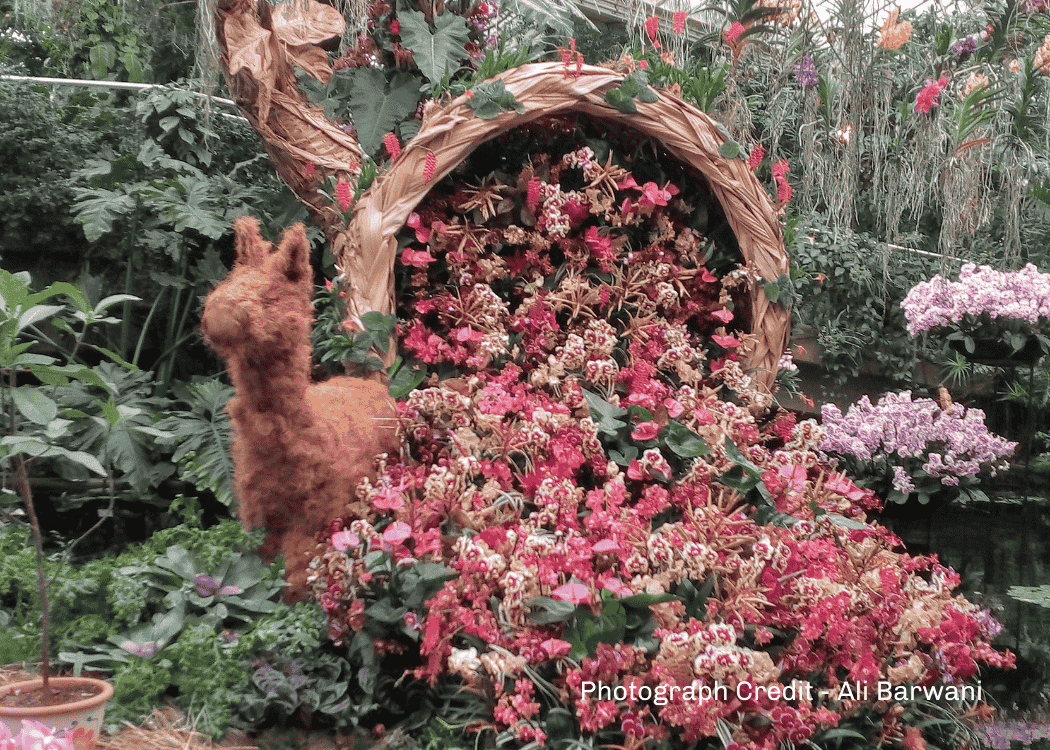
The vestibule was congested, the freedom to proceed appeared bewildering to many. Progress stopped. In the entrance is a model alpaca garlanded with colourful hybrid orchids. It is kitsch, like those souvenir donkeys holiday makers used to return with from package tours to Spain in the 1960s. Not my cup of tea. However, it obviously appeals to children and those with a passing interest in novelty floristry, as this seemed to be the cause of the delay. A bit further on, one floral installation did pique my interest. It was a figure of a paramotorist, floating as if coming in for landing. Paramotorists have a small engine strapped to their backs powering a large rotor blade that helps them buzz around as they hang suspended from a paraglider. What is its relevance to the exhibition? I was beginning to feel intrigued.
The orchid festival works on two main levels. On the one hand it is a series of spectacular floral displays designed to wow the punters, but on the other hand it leads you into the important work of botanists and conservationists documenting the floral diversity of Peru. The final component of the Peruvian microcosm is a celebration of Peruvian art and culture. This is represented by several large works by the celebrated Peruvian fashion and portrait photographer Mariano Vivanco and complemented by vivid murals and pottery created by the Lima-born artist Gisella Stapleton.
If you are interested in learning more about the plants, then you need to keep your eyes peeled for the Peruvian rarities scattered around the exhibition. These plants are not always spectacular or obvious, but they can be identified by a small wooden name label bearing the scientific name of the plant, its local name, the plant family it belongs to, and its country of origin. For example, in the desert zone, as you enter you will find a juvenile specimen of the world’s largest bromeliad, Puya raimondii (commonly known as the queen of the Andes). Later, you will encounter giant floral sculptures of this rare plant created out of masses of fruiting
pineapple plants and white moth orchids. All jolly fun, and Instagram worthy, but I am certain most people walked straight past the real specimen without giving it a second glance. Another plant worth looking at in the desert area is Browningia hertlingiana, or the blue cereus. This cactus comes from the slopes of the dry forests of the Andean valleys. where it can grow as tall as 8 metres.
Leaving the desert climate zone via another set of double doors you enter a second pinch point. My tip is to politely scriggle through, or you will end up stationary for no good reason. We are now in a different ecosystem. The air is buoyant, there are massive tropical leaves and bright colours, and the sound of running water. I am instantly won over by the floral spectacle floating on a grass island on the central pond. It is a giant woven cornucopia overflowing with orchids, bromeliads, anthuriums and colourful tropical foliage plants. These plants aren’t rare, we stock most of them in our houseplant departments, but they are present in such abundance, and are so well displayed, that you cannot help but be impressed. The theatrical cornucopia installation was inspired by the scenery of Lake Titicaca straddling the border between Peru and Bolivia (said to be the birthplace of the Incas). The lake theme is continued with a flamboyance of pink flamingos with bodies created from the pinkest phalaenopsis orchids you have ever seen. Looking carefully along the pool path you will spot a labelled specimen of Geogenanthus ciliates from the lush rainforests of northern Peru. Last year I sourced a few of these rare houseplants for our customers at our Alexandra Palace Garden Centre branch, so it is always worth popping in to see what is new in stock.
In another display you encounter an orchid aviary that reflects the diverse bird populations of the region. And elsewhere, you walk under a starry night sky created from dried allium seed heads saved from last year’s outdoor garden displays. This clever idea didn’t work for me. Most people don’t look up, so wandered by without seeing them. And for those that did, the allium heads did not stand out enough against the grey sky. I suspect it would look better against a blue sky. One final breath-taking floral installation you mustn’t miss is the model of a baby whale shark, standing for the leviathans that inhabit the waters of the northern coast of Peru. Shafts of sunlight penetrating the ocean are represented by pools of white orchids, and the effect is haunting.
For me the most interesting part of this year’s orchid festival is the film showcasing the work of Kew botanists, Huarango Nature conservationists, and paramotorists. Together, they are surveying rare plants in the fragile and inaccessible coastal fog deserts of Peru, known as lomas. Much of this area has never been explored before, making the work of the team crucial in documenting and preserving the unique flora and fauna of the region. The significance of the paramotorist sculpture now becomes apparent. It is a much more environmentally friendly way of travelling around compared to driving an off-road vehicle. Paramotorists can cover great distances in a short time and return with botanical specimens and aerial photographs of the vegetation without causing significant damage to these delicate habitats.
Leaving the Princess of Wales Conservatory I stood in the cold feeling the wind. Seeing with fresh eyes what I had missed before entering the building, the swollen buds on the leafless trees and shrubs, lichen plump from the rain, hearing pigeons, robins and coal tits call. I was refreshed and ready to walk back to Kew Station and join the weary commuters heading home.
In conclusion, the Kew Orchid Festival celebrating Peru is a must-visit event for anyone who appreciates the beauty of nature and the importance of conservation. The exhibition is set to
close on March 2nd, so book your tickets online and hurry to visit Kew Gardens to immerse yourself in a world of colour, creativity, and scientific discovery!
Further details https://www.kew.org/kew-gardens/whats-on/kew-orchid-festival
Other things to see at Kew: https://www.capitalgardens.co.uk/blog/exploring-the-new-winter-garden-at-kew/






Fascinating and absorbing. I am still looking through a list of things mentioned. A perfect diversion.