Blog
Clematis viticella – the ‘Virgin’s Bower’.


Ali Barwani takes a look at Clematis viticella, a large group of easy to grow late-summer clematis. It may be past high summer, and we have recently had plenty of wet weather, but these floriferous climbers are ready to inject vibrant colour into the garden right now.
Clematis viticella – the ‘Virgin’s Bower’.
The birds are singing in the trees as Jeremy, one of our plant-area assistants, is kneeling and scraping away at the grasses growing in the brickwork paths at Capital Gardens’ Alexandra Palace Garden Centre. His hands reach under a display table to tug at a clump of weeds rooted in the gravel, but rain has made the foliage slippery, and the leaves tear raggedly rather than coming out entire with roots.
‘Hey Ali! Are you coming to help me?’, he asks.
‘Not now,’ I reply. ‘I’ve got to look for something to write about for this week’s blog.’
Feeling a bit sheepish, I don’t tell him that I’m glad I have been given this writing task to do today. I move quietly on.
Walking through the climbing plants section I pause to admire the stunning flowers of Clematis ‘Etoile Violette’. This late-summer variety is covered in masses of deep purple flowers. Its purple petals (botanically, sepals) are enhanced by a central boss of cream stamens – adding depth. Next to it is Clematis ‘Madame Julia Correvon’. This reliable performer has velvety petals of richest red with a central eye of beguiling yellow stamens.
These two climbers are members of the Clematis viticella group. They have smaller flowers than the blowsy, plate-like spring and summer flowering hybrids, and they flower profusely in summer and into autumn. I now know what I will write about today.
In the wild.
The wild species, Clematis viticella, is native to southern Europe and eastwards into Greece and Iran. It is a vigorous plant producing nodding, purple-blue flowers in late summer.
C.viticella has been cultivated in British gardens since its introduction in the mid-16th century. The herbalist John Gerard recorded it flourishing in his garden in Holborn, London, in 1597. It was quickly given the name ‘Virgin’s Bower’ in honour of Queen Elizabeth I.
The wild form of C. viticella is not widely grown in gardens nowadays, but it has been extensively used for breeding numerous hybrids carrying its hardiness and late-flowering habit. Together, all these hybrids and cultivars make up the Viticella Group.
What makes a Viticella Group clematis?
Clematis cultivars are divided into 15 groups. These groupings are based on the plant’s heritage and appearance.
https://www.rhs.org.uk/plants/pdfs/plant-register-supplements/clematis/4th-clematis-supplement.pdf
Simply put, Viticella Group members are hybrids with at least one parent mainly derived from Clematis viticella. Their leaves are finely divided, and they produce dainty flowers on the current year’s growth in summer and late autumn. They are hardy and will do okay in shade – although flowers will be produced more profusely in a sunny situation.
The flowers can be single (with 4 or 6 sepals), semi-double or double. They come in a range of colours that includes purple, mauve, red, pink, blue and white – with all shades in between.
Many of the most popular C. viticella hybrids today were raised over a century ago. In particular, those created by two French nurserymen, Francisque Morel and Victor Lemoine. Clematis ‘Madame Julia Correvon’ is one of the hybrids created by M. Morel, introduced in 1900. And Clematis ’Etoile Violette’ was raised by M. Morel in 1912.
If you want a larger flowered viticella hybrid then look for ‘Polish Spirit’, which has large, rich purple-blue flowers. This was raised by a monk, Brother Stefan, in Poland in 1989.
With so many beautiful Viticella hybrids to choose from it is difficult to pick a favourite. Mine is probably Clematis ‘Minuet’, a small flowered, tow-tone variety with sepals that are mauve on the edges and white inside, with a central corona of green stamens.
Do Viticella hybrids make good garden plants?
Unlike some clematis types, they are generally trouble free and easy to grow. They are free-flowering and require no dead-heading. They perform well and consistently, year after year.
Viticella Group are adaptable to different garden uses. They can be grown on their own up a trellis or support. It is possible to grow them in large containers, although they will do better planted in the ground.
Viticella hybrids look fabulous when they are in flower, but remember, for half of the year there won’t be much to see. Luckily, they are good mixers.
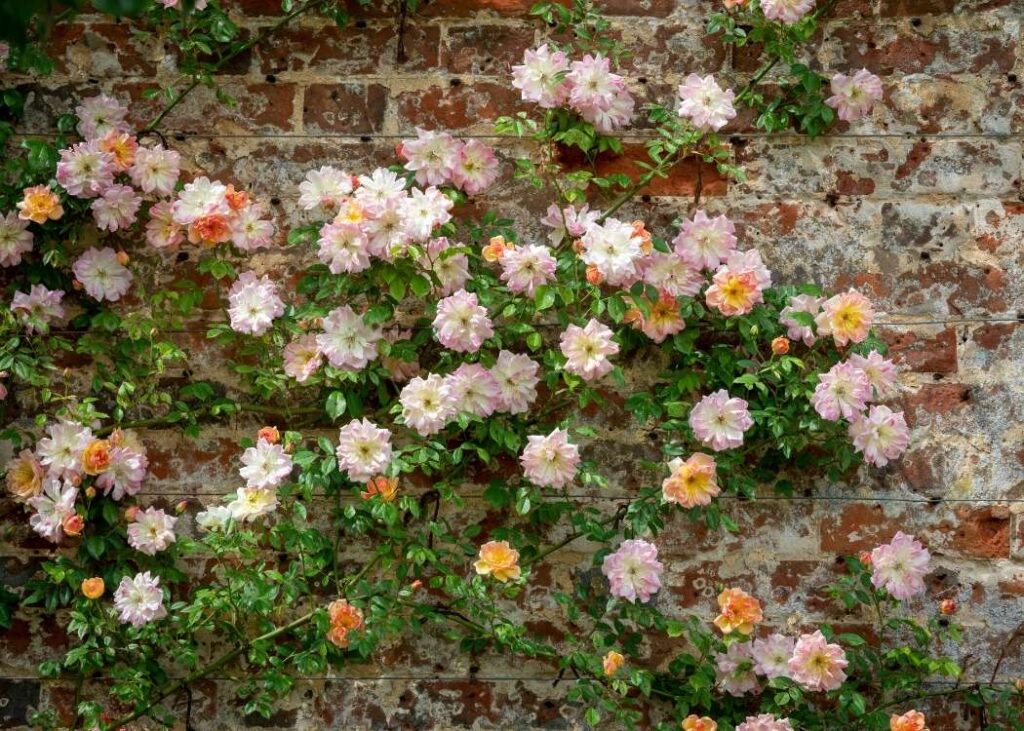
C.viticella hybrids thrive growing through a living support such as a tree or large shrub. They also enjoy scrambling through sturdy climbers such as a rambling rose, Solanum crispum, or wisteria.
Depending on the plant partner selected, they can be used to achieve different design goals.
For example, Viticellas can add summer interest to a spring flowering shrub such as Lilac or Forsythia that would otherwise remain a boring green mound in summer.
Alternatively, they can add extra pizzazz to a flowering shrub. Try growing it through a Buddleia or Lavatera, knowing that both plants will flower at the same time the combination will be sensational!
A similar complement can be achieved by growing them through shrubs with fabulous foliage, for example rambling in a pollarded Catalpa or purple-leaved Cotinus coggygria ‘Royal Purple’.
Pests and diseases. Viticella hybrids are generally trouble free to grow, making them ideal for beginning gardeners. They are highly resistant to clematis wilt, and less susceptible to fungal attack from mildew than the larger flowered varieties.
Pruning advice.
Viticella group belong to pruning group 3, where dead stems can be cut back after flowering. To keep your viticella compact, prune hard to around 30 cm from the ground after the last flowers have finished in autumn but before the first signs of new growth in spring. If you want them to trail higher, through a tree, hedge, or tall shrub, then just prune them back to around chest height in early spring.
https://www.rhs.org.uk/plants/clematis/pruning-guide
In conclusion.
If you are looking to add colour to you garden to extend the summer then these climbers will do the job, producing masses of flowers. If you are new to gardening, or a clematis novice – then the viticella group are excellent plants to start with. They are also perfect for enthusiasts who want to expand their collection.
Further reading.
Some climbers to plant for flowers in spring.
https://www.capitalgardens.co.uk/blog/scented-spring-climbers/