

Blog
Scented Spring Climbers

Every garden needs its spring-flowering scented climbers. Why? Because they add early interest, delicious perfume, and provide height and privacy without occupying much space on the ground. Climbers are very important if your garden is small; then, the only way is up!
Where Should I Plant Them?
Choose a location where you are likely to linger or pass-by and catch their rich scent such as a doorway, path or seating area. Climbers are also great for softening walls and clothing arches, pergolas and trellis.
To learn about how to provide support for climbing plants click on the link:
https://www.gardenersworld.com/plants/tips-for-training-climbing-plants/
The Plants.
Climbers that carry scented flowers in spring offer great garden value. Fragrant flowers are also an important food source for foraging bumble bees and other early pollinators.
We have chosen six of our favourites to discuss below:
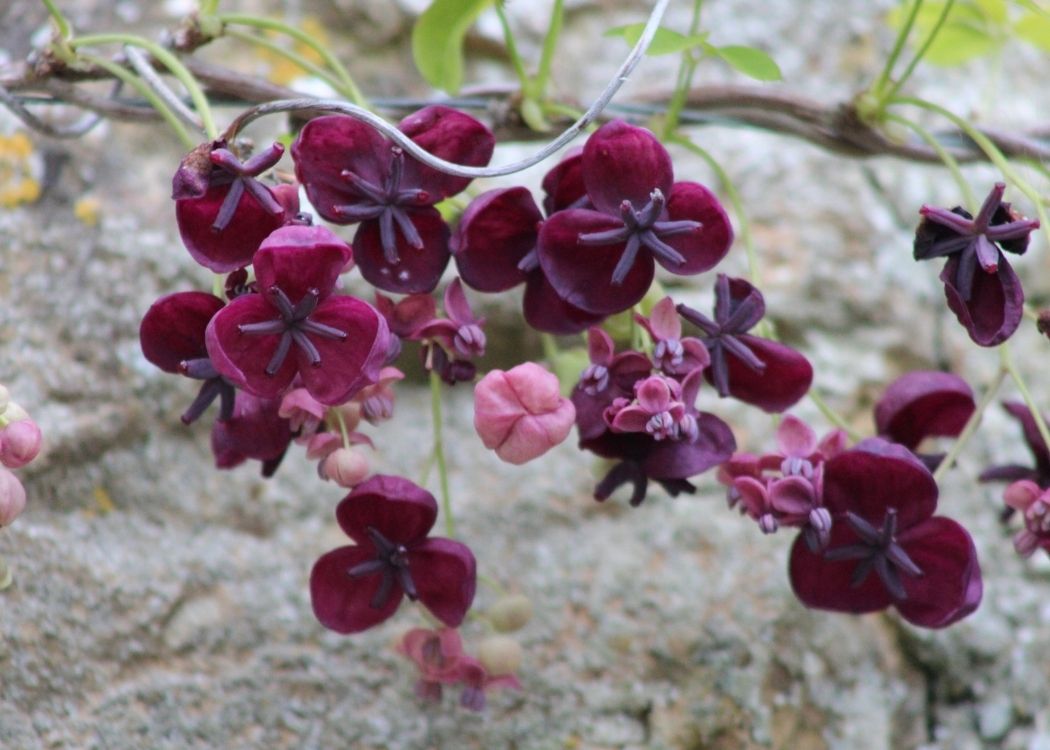
1) Akebia quinata – the Chocolate Vine. This vigorous climber looks tropical but will thrive outside in a sunny location. Akebia has soft foliage, with each leaf composed of five leaflets. The Chocolate Vine is a semi-evergreen, meaning it can retain some leaves in mild winters. Akebia flowers during March-May.
Although the delicate foliage is attractive, the real wow-factor is its chocolate-purple flowers. The exotic looking flowers release a light, spicy scent with a base note of vanilla.
Did you know? In a long, warm summer these vines can produce large sausage-shaped fruits as long as there is another vine nearby for cross-pollination.
Expert tip: the more unusual white flowered cultivar ‘Alba’ produces the same delicious perfume as the claret flowered form, but it brings lightness to the garden.
2) Clematis armandii. The perfect clematis if you need something fast growing to cover a large wall, trellis or fence. The mature leaves are long, dark green and leathery, whilst in contrast the new foliage is delicate and soft. C. armandii enjoys a sunny position with rich soil. This early flowering climber produces masses of strongly perfumed star-like white flowers during March – April. The scent is reminiscent of almonds or citrus depending on the variety.
- armandii is an evergreen, meaning it retains it leaves year round – providing a constant green presence in the garden. Prune it after flowering to keep it under control.
Expert Tip: check out named varieties. The variety ‘Apple Blossom’ has pale pink flowers and bronze coloured young foliage. ‘Snowdrift’ has pure white flowers.
3) Clematis cirrhosa. An evergreen clematis that is suitable for smaller gardens. Their dark green leaves can be undivided or compound with 3-6 leaflets.
Flushes of flowers can appear regularly from October-May depending on the weather. The small nodding flowers are creamy -yellow and release a delicate lemon scent.
Popular cultivars include:
- cirrhosa ‘Freckles’ – a choice variety with petals that are boldly splashed in purple-red when you gaze into the bell-like flowers.
- cirrhosa ‘Wiseley Cream’ – a larger variety with dark green lobed leaves. Wiseley Cream produces creamy bowl-like flowers that are larger than those of ‘Freckles’. ‘Wiseley Cream’ is highly scented.
4) Clematis montana – A very popular spring flowering clematis worthy of our consideration. Clematis montana is a prolific late spring bloomer. This twiggy climber is often used to camouflage unsightly garden features, but it is well worth growing just for its magnificent display of spring colour. Their scent can vary from lemon or almond, to toasted marshmallows depending on the variety.
The varieties ‘Elizabeth’, ‘Fragrant Spring’, ‘Mayleen’, ‘Odorata’ and ‘White Fragrance’ are notable for their fine scent.
Although each variety of montana only flowers for a limited time, by carefully choosing a sequence of different montana varieties it is possible to curate a show of flowers from April into September.
5) Wisteria. This familiar climber is a vigorous grower. Wisteria vines are deciduous, meaning they drop their leaves in autumn.
Wisterias traditionally bear long racemes (clusters) of violet pea-like flowers, although they also come in pink or white flowering forms.
There are two main groups of wisteria: Japanese wisteria (W. floribunda) and Chinese wisteria (W. sinensis).
Japanese wisteria blooms in early summer after the leaves have appeared and grown. This species is delicately perfumed.
Chinese wisteria flowers in late spring before the leaves have appeared. If you want a spectacular late spring flowering climber, then Chinese wisteria is the one for you!
Chinese wisteria has a superior scent compared to the Japanese variety.
To learn how to prune wisteria watch the video in the link:
https://www.youtube.com/watch?v=P0qDeGhEjLY
Finally, a rarity that deserves to be more widely grown. However, it does require a bit more care, especially during winter.
6) Holboellia coriacea, the Sausage Vine, produces a strong lemony-scent with hints of ripe melon when it flowers. This vigorous vine requires space to climb, such as a large wall or trellis – alternatively it can be allowed to romp through a mature tree. Its plentiful, small greenish-white flowers are produced in April and may be followed by large purple sausage-shaped fruits in a good summer.
Expert Tip: another species of Sausage Vine, Holboellia latifolia has an even more intense perfume; however, it is more tender and requires a sheltered location to avoid frost damage.
Conclusion:
If you are a beginning gardener and want to increase the spring interest in your garden then these early-flowering climbers offer both height and rich scent. If you are still not sure which climber would be best for your garden then why not take advantage of the expert advice offered by our plant area staff when you next visit one of our garden centres?
Further Reading:
If you are feeling in the mood to get gardening, now is the time to think about sowing seeds for glorious summer flowers. To learn about how to do this follow the link to our blog:
https://www.capitalgardens.co.uk/blog/top-ten-cut-annual-flowers-from-seed/

Thanks for that interesting and helpful blog. How large does Akebia quinata get please?