

Blog
Embracing the blues: Bulbs for Spring and early Summer blooms


The blue bell is the sweetest flower
That waves in summer air;
Its blossoms have the mightiest power
To soothe my spirit’s care.
From Emily Bronte’s ‘The Blue Bell’
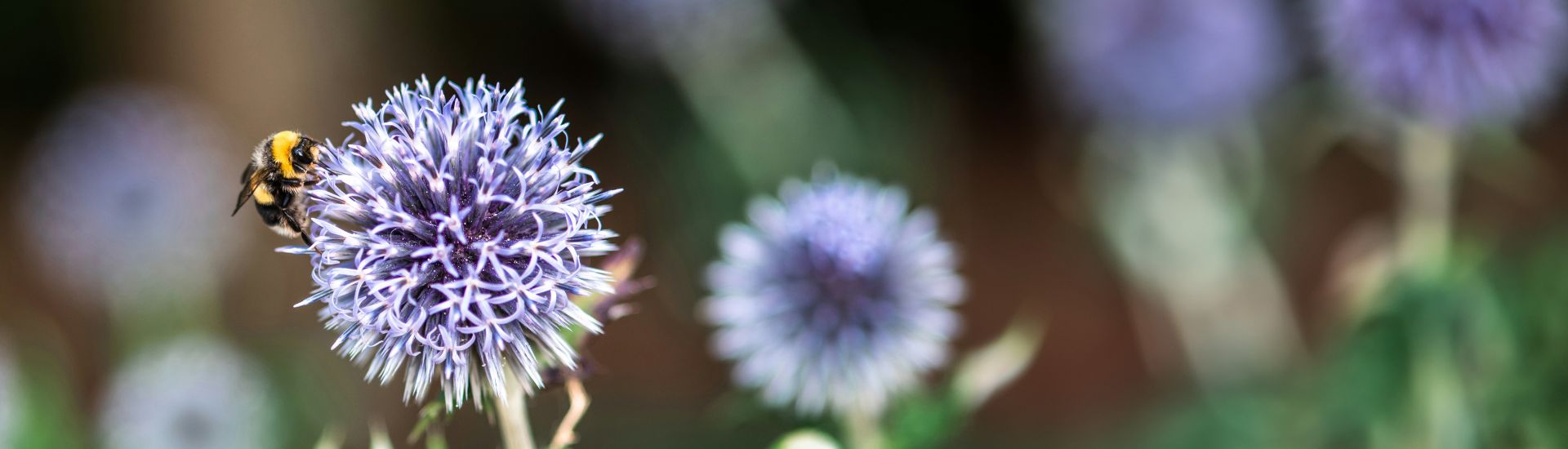
Heralds of brighter days to come, beloved by bees, blue-flowered bulbs contrast strikingly with the white and yellow blooms and lime green foliage of early spring, mingling good-heartedly with pinks and lilacs as summer arrives. They can be bought as bare bulbs in autumn or in the green in pots in spring and look stunning naturalised in swathes in grass. Take a handful, throw them gently and plant where they fall. They illuminate window boxes, pots and borders too and require very little care. As with other bulbs, leave the foliage to die back naturally – it provides food for the following year’s growth.
Scillas
Six-petalled, star-like flowers with prominent stamens appear between early and late spring according to species. Generally best in dappled shade, but happy in a sunny spot too, scillas spread willingly to form naturalised colonies and are extremely popular with early bees. Easy to grow, they do, nonetheless, require good drainage. These versatile plants are equally at home in grassy areas, under deciduous trees, in rockeries and in containers.
Perhaps the best known is S. siberica, a tough little plant from the Back Sea area. Flowering between March and April, its sky-blue flowers face downwards and have a deeper blue stripe down each petal. Approximately 20cm tall.
S. mischtschenkoana flowers earlier, sometimes from mid-January. Ethereal, ice blue petals are complemented by the darker stripe down the centre of each. 15-20cm.
S. luciliae (one of the flowers formerly known as chionodoxa) blooms with the snow melt in its native habitat of Turkey, hence its common name, Glory of the Snow. Dazzling blue flowers fade to white at the centre, and appear around March. These are larger than those of some other species but there are generally fewer of them. It’s a little smaller than S. siberica at around 10cm.
Equally diminutive S. bifolia has bright, Delft blue flowers from late February to March.
You’ll find more here
Muscari
Flowering around March, grape hyacinths do best in full sun or light shade and cope well with poor soils, making them a good choice for rock gardens where they provide an early burst of colour. Their tightly-packed clusters of tiny, bell-like, violet blue flowers are fringed with white at the tips. Despite their size, each is rich in nectar and sought out by bees and other insects, particularly the hairy footed flower bee, which emerges from hibernation in early spring, using its long proboscis or tongue to probe each flower.
Muscari are perhaps at their best in pots and window boxes planted with other spring bloomers like primroses, hyacinths and low-growing daffodils. Pop a few stems in a small glass vase for spring cut flowers. They last surprisingly well.
M. armeniacum ‘Touch of Snow’ has a few very light blue or white flowers at the top of each spike. Muscari ‘Jenny Robinson’ has pale, almost white flowers.
Ipheion uniflorum
With starry pale blue flowers and yellow stamens secreted in a central well, Ipheion uniflorum flower in March and April but may bloom in late February too. Similar to but stiffer in form than scillas, like prim yet glamorous sisters, they prefer full sun but tolerate some shade too. Honey-scented flowers are a feature of some specimens, a nose-tingling contrast to the distinctive smell of garlic given off by both leaves and stems when crushed. Give them well-drained soil or compost and plant in pots, along paths, at the front of borders and naturalise in lawns. 15-20cm high.
Camassias
Mainly native to the Pacific Northwest of the American continent but also found further south and east, camassias thrive on the fringes of woodlands and in damp meadows, where they once grew in abundance. Members of the asparagus family, their spires of starburst flowers open wide as if to welcome the sun. The bulbs of true camassias were cultivated as a food staple by some indigenous peoples and they were also traded as a valuable resource. The plant is easily confused, however, with the ‘deathcamas’ which looks very similar but, as the name suggests, is emphatically not edible. It’s not, therefore, advisable to eat them, as the exact ancestry of plants may be unclear.
Relatively low-growing at 30cm in height, C. quamash has deep delphinium blue flowers with yellow stamens in late April, while violet-blue C. leichtlinii, taller at around 90cm, blooms in May and often on into June, cleverly bridging the gap between spring and summer. Grow them in sun or light shade. They’re happiest in damp but not waterlogged soil.
Use in wildflower meadows, naturalise in grass, or plant at woodland edges with foxgloves or in borders with damp-tolerant euphorbias like E. palustris and E. griffithii and grasses Luzula sylvatica and Deschampsia cespitosa. Read more here
English bluebells
An incomparable treat, surely, is to come across bluebells in their thousands carpeting a woodland floor. Luminous in colour and seeming to stretch forever into the distance, the air almost sings with their glorious, sweet, heady perfume. More deep lavender than blue, they’re all the better for producing the occasional surprise in the form of pale pink or white variations.
English bluebells, Hyacinthoides non-scripta, which so moved Emily Bronte, flower in April and May. An estimated 29-45 percent of the global population is found in the UK but hybridisation by the rather thuggish Spanish species means that, while not currently endangered, they could eventually disappear. So the charity Plantlife recommends not planting the Spanish ones near native bluebell colonies in woodlands or gardens. It’s easy to distinguish between them. English bluebells have much smaller leaves, their flowers are a deeper lavender blue, grow up just one side of the stems and the stems (and flowers) curve over and downwards at the top. The Spanish ones are unscented too. Where hybrids are concerned, however, it’s often more of a guessing game. But if it doesn’t have all the characteristics, it’s unlikely to be English.
Bluebells prefer dappled shade but tolerate more sun in areas with higher rainfall and humidity. In essence, they’re woodland plants but, like that other iconic native, the foxglove, are also to be found in grasslands and hedgerows. Thriving in humus-rich, moist but well-drained soil, they’re ideal in woodland plantings and in partly-shady places with ferns, hostas and astilbes.
Some gardeners find they spread too much and indeed they can, eventually, out-compete other, smaller plants, but this takes quite some time. If you’re concerned, simply keep an eye on them and pull out any that have strayed beyond their allocated boundary.
Did you know? Bluebell sap was used to bind pages into books and stick feathers to arrows. And the bulbs were made into starch for Elizabethan ruffs and sleeves.
As befits such enchanting plants, there’s a rich tradition of folklore associated with them. Bluebell woods are said to be woven with fairy spells, and indeed there’s something magical about those swathes of violet blue in dappled sunlight, silent except for birdsong and the buzzing of bees. It was also said that hearing a bluebell ring heralded a visit by a bad fairy and that picking one summoned fairies who would lead you astray, wandering lost for eternity.
While it may be tempting to take home a bunch from the wild, do resist. Not only will the fairies get you, it is, more importantly, an offence under the Wildlife and Countryside Act to pick, dig up or destroy them. And while they look robust, they’re easily crushed beyond repair when trampled on.
How we care for bluebells. Read here
Although we may not have all the plants listed in our stores, our staff will be happy to suggest alternatives.
Vibrant and energising or cool and soothing, whatever their shade, blue flowers will uplift, as the middle Bronte sister might have testified. Apparently, a certain bluebell perfume was Margaret Thatcher’s favourite, and buying your beloved’s fragrance of choice is a time-honoured Valentine’s Day tradition. But why not get them potted bulbs instead? The object of your affection will benefit in so many ways. There’s the fresh air and exercise to be had when planting them out, and then the joy of watching the flowers emerge. And your purchases will not only come back year after year but will multiply too. They really are the gift that gives on giving. And the bees will be grateful too.






I regularly receive mail from capital gardens but this latest one is a bit confusing, apparently a blog from someone on her preview visit to Kew orchid festival but doesn’t give the dates of the actual festival ?