Blog
Scotney Castle gardens in autumn


It’s the season of mists and mellow fruitfulness once again. At Scotney Castle in Kent most of the apples have now been harvested. But on chilly autumn mornings, the mist still cloaks the surrounding landscape, lifting within the gardens to reveal the ruined medieval castle and moat, emerging ghostlike from the haze. Renowned for their breathtaking views over the Weald, the house and estate combine carefully planted ornamental gardens and sweeping open parkland in the Picturesque style.
Autumn is also the season of burnished colours and floating, falling leaves, easily mistaken, if glimpsed from the corner of the eye, for late-flying butterflies as they flutter softly down. The show of colour weaves through the whole of the garden. A highlight is the sweet gum or Liquidambar styraciflua by the boathouse, with leaves of flaming orange, ruby and deepest purple. They’re magnificent trees, too large for most gardens but at their best in large spaces such as this. Search out, too, the vivid apricot and crimson Parrotia persica near the moat and, tucked away in the West Glade, the coppery swamp cypress, luminous in the golden afternoon light. And in the Quarry, the fine-leaved but punchy-toned acers seize the attention, particularly when viewed from the semi-circular Bastion above.
Fungi, too, have a role to play, both as autumn curiosities and in their essential work recycling the plentiful dead organic matter, helping to provide nutrients for plants. Scarlet fly agaric with their sinister white, warty speckles pop out from leaf litter under trees and shrubs. Their name has its roots in their traditional use, crumbled into saucers of milk where they both attracted and despatched flies. Glossy golden waxcaps and snakeskin-patterned parasols are also to be found, dotted here and there around the gardens and parkland.
Look out, too, for lichens, increasingly visible in autumn as branches become bare. It’s easy to pass by without really seeing them but they’re worth examination for their intricate beauty and intriguing variety. Spectacular in the Quarry, where they hang thickly on small trees, in some places almost obscuring the branches themselves, they’re clever hybrids of fungi and algae. Some are spider-like, others reminiscent of miniature, branching seaweeds, and still others are flatter and creeping, all in gorgeous grey-greens and mustards.
There’s still rainbow chard in the Walled Garden but the pumpkins and squash have been safely gathered in and are on display outside the shop – a pleasing jumble of smoky grey, tangerine and creamy white. Some of the produce is sold to visitors and the rest divided between the restaurant, a local foodbank and the gardeners and garden volunteers. The flowers here are fading but you can savour a few last roses, asters, salvias and purple Verbena bonariensis. Marigolds and star-like rudbeckias soldier on as well in burnt orange and yellow. Seedheads will soon predominate and left in place in your own garden, they’ll provide winter food for birds and shelter for insects.
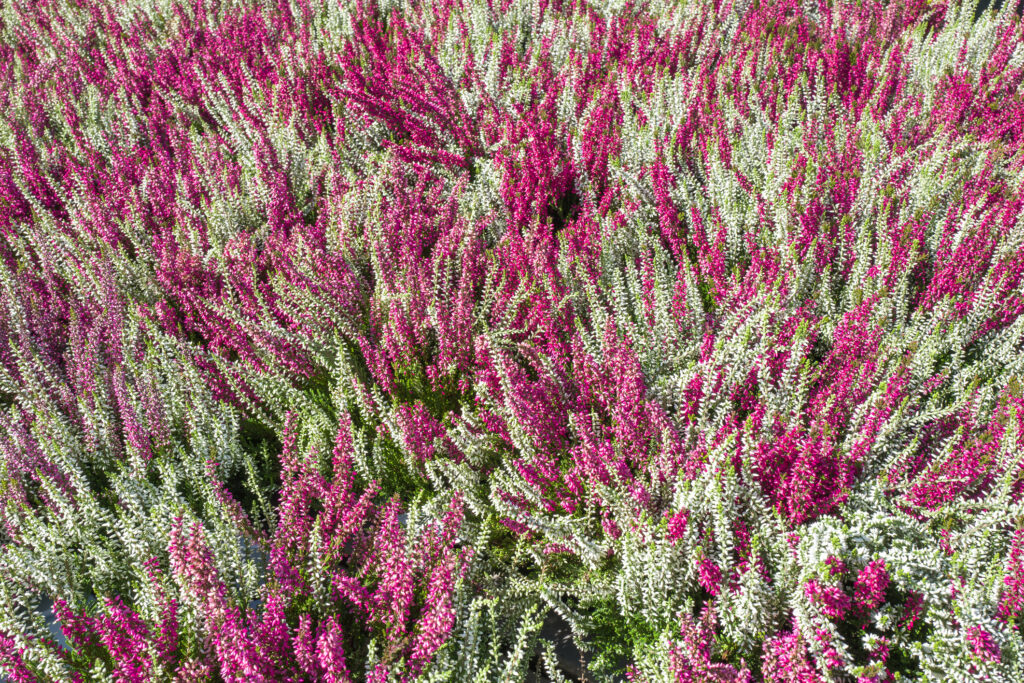
The Quarry is sometimes overlooked but is well worth a slight detour down some shallow stone steps. Newly-planted with rodgersia, hellebores and glorious burgundy Euphorbia ‘Miners Merlot’, the steep, terraced sides are also decorated with self-sown tree heathers. There are, too, a few pink hydrangeas and delightful speckled magenta tricyrtis, the toad lily, both late-flowering stalwarts of shady borders.
Ferns are also lovers of damp, shady places and you’ll see them scattered throughout the garden, including hardy evergreen hart’s tongue Asplenium scolopendrium and the finely-cut shield fern Dryopteris erythrosora. Its young leaves are often a pale, coppery-pink, adding to its already considerable charms.
Down by the castle, a few dahlias and deep pink asters are still in flower in the neatly-edged border, their bright colours beautifully offset by the blueish-grey leaves of euphorbia. Pass through a doorway in the wall and you emerge into the Tropical Garden. Planted this summer, it’s come on in leaps and bounds and is alive with the rich pinks and oranges of dahlias, alstromeria and ginger lilies, as well as the paler pink of delicate begonia blooms. The emphasis is on lushness and foliage is crucial in helping to create the tropical feel. While the soft, green, serrated leaves of the honey bush, Melianthus major hold droplets of dew and rainwater, the contrasting silver and burgundy foliage of persicaria is more dramatic, their small white flowers seeming shy and retiring in comparison.
On your walk back up to the exit, pause and say hello to the cows in the adjoining parkland. The herd is a mix of sweet and gentle Longhorns and Sussex, introduced as part of Scotney’s land regeneration programme. The estate is an SSSI (Site of Special Scientific Interest) and the cattle act like small bulldozers, crashing through scrub and bramble with ease and munching on it to clear unwanted vegetation.
https://www.nationaltrust.org.uk/visit/kent/scotney-castle/cattle-grazing-at-scotney-castle
Autumn is a good time to pay attention to and appreciate the small things and Scotney has them in abundance. Listen to the robins belting out their song, establishing winter territories. Gaze up through networks of branches and cool green and fiery red leaves into a clear, bright, blue sky. And breathe deeply on the fresh, cool air as you take time to stand and stare.
https://www.nationaltrust.org.uk/visit/kent/scotney-castle/the-garden-and-estate-at-scotney-castles
Want to know more about any of the plants mentioned above? Why not use our online Plant finder?