Blog
Chelsea 2023 highlights

Chelsea 2023 highlights
Lilac and violet, lipstick pink, speedwell blue, buttercup yellow and white – these are the colours of spring and early summer in hedgerows and fields as well as in the garden. The zeitgeist at Chelsea this year was, as you might expect, all about sustainability and wildlife and much of the planting had a delicate, airy feel in keeping with this. Native plants were much in evidence and were used for hedging and trees as well as for floral areas. The emphasis was on reclaimed, re-used and recycled hard landscaping materials.
Garden awards
Best in Show:
Horatio’s Garden, designed by Charlotte Harris and Hugo Bugg, had wild and frothy, yet soft and colourful planting, making excellent use of the chartreuse green of euphorbias and smyrnium as a colour foil alongside thalictrums, cirsium and bronzy-purple leaved Penstemon ‘Dark Towers’.
The People’s Choice Garden:
Chris Beardshaw pulled it out of the bag spectacularly once again with his Myeloma – A Life Worth Living Garden. Its lush planting was packed with ferns, rodgersia and hostas which provided oodles of contrasting texture and different shades of green. The flowers, including iris, bistort and zantedeschia were sedate but colourful with white, yellow, blues and purples predominating. A masterclass in garden design.
Other highlights:
As so often with Chelsea the standard was such that it’s impossible to choose favourites but Sarah Price’s Nurture Landscapes Garden stood out for me with its soothing caramels, russets, purples and steely greens. It’s an understated but impactful mix of colours that have a North African feel and work really (and unexpectedly) well together.
The Boodles British Craft Garden was a painterly combination of cleverly-planted yellows, purples and blues which managed to be both cheerful and gentle at the same time. And the Shifting Garden used containers not just to display plants but to create changes in level, showing us how to make the most of different dimensions in a very limited space. Blues, purples and white nestled alongside silvery foliage and succulents and the eye-catching cycad added an element of drama.
If you didn’t make to Chelsea you can have a peek at all the gardens here: https://www.rhs.org.uk/shows-events/rhs-chelsea-flower-show/Gardens
The Great Pavilion displays
Glorious glads (dear departed Dame Edna would have been ecstatic), zinging zantedeschias, purple, orange and lime floristry displays climbing up and cascading down used oil barrels and bins – the displays were, as always, a riot of colour. Chelsea also gives breeders and growers an opportunity to showcase new plants – something that’s always of interest to keen gardeners! Sometimes these are an instant hit, taking the gardening world by storm as Geum ‘Totally Tangerine’ did in 2010. Three of the best for vibrant colour this year were:
Tradescantia ‘J.S. Brainstorm’
Despite its slightly bonkers name this is a winner with its eye-popping magenta three-petalled flowers. It has a long blooming period, from June-November, and is said to be hardier than some other tradescantias. Good in part-shade but will also do well in full sun and likes some damp in the soil.
Erysimum ‘Colour Vibe Red’
If scarlet is your thing, this deliciously fragrant perennial wallflower is just the job. Flowering in late spring and early summer, it loves a sunny spot.
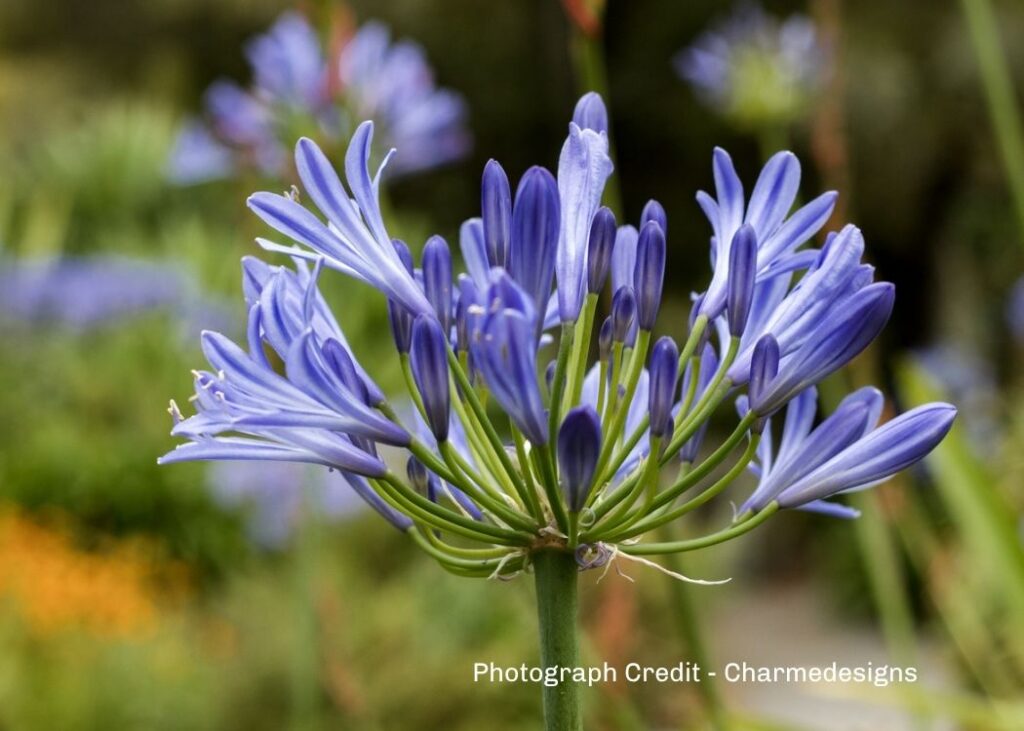
Agapanthus ‘Black Jack’
The winner of the coveted ‘Plant of the Year’ award has rich heliotrope purple blooms and, the breeders say, 10 times more florets than other agapanthus. Drought-tolerant and repeat blooming from July to September, it’s also loved by pollinators. A smallish agapanthus that’s just right for a pot in a sunny space.
You can see the full list here: https://www.gardensillustrated.com/chelsea/plant-of-the-year-winner-2023/
Wildlife and sustainability
Chelsea this year showed us how we can tread lightly on the earth and leave a low carbon footprint. Alongside the cottagey, wild feel to the planting there were also plenty of ideas for reuse and recycling as well as porous and locally-sourced hard landscaping.
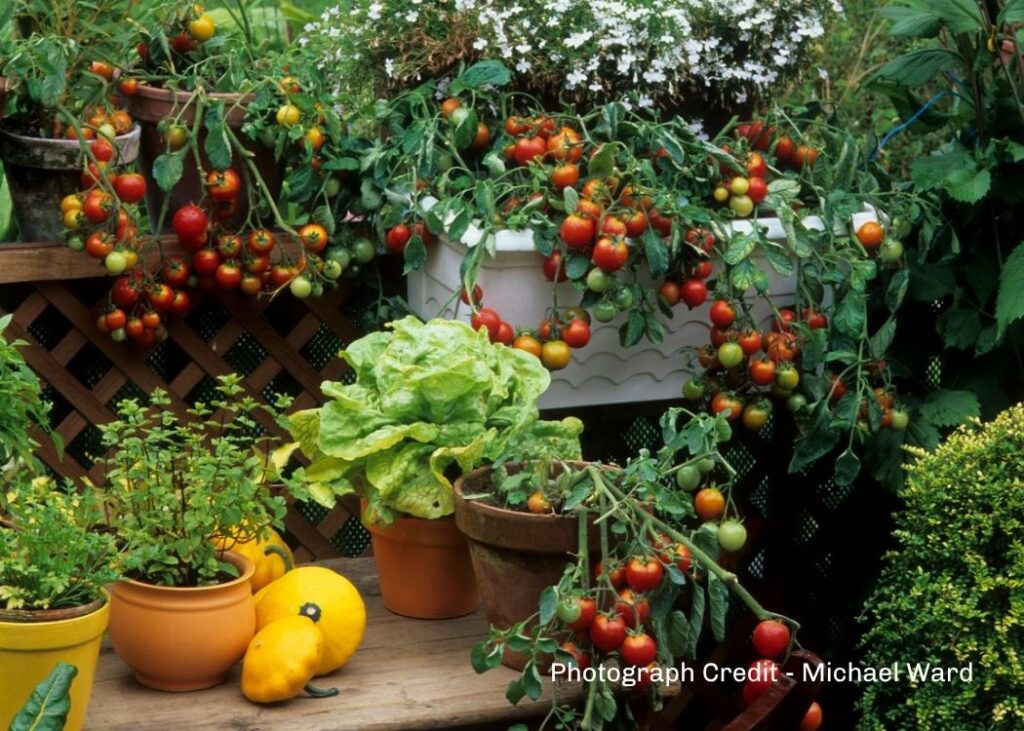
The Platform Garden had an ingenious system for harvesting and dispersing rainwater and there’s a great deal to be learnt from this approach. Plants in old tins and bins in the beautiful St George Alright Here Balcony Garden were reminiscent of gardens and outdoor spaces in Africa, Asia and Latin America where standard pots aren’t always widely available or affordable. Instead, any spare or empty container is re-purposed and put to good use. All you need to do is drill a few holes in the bottom of the container for drainage and fill with compost and plants. The same garden employed old shelves for a plant display and reclaimed bricks as a mini-fernery.
Nature, given the chance, will reclaim the trickiest of spaces. Think buddleia growing out of cracks in old cement paving or rosebay willowherb sprouting from the roofs of abandoned houses. The Centre for Mental Health’s Balance Garden used salvaged and crushed building waste as beds for tough grasses and wildflowers which thrive in difficult environments.
The effect isn’t necessarily what you’d want in your garden, however. Multiple award-winner Cleve West’s controversial Centrepoint Garden, for example, probably wasn’t what most of us would choose to sit in. The planting was fairly sparse and one could be forgiven for thinking it looked rather scrubby and weedy. But there’s a real skill in designing and placing plants to create a space that looks as though odd wildflowers and grasses have just drifted in on spec, deciding where they want to be rather than being deliberately cultivated. Like it or not, it can be argued that, for this reason, it had a place at Chelsea.
So when is a weed not a weed?
It’s up to you. Undoubtedly having an uncultivated corner in your garden and letting nettles, brambles and dandelions use it as their own supports and encourages wildlife in all sorts of ways. But this is not your only option. The RSPCA Garden with its valerian, ragged robin and meadow buttercups demonstrated that naturalistic planting can be vibrant and beautiful. https://www.rspca.org.uk/adviceandwelfare/garden/chelsea/plantlist
Adapting to extremes
We don’t really know what the Climate Emergency is going to throw at us so somehow we need to prepare for all weathers and plant for resilience. The Choose Love Garden, with its shades of peach and apricot, blues, purples and silver, used iris and verbascum that are adapted to hot, dry conditions. Other lovers of drought and heat include the carefully-spaced succulents in the Hamptons Mediterranean Garden and the design illustrated that the gaps between plants can sometimes be as important as the plants themselves. Drought-resistant plants are often spaced out in the wild and gravel or rock emphasises and highlights the colours, texture and structure of the plants. The Teapot Trust Elsewhere Garden, in contrast, used candelabra primulas, angelica and thalictrums, all tolerant of wet conditions.
As Monty Don remarked, we need to adapt to extremes of hot, cold, wet and dry in horticulture. ‘Tricky but interesting,’ was the phrase he used, and indeed it is. In these unpredictable times we’ll be looking to the RHS, among others, for guidance on how best to keep our gardens looking fabulous.