Blog
Magnificent magnolia

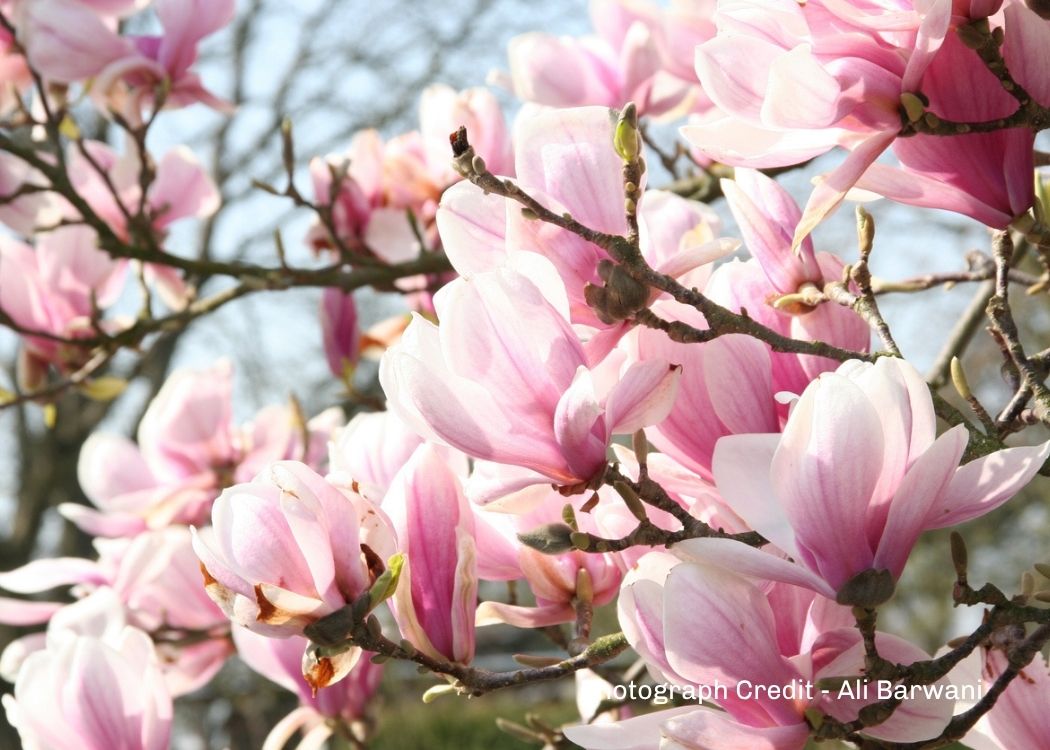
The streets may not be paved with gold but here in the northern corner of East Sussex they are lined with magnolias. From sizeable trees to shrubs suitable for growing in containers, these popular garden plants have exuberant flowers in abundance which, at this time of year, seem to be offering themselves up to welcome the sun.
Despite being an ancient plant in evolutionary terms, age has not withered the magnolia and has increased its variety. Treat yourself to a spring trip to Bodnant Garden in North Wales, Caerhays Estate in Cornwall or Ventnor Botanic Gardens on the Isle of Wight. Then feast your eyes on the masses of architectural blooms standing out on bare branches which merely hint at the number of species and cultivars available. In hues from pure white through palest pink to rich raspberry and plum and shades of yellow too, these flowers can be open and star-like or upright and bowl shaped with strong, thick petals. While the fossilised flowers of Magnolia acuminata (a large tree still found living today in the eastern US) have been found dating back 20 million years, fossils belonging to the magnolia family date back even further, to 95 million years ago – the time when dinosaurs ruled the earth.
Among the first flowering plants to appear, magnolias evolved before bees, butterflies or moths. Instead, they were pollinated by small beetles attracted to the protein-rich pollen produced by the flowers. Open during the day, these closed at night, trapping the hapless beetles within. In the morning the flowers re-opened, allowing the insects to fly away to the next tree, carrying fertilising pollen with them. This is a relationship that continues today, although bees now play their part too.
While the flamboyant blooms are often considered their best feature, magnolias have other, less immediately visible qualities to be enjoyed if time is taken to stop and examine them more closely. Their supersoft, hairy buds are eminently stroke-able. And once the flowers open, they reveal intriguing central structures which mature to become prehistoric-looking, cone-like seed pods. As the year turns these split and out pop small bright red or orange berries containing small black seeds.
Native to Southeast Asia, the Americas and the Caribbean and flowering in spring or summer, magnolias can be deciduous or evergreen. There are hundreds of species and many more cultivars, some fragrant, some with blooms shaped like waterlilies or tulips. Several species are endangered in the wild and new ones are still being documented, one, named Magnolia ciroorum, was found in Honduras as recently as 2023. First to set foot on our shores was M. virginiana, arriving from America in the late 17th century, not long after the first Pilgrims had travelled in the opposite direction. However, most of the species we grow today arrived from Southeast Asia over the following centuries.
Magnolias need a sheltered spot; in the wild they tend to grow in forested areas and high winds and frosts can damage flowers. Some are hardier than others but it’s best to avoid an east facing position if possible as early morning sunlight on frosted plants can burn leaves, buds and flowers. Alternatively, cover with fleece if frost is forecast. If growing in a colder part of the UK, it’s advisable to choose one that flowers in summer rather than spring. They prefer full sun but most will tolerate light shade. Be careful not to let them dry out in summer.
As a general rule, magnolias like a neutral to slightly acidic growing medium but several will do well on chalkier or heavier soils. Monty Don demonstrates how to plant one here: https://www.bbc.co.uk/programmes/p074dxkx While some growers recommend adding compost or leaf mould to the planting hole, others feel a little tough love encourages a stronger plant. If your soil is poor and dry though, it’s safest to mimic their natural habitat and add lots of organic matter when you plant. Small varieties can be grown in containers using a mixture of John Innes no. 3 and ericaceous compost.
Once basic conditions are met, these botanical celebrities are undemanding where upkeep is concerned. Simply mulch in spring with leaf mould, ericaceous compost or well-rotted manure. As well as adding valuable nutrients this will help with moisture retention during dry summers. Pruning is only really necessary to remove dead, diseased or crossing branches. Although some will become largeish trees, they are slow-growing and can take between 10 and 20 years to fully mature.
Magnolias to try
For neutral to alkaline soils
M. grandiflora: The grande dame of magnolias blooms in late summer. Its large white flowers are lemon-scented and the substantial, shiny evergreen leaves with rusty undersides are a feature too. The National Collection is held at RHS Wisley where they’re being tested for climate resilience and have been found to tolerate hot, dry conditions very well. A majestic plant which can grow to 15 x 15m, it’s often trained against a sunny wall where it can soak up the heat.
M. x soulangeana has been found to cope well with cold wet winters and hot dry summers. Its late spring flowers, pink or white and bowl-shaped, appear at around the same time as the leaves are sprouting. Compact at 6 x 6m.
Also tolerant of cold is spring-flowering M. x loebneri ‘Leonard Messel’. Growing to around 8 x 6m, it has pale to rose pink starry flowers.
Evergreen M. delavayi has large, blowsy, scented creamy white blooms in summer. Only hardy to -5 degrees C, it really does need a sheltered spot. Approx 10 x 10m.
For small spaces
Small garden favourite M. stellata has a cloud of starry early spring flowers, white, sometimes with pink tints. Also tolerates neutral to alkaline soil. 3 x 4m.
At 2-3m tall, evergreen M. laevifolia ‘Gail’s Favourite’ looks like a very compact M. grandiflora. Numerous fragrant white flowers appear from mid to late spring.
Diminutive M. ‘Genie’ has gorgeous, goblet-shaped, blackcurrant ice flowers in spring. At 2.5 x 2m it’s more of a large shrub than a tree.
M. liliflora ‘Nigra’ has attractively veined, plum-coloured tulip-like flowers, often paler on the inside. Blooming from early to late summer it grows to approximately 3 x 3m.
For fragrant flowers
M. ‘Heaven Scent’ is perhaps the most strongly scented. The pale pink to white petals are marked with a deeper pink central stripe. Reaching up to 10m tall, it flowers in spring.
Others have a more delicate fragrance which may vary with the weather, position and nose of the inhaler! One of my personal favourites is M. seiboldii. In early summer, open white flowers with a cerise central ring and pale lime cone appear, nodding slightly downwards. It grows to approximately 6 x 8m but the all-important central colour is still visible because of the way the flowers hang. It copes with alkaline soils too. Other scented magnolias include scented magnolias include M. grandiflora, M. delaveyi and M. laevifolia.
Mellow yellows
Although the idea of a yellow magnolia may not seem entirely right to purists, many do have a rather glamorous appeal, particularly when the flowers are seen next to their bright green foliage against a bright blue sky.
M. x brooklynensis ‘Yellow Bird’ produces upright lemon yellow flowers in spring and reaches around 10 x 6m, while slightly smaller M. ‘Daphne’ has longer, slimmer, more elegant petals in late spring. Both bloom after the leaves appear.
We may not have all the plants listed in our stores but our staff will be happy to suggest alternatives.
Magnolias have other strings to their bows. They’ve been used in traditional medicine for centuries and the petals of some (but not all!) species are edible. But they’re best loved for their spring bling and the way they can light up even the dingiest of days in all their magnificence.
Further Reading:
https://www.nationaltrust.org.uk/visit/gardens-parks/gardens-with-magnolias
https://www.bowhayestrees.co.uk/post/are-magnolia-trees-good-for-wildlife-pollinators
https://www.rhs.org.uk/garden-inspiration/plants-we-love/magnolias-garden