Blog
Autumn window boxes for colour and life

Autumn window boxes for colour and life
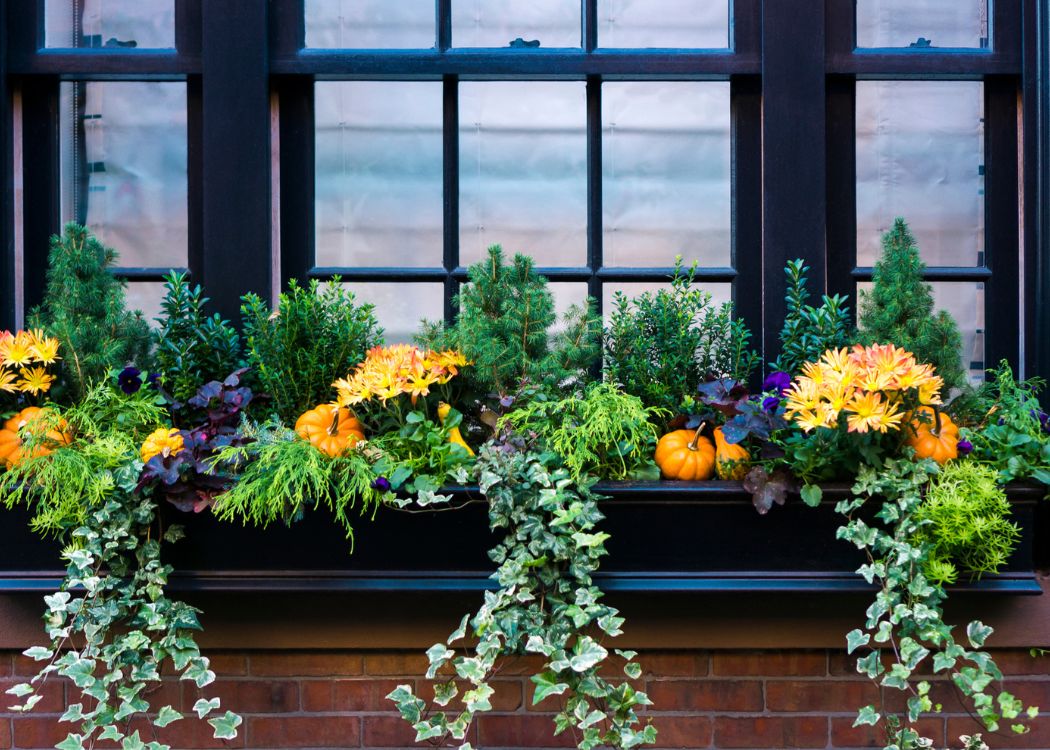
Autumn leaf colours seem to be particularly electric this year and in the same vein, the change of seasons needn’t mean leaving your window boxes to fade away. On the contrary. Autumn container displays are often more understated than summer ones but there’s still plenty of scope for showing off with the imaginative use of foliage plants as well as flowers. And let’s not forget the edibles. Hardy evergreen herbs, salad leaves and even a few veg mixed with ornamentals are solutions to making optimum use of a small space.
Choosing your plants
There are fewer flowering bedding plants in autumn than in summer but a combination of contrasting leaf textures and brightly coloured foliage can look stunning. And it’s a particularly good solution for boxes on a shady windowsill. You could, for example, create a planting of heucheras of contrasting colours mixed with ferns of different textures. Try it. You’ll see what I mean.
Some design tips
- Think about the style you’d like to create. Formal or slightly wild and untamed? Understated silver and green plants or vibrant flowers and fiery colours? Ornamental or edible or a mixture of both?
- Plant in odd numbers or multiples of three, so you have, for example five plants in a box.
- It’s easy to be carried away by all the beautiful plants available and just buy one of everything. But don’t be tempted to use too many different plants in one window box – your design can end up looking bitty and incoherent.
- Do use at least two or three specimens of the same plant, in the same window box if you only have space for one, or in neighbouring boxes.
- Mixing evergreen foliage plants with your flowers will mean that you won’t need to change all your plants as the seasons move along.
- Think about the amount of light your window boxes will get and choose your plants accordingly.
- Try out your design before buying your plants. Placing them in one of our window boxes while in store will allow you to see how many plants you need and what your design will look like.
- ‘Thriller, filler, spiller’ is a helpful design mantra for window boxes:
Thrillers create impact through height and/or colour. Fillers are lower growing, foliage plants that offset the thrillers as well as hiding the compost and their stems. Spillers trail down, optimising the use of space, softening edges and disguising some of the window box itself.
Some plant ideas
Most of the plants listed as shade tolerant will also be happy in sun.
Flowering plants
For sun:
Cyclamen – an autumn window box favourite in a range of colours from white through to pink, red and lilac. Some will continue flowering well into winter and, as with primroses, you’ll find the odd one is scented.
Heathers – callunas can flower from late-summer right through autumn. They prefer acid soil so if you want them to have a long and happy life, use ericaceous compost. They can be combined with other acid-loving plants such as small pieris.
Small pots of autumn stalwarts like chrysanthemums and Liriope muscari may also be available.
If you have a large window box – you’ll probably need one that measures at least 19cm from back to front – you could experiment with feature plants like hesperanthas or alstromerias, both of which often flower until November. Why not go for a small-scale prairie planting and team them with some evergreen grasses? You’ll find inspiration here:
www.rhs.org.uk/garden-design/prairie-planting-creation-maintenance
www.gardenersworld.com/plants/five-autumn-perennials-for-november/
Looking for fiery colours? In that case Solanum pseudocapsicum with its bright orange fruit is a winner. It’s perfect for a Halloween display as well as in window boxes. Just beware as the berries are poisonous. Look out for our Halloween blog, coming soon!
For dappled or part-shade:
Violas and pansies are cottage garden standards but never tame. Surely amongst the most cheerful and uplifting plants on a dull autumn day.
Fillers
For sun:
Small, immature shrubs make great fillers. Try tiny conifers like the delightful, aromatic golden cypress, small green cordylines, Euonymous fortunei and Ilex crenata (a good alternative to caterpillar-prone box). For silver tones you might like the twiggy and slightly unusual-looking Calocephalus brownii.
(If you do plant small shrubs, just bear in mind that most won’t be happy in window boxes for ever. They’ll need more space after a while, partly because they’ll be happier and partly because they will start to outcompete smaller bedding plants. However, they do have an afterlife and will be very happy replanted in larger pots or your garden.)
Herbs: sage cultivars are a useful source of leaf colour. Choose from purple, green, golden, or ‘Tricolor’, which has green leaves edged with white and tinged with pink.
And evergreen grasses such as Festuca glauca and carex add low-growing textural interest. (Most carex are evergreen but it’s as well to check the label or ask one of our staff just to make sure.)
For dappled or part-shade:
If you’re looking for shrubs, how about the ever-versatile Euonymous fortunei? You may think of these as being rather dull but actually they’re incredibly useful in many situations; variegated cultivars such as ‘Emerald ‘n’ Gold’ and ‘Silver Queen’ can really brighten up your display
Skimmias, those marvellous all-rounders, in bud now, will also delight with their scented flowers in spring, and some will have berries.
The extraordinary variety of heuchera leaf colours never ceases to amaze me, and more seem to be added every year. There are hundreds of them according to the RHS, spanning almost all colours of the rainbow and moving beyond it into chestnut, silver and nearly-black. ‘Sugar Plum’ has dark-veined pink leaves, ‘Forever Purple’ is a rich, royal hue, ‘Obsidian’ is deep purple, almost black, ‘Fire Alarm’, ‘Peach Flamingo’ and ‘Lime Marmalade’ are all self-explanatory, as is ‘Lemon Dinosaur’. ‘Green Spice’ has deep green leaves with silver centres and dark veins. With all these colours, who needs flowers? Heucheras prefer some shade and most are fairly reliably frost-hardy.
Evergreen ferns, in my humble opinion, deserve a place in all window boxes that don’t get much sun. Embracing the dark side, they’re a winner in a shady planting. Excellent do-ers include Asplenium scolopendrium (the hart’s tongue fern), Blechnum spicant and Polystichum polyblepharum.
There’s also a place for evergreen grasses. Carex oshimensis will be happy in part shade as will Luzula nivea – a member of the rush family. It has the bonus of small white flowers in summer so is a window box keeper.
Spillers
For sun:
Silver-leaved Helichrysum petiolare isn’t fully hardy but may well survive in a sheltered window box in the south of the UK.
For part-shade:
Happy in sun or shade, your ‘go to’ spillers for autumn are ivies. While it has a reputation for thuggishness, ivy in a window box is unlikely to get out of hand and is a really useful, tough, evergreen with many variegated forms to choose from. Consider Lysimachia nummularia too. ‘Aurea’ is golden leaved cultivar and the most commonly sold.
The edible window box
The end of summer doesn’t necessarily mean the end of growing your own greens. Crops like lamb’s lettuce, purslane and spinach will all continue to thrive in autumn’s cool temperatures and some will even survive frost.
www.growveg.co.uk/guides/4-super-hardy-salad-leaves-to-grow-in-winter/
Choosing your box
For details on how to choose and prepare your window box follow the link to our blog:
www.capitalgardens.co.uk/blog/the-art-of-creating-beautiful-window-boxes/
Autumn is a glorious season when the skies are blue. And that blue is the perfect foil for autumn colours. Take a leaf out of the trees’ book and brighten up your view with a vibrant or stylish autumn window box.