Blog
Kew’s 30th Orchid Festival 2026

Kew’s 30th Orchid Festival 2026
Like the White Rabbit I fear being late. But unlike that poor creature I am not out of breath because I am seated on a westward bound Piccadilly line tube train. I entered the rabbit hole at Bounds Green just as the dreaded phrase ‘severe delays expected’ appeared on the electronic information display. But now that we are leaving Earl’s Court the train is moving quickly, and we emerge from the tunnel into daylight. Soon we are at Hammersmith, and I cross the platform to join a District line tube bound for Richmond. I remember to consult my watch, and it helps.
Why the hurry? Like Charlie Bucket I have a Golden Ticket! My ticket doesn’t get me into Willy Wonka’s Chocolate Factory, but it allows me access to something equally magical. I am on the guest list for the Media Preview of Kew’s 30th Orchid Festival. Exiting Kew Gardens station, heading down Lichfield Road towards Victoria Gate I feel as though I am being drawn by a shaft of dry light down the rainy pavement. The main gates are still locked, so I join the queue of reporters and influencers. I am early. See! No need to panic.
Having registered at the media desk I am free to explore the exhibition. Without the general public it is perfect for photography, but I do miss the buzz generated by an excited crowd. Why the orchids of China? Solène Dequiret, Glass House Manager of the Princess of Wales Conservatory at the Royal Botanic Gardens, Kew explains: “For Kew’s 30th Orchid Festival, we are inspired by China’s incredible biodiversity and cultural richness. We…celebrate Chinese tradition with plants and people at its heart, from intricate Orchids displays to symbolic animals sculptures and art. It’s a joyful celebration of nature, creativity and connection during the cold winter months— and a reminder of the importance of protecting the world’s biodiversity”.
The first large floral creation I encounter is a giant arching serpent curving down to rest its massive head on a boulder. The reptilian scales are created from shingled ginkgo leaves. The body of the ophidian, a mass of exotic plants: orchids, bromeliads, and ferns. This installation is called ‘The coming of spring’, and it represents transition during this Chinese New Year, from the Year of the Snake to the Year of the Horse.
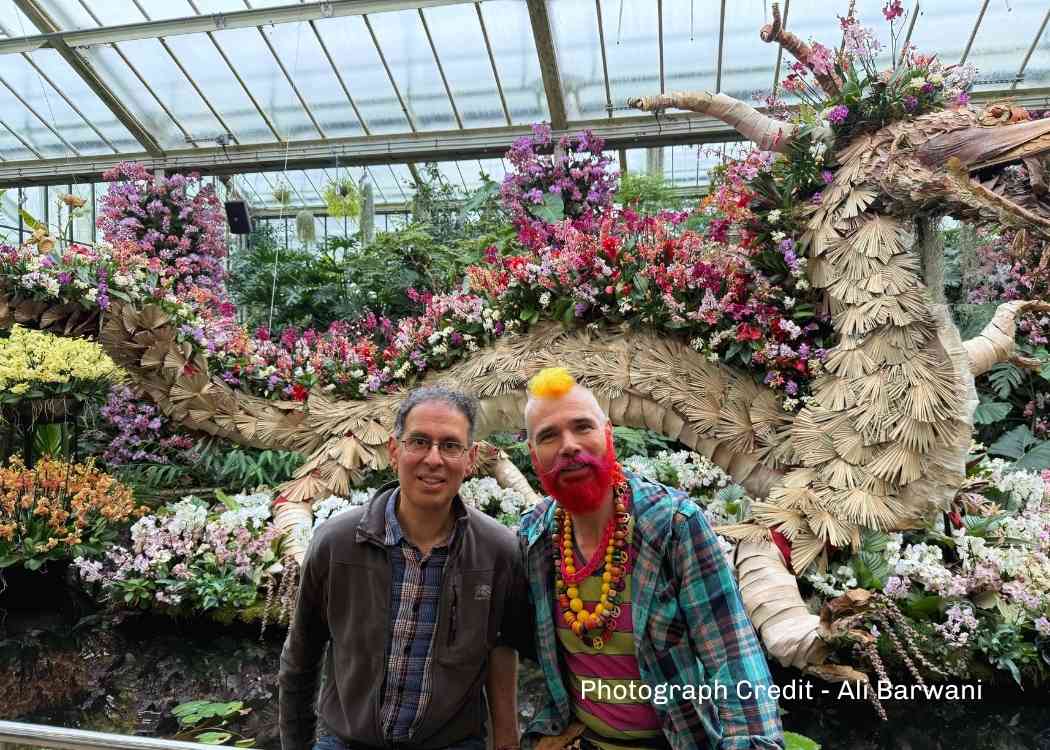
Moving on, I arrive at the monumental Chinese dragon, that sits upon a floral island in a large reflective pool. Here I get the chance to talk with Henck Röling, artist, florist, gardener, singer, rebel, and Kew Ambassador. I ask the tall and colourfully dressed Henck to tell me about how he came to be involved with the Kew Orchid Festival. He explains, “my role in the orchid festival has grown from being an ordinary volunteer. With my experience in floristry, I quickly was suggesting adding certain displays or advising how to improve them. Since a couple of years Kew has been paying me to help build the displays as I bring skills the usual horticulturalists don’t have. The presence of floral sculpture has lifted the focus of the festival over the years.”
Looking at all the wonderful animal sculptures located around the festival, including pandas, koi carp, snub-nosed monkeys, and a flying phoenix, I wonder which sculpture was the most ambitious. With an amused smile, he says, “this year we have the dragon in the pond. Because of his sheer size he was probably the most challenging. During the planning stage me and Solène (the manager of the glasshouse and designer of the festival) were brainstorming on how to clad the ‘skin’ of the dragon, till Solène spotted the fan palms outside the glasshouse that needed cleaning up, so lots of leaves were collected for covering.” Pausing, he adds, “the shape of the dragon is also completely our design. As there is only a very rudimentary structure underneath, it took us many man hours to complete him. It is probably our biggest, most ambitious pond display to date.”
While admiring the dragon, I ask Henck about its construction. He tells me, “we started the build of the dragon in the second week of January. Construction of the frame happened in one day with a team of four people. Cladding the belly took three people two days. Adding details like the legs and tail was another couple of days by a few people. The actual planting of the dragon took four people a day, plus another day for the underplanting of the island.” Impressed by such intense work, I start to wonder about the emotional side of the creative teamwork. Henck confirms what I am thinking, “on completion of planting the dragon I was a little emotional as I realised it was going to be really good. But the best part is always how all the team and volunteers pull together to put such an amazing festival together. People who work in other parts of the garden during the rest of the year gather in the Princess of Wales glasshouse. And the spirit is always amazing, with everyone contributing according to their ability. It makes me very grateful to be involved in the Kew Orchid Festival.” Henck’s powerful words give me a feeling for the passion and dedication of all those involved in creating this annual event.
I conclude by asking if he is looking forward to the arrival of the public later in the week, he replies, thoughtfully, “visiting the festival and hearing all the reactions from the visitors is another highlight. It is amazing that we are able to entertain and inspire so many people.” With these final thoughts, I thank Henck for his time and leave him to answer more questions from the throng of reporters gathered around him.
The Kew Orchid Festival has a trifecta of aims, creating exciting displays for visitors, highlighting botanical science, and showcasing the culture of the region. Having seen many of the fabulous floral displays, I move on to the second aim.
There is much to learn from the information boards as you circulate the exhibition. For example, did you know that China is one of our planet’s great centres of plant diversity? It is thought to be home to more than 30,000 native plant species, including approximately 1,710 orchid species, numbers likely to rise as botanists continue with their work. I recommend taking a break and visiting the pop-up Orchids shop where you can find books, clothing, and gifts. Sit down and watch the specially commissioned film showcasing how Kew scientists work behind the scenes to discover, conserve, and multiply endangered orchids.
Art and culture is represented with a number of artist collaborations. Such as, Yi Crafts, an East and Southeast Asia handcrafts studio based in London, has displays focusing on the vanishing traditional handicrafts and cuisine of China’s ethnic minorities. Further on, I admired the artworks of Zheng Bo, an artist with Bai Yunnanese heritage. The artworks depicting Chinese calligraphy tell the tale of five orchids who long to migrate to the ocean. Having viewed these works, you will find yourself exiting the festival via an archway decorated with a horse. This reminds us that 2026 is the Year of the Horse. But don’t mistake the end for an end, when it is actually a beginning. Remember, every ticket sold helps to support Kew’s vital conservation work.
Further Details:
The Kew Orchid Festival 2026 runs from 7 February – 8 March 2026.
All details can be found at: kew.org or click here
Entry to Orchids 2026 is included when purchasing a ticket to Kew Gardens, but visitors must book separate timed entry slots for Orchids 2026 in advance.
Also worth seeing while you are visiting Kew Gardens: