Blog
National Indoor Plant Week 2026: Fern Frenzy

Recently, I have been thinking about ferns. Firstly, because they were the topic of an afternoon talk I gave to members of a local charity, Haringey Circle. During this event we discussed aspects of fern evolution, adaptation, distribution, and reproduction. We also explored Pteridomania, or Victorian fern madness. Did you know that the baroque swirls decorating custard creams represent unfurling fern fronds? This is a vestige of Victorian marketing. By offering visitors a plate of these biscuits you were showing that you were au fait with the latest trend. So, the next time you visit the supermarket or corner shop, buy a packet and see for yourself, for research purposes.
Secondly, I have been considering indoor ferns as the subject for this week’s article because National Indoor Plant Week 2026 takes place from 14– 20 September.
In case you think, as these articles might suggest, that everything I do relates to gardening, at the start of last week I was free to socialize with the West End glitterati, if only they had my email. Actually, I attended a special production of Noël Coward’s one act play ‘Still Life’ at the Theatre Royal Drury Lane thanks to my friend Peter. Ninety years ago, this play premiered in the West End as part of the short play anthology ‘Tonight at 8:30’. Nowadays, it is best known from the film adaptation that made it famous, ‘Brief Encounter’.
The production I saw was staged as an immersive event, hosted in the theatre’s magnificent Grand Saloon. It began with the audience enjoying a luxurious afternoon tea, before the room transformed into Milford Junction Railway Station. Now, I don’t mention this because I think you should see this play, especially because it is too late – it was only on for one week and finished on the 12th of September. Nor did afternoon tea include custard creams, which would have allowed me to segue into our topic, indoor ferns.
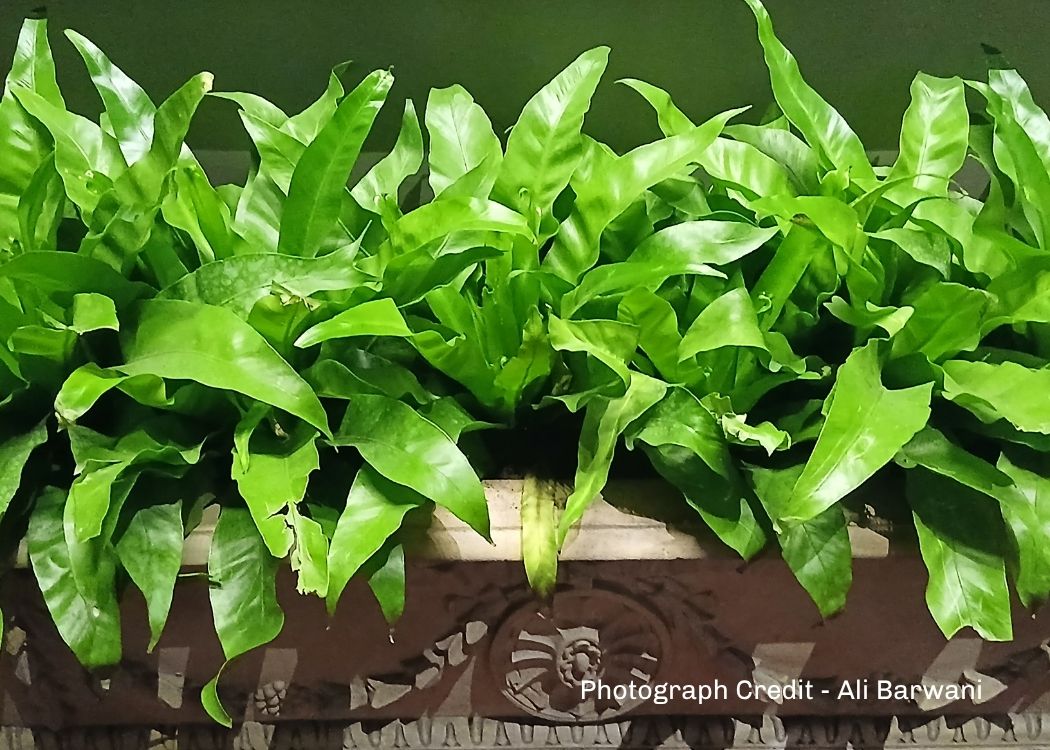
I mention it because after the play ended I had a look around the magnificent Georgian building, which has undergone a major £60 million restoration project. With so much architectural magnificence, murals and sculptures, not to mention Andrew Lloyd Webber’s collection of Pre-Raphaelite masterpieces and contemporary commissions it is an art lover’s paradise. However, to complement this rich interior, and to add life, I was impressed by the highly effective use of troughs packed with large specimens of bird’s-nest ferns (Asplenium nidus). These ferns can be seen in the photograph at the top of this page. And it is this luscious fern, with its broad, glossy fronds that is the plant I intend talking about for National Indoor Plant Week.
The bird’s-nest fern is a real looker, with long, glossy apple-green fronds. Lustrous, lush and structurally interesting, it makes the perfect choice to add a tropical feel to the home. It is also available as a number of cultivated forms, including ‘Crispy Wave’ with intensely pleated fronds that give it a puckered look, and ‘Osaka’ (Japanese Bird’s-Nest Fern) whose narrow leaves have a ruffled edge, which gives them their distinctive appeal.
In houseplant books and websites, Asplenium nidus is stated to be a widely distributed species. Its range is said to encompass tropical southeastern Asia, eastern Australia, Hawaii, Polynesia, Christmas Island, and India. However, other houseplant books often include an additional tropical east African distribution for the species. So why do different sources give different distributions? Puzzled, I looked it up on Kew’s Plants of the World Online, which confirms the native range of this species as being Malesia to N & NE Queensland. Still curious about the discrepancy I contacted the botanist Rafaël Govaerts, Senior Content Editor – Plant & Fungal Names, Scientific Collections – Biodiversity Information at Kew Gardens. Rafaël informs me that in the past Asplenium nidus used to include a number of ferns that are now known to be different species. For example, the African plants are now known as Asplenium mauritianum.
In other words, while historically Asplenium nidus was regarded as being a single widely distributed species, recent molecular studies have shown that this name has traditionally been used as a ‘blanket term’ for ferns that look alike but are not closely related. While this discussion might seem esoteric, it means that it will help separate the true Asplenium nidus from other popular bird’s-nest ferns that are often sold under the same name by the houseplant industry. More importantly, it will help in the conservation of cryptic fern species that formerly went unrecognised.
This tropical fern is epiphytic and epilithic, meaning that in nature it grows up trees and on cliff faces. When naturally growing high in trees they form a vase-shaped rosette of green leaves into which fallen leaves and other debris accumulates, giving the appearance of a birds nest, hence their common name. Interestingly nidus is a Latin word which means ‘nest’.
Being tropical in origin, the bird’s-nest fern appreciates humid, warm conditions, making it suited to growing in a steamy bathroom or kitchen. It likes a bright location, but not in full sunlight. If you are not growing this fern in a humid spot, then regular misting with a spray bottle and placing it on a pebble tray will help keep it looking good. My tip for keeping it happy is to water it with rainwater or soft water, and to avoid getting water into the centre of the rosette. And remember it is not a heavy drinker. Is it safe to have around pets and children? It is widely reported to be non-toxic and pet friendly, and the young shoots have traditionally been harvested and used as a vegetable in Taiwan.
The bird’s-nest fern remains a popular houseplant because it is an elegant plant that has character. Unlike flowering houseplants, like orchids and peace lilies, it relies solely on the beauty of its leaves to win admiration. With the correct care and treatment, the bird’s-nest fern will grow into a magnificent specimen that brings life to any room. This is why I have chosen it as my plant of the week during National Indoor Plant Week 2026
Things to do:
Add a new houseplant to your home or office.
Repot or clean the leaves of your current indoor plants.
Share images of your favourite indoor plants online, and don’t forget to tag us in the photographs.
Further details:
The Theatre Royal Drury Lane.
National Indoor Plant Week 2026:
https://nationaldaycalendar.com/celebrations/national-indoor-plant-week-third-week-in-september
Haringey Circle: