Blog
Phormium: Winter Stars with Stripes

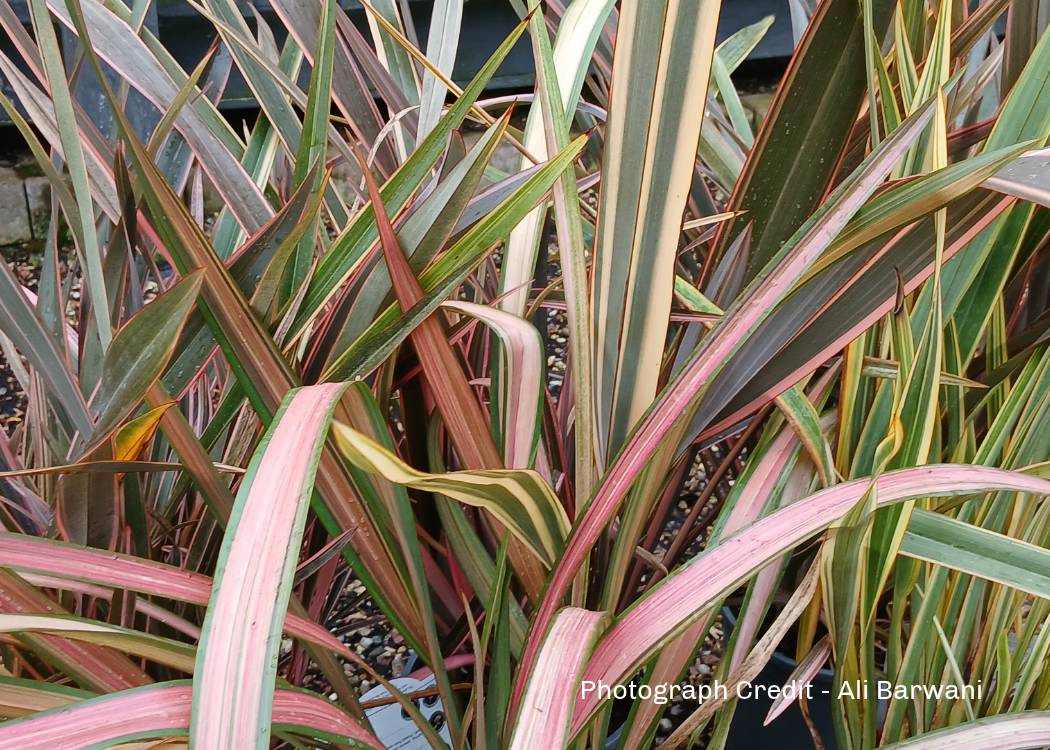
Phormiums (New Zealand flax) are a bit like marmite: “love it or hate it”. Oh, some people will tell you they are striking, sword-leaved perennials that add architectural form and colour to our gardens. But others will claim they drive them crazy due to their overuse in commercial landscapes and low-maintenance urban planting: roundabout plants.
I can sympathise with both sides. Walking through Enfield Town the other day, I passed a neglected variegated phormium in front of a modernist public building. The leviathan had outgrown its raised brick planter, having long ago evicted the other occupants like a bloated botanic cuckoo. To make matters worse, its leaves had been hacked flat-topped by contractors, leaving them looking like they’ve been given a haircut by a Brobdingnagian three-year-old with their first pair of scissors.
However, recently I also saw them looking stunning in the Australia and New Zealand Garden at RHS Hyde Hall in Essex, planted on a slope among a range of Southern Hemisphere shrubs and perennials.
In their native habitat, in New Zealand, they can be found growing wild along riverbanks and coastal estuaries. This means they can survive waterlogging, but they can also deal with drought conditions. There are two species of Phormium: P. tenax and P. cookianum (sometimes known as mountain flax).
Phormiums were valued by the Māoris. The fibrous leaves were woven into cloaks, rope, mats and baskets, and the roots were employed medicinally. The scientific name Phormium comes from the Ancient Greek word phormion or phormos, meaning “basket” or “mat”, which references the woven items made from the plant’s tough leaves.
Grown in England, New Zealand flax can cope with both summer flooding and drought. And in winter, they can survive temperatures down to around -5°C to -10°C, provided they have free draining soil to prevent winter root rot.
Chronologically speaking, I first became aware of phormiums around forty years ago when I saw a magnificent specimen growing on the undercliff near Ventnor Botanic Garden, on the Isle of Wight. This monster was Phormium tenax, with three-metre-long straplike leaves, and rising above the foliage were dramatic ox-blood flower spikes carrying curious scarlet flowers. The stiff upright blooms were nectar rich. The colour, shape and configuration of the flowers told me that birds were their likely pollinators. I gathered some of the small jet-black, papery seeds, which quickly sprouted when planted. My seedlings rapidly morphed into giants that later had to be dug up and disposed of. I had underestimated the space they would require.
Given their potential, as gardeners start to plan for climate scenarios that many traditional garden plants may struggle to survive in, I feel it is time to take a fresh look at these resilient evergreens. Aesthetically, they add a tropical look to gardens, pots and balconies, providing year-round colour and architectural form. Luckily, four decades later, there are many smaller varieties of phormiums available in a panoply of colours, including gold, apricot, purple, magenta, pink, and a colour so dark it almost appears black. And if you want something eye-popping then look at the modern stripey cultivars such as the pink and lime ‘Jester’ and the pink and purple ‘Dazzler’.
For me, having observed phormiums for roughly four lifetimes since seeing my first specimen, I once again think they are fine, and perhaps you too will have changed your mind to join team ‘love it’!
Further reading:
Learn about Capital Garden’s ongoing investigations into which plants are likely to flourish in London’s gardens as the climate becomes less predictable.
https://www.capitalgardens.co.uk/blog/we-are-planting-ideas/
Some recommended striped varieties:
‘Dazzler’ – maroon leaves with pink stripes. (1.2 x 1.2m)
‘Golden Ray’ – wide leaves with rich buttery yellow leaves and thin green stripes. Forms dense fans. (2 x 2m)
‘Jester’ – pink leaves with green marginal stripes (1.2 x 1.2m)
‘Maori Queen’ – arching pink sword-like leaves with olive green stripes (1 x 1m)
‘Yellow Wave’ – wide, buttercup yellow leaves with pea green marginal striations (2.4 x 2.3m)