
Blog
200 Years on the High Street: The Story of Woods of Berkhamsted

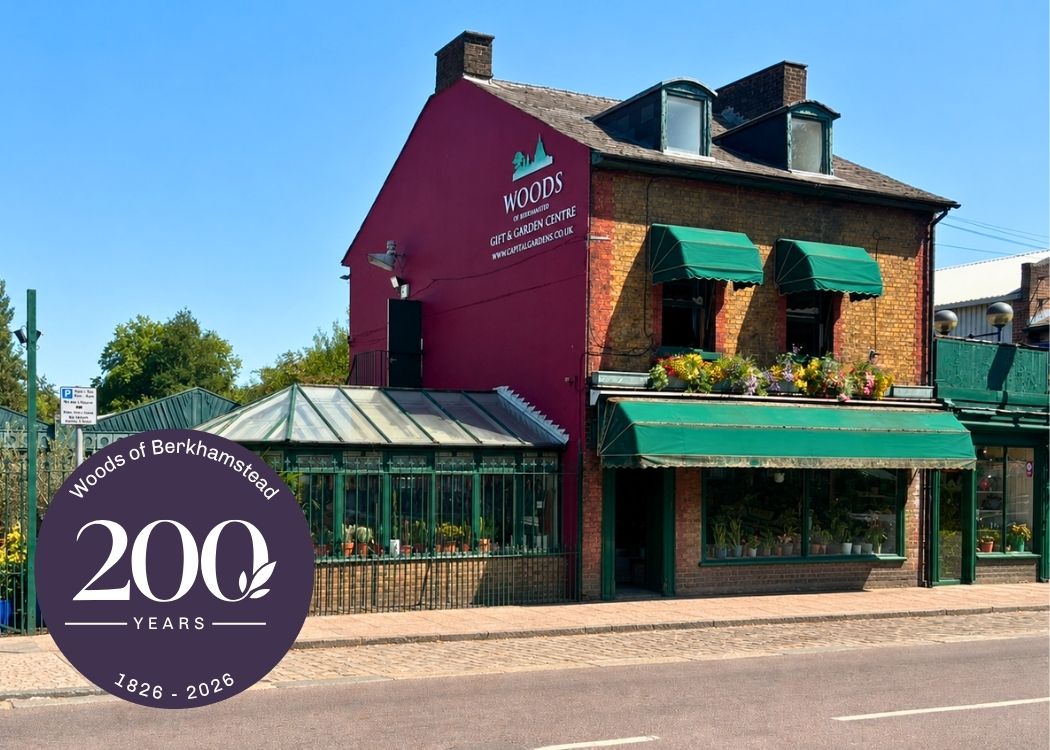
200 Years on the High Street: The Story of Woods of Berkhamsted
Walk into Woods today, and you’re standing on ground that has been worked, argued over and rebuilt for two centuries. This year marks 200 years since James Wood first set up shop on Berkhamsted High Street, and the story between then and now takes in a family business, a public riot, a fire, and a nursery next door that once exhibited at the Crystal Palace.
A wireworker sets up shop
James Wood was born in Berkhamsted in about 1806 and raised at Marlins Farm in Northchurch. In 1826, aged around twenty, he set up his own wirework business on the High Street, working first from a cottage he rented from Elizabeth Woodman. The plot next to it, the ground his business would later grow into, was owned by Berkhamsted School and had previously been rented out to Henry Lane, whose family ran the nursery on the other side of the High Street. As Wood’s business expanded, he took over that plot himself and continued renting it from the school.
It was clearly a good trade to be in. Under the name James Wood & Son, the business grew with the help of James’s own sons, turning out iron fences, gates, tree guards, greenhouses, garden seats and arches, alongside smaller ironmongery like candle snuffers, rat traps and sieves. The client list read like a who’s who of the area: the Rothschilds, the Coopers of Gadebridge, and the Brownlows of Ashridge among them.
When James died in 1861, his wife Fanny took charge and renamed the firm F. Wood & Son. When their eldest son, also James, later took over, the original name was restored, a small detail that says a lot about how much the Wood name mattered to the family.
The night Berkhamsted fought back
Not every commission went smoothly. In 1866, Lord Brownlow of Ashridge Estate commissioned Wood’s to build two miles of five-foot iron fencing around Berkhamsted Common, an attempt to enclose land the public had always used freely. It didn’t go down well. The Commons Preservation Society, acting for local landowner and politician Augustus Smith, chartered a train from Euston to Tring and brought in 120 navvies who tore the entire fence down in a single night, the 6th to 7th of March 1866. The common was reopened, the fence was never rebuilt, and a four-year legal battle eventually ruled in Smith’s favour. The Wood-made ironwork itself was salvaged and put to use elsewhere in the town.
More than an ironworks
The small building beside the main house on the site, now the children’s department, has its own run of history. It’s been a toy shop known as Mrs Figg’s, briefly referenced in Graham Greene’s autobiography A Sort of Life, which recalls buying a table croquet set there as a boy. Later, it served as a military outfitters during the Second World War, then as Ginger’s Hairdressers. When Ginger retired, the shop was folded into the growing Wood business, and the ground floor of the house, now the houseplant department, was converted into a storefront.
The firm also traded for a time as domestic heating engineers and plumbers, never quite losing its ironmongery roots along the way.
From iron to plants
A fire in 1974 destroyed the iron-framed showroom on the High Street. What rose from it was a garden centre, and J. Wood & Son became Woods of Berkhamsted Garden Centre. Capital Gardens took over in 1998, and the site is still trading under the Woods name today. Look for the old manufacturing equipment on display in the pot department, near the High Street iron railings: it’s believed to be a genuine piece of the original ironworks.
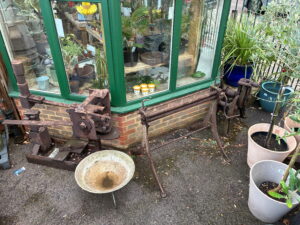
Historic machinery on display at Woods of Berkhamsted, believed to date back to the site’s ironworking past.

One of the surviving pieces of historic machinery displayed at Woods of Berkhamsted.

Historic metalworking equipment provides a reminder of Woods of Berkhamsted’s industrial beginnings.

Old ironworks equipment on display at Woods of Berkhamsted, connecting the garden centre with its 200-year history.
200 years on
Two centuries on from a young wireworker renting a cottage on the High Street, Woods is still on the same ground, still serving the town, and still shaped by the family that built it. That’s what this bicentenary is really marking: not just an anniversary date, but two hundred years of continuous trading on one plot, through fire, fencing riots, and five changes of trade.